NEW DELHI: For more than a decade, Indian Prime Minister Narendra Modi and his Bharatiya Janata Party (BJP) have cultivated an image of political dominance, repeatedly outmanoeuvring opponents and maintaining a strong grip over the national political narrative.
But a youth-led movement that began as an online joke has evolved into a significant protest campaign, bringing together students, activists and sections of the wider public around grievances over examination irregularities, unemployment and government accountability.
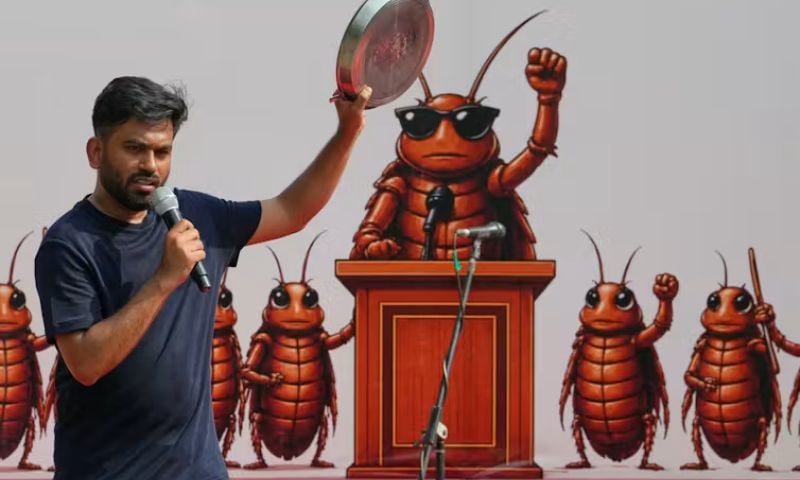
The movement, known as the Cockroach Janta Party (CJP), emerged after Chief Justice of India Surya Kant referred in May to some unemployed young people who turn to journalism, social media and Right to Information activism as “cockroaches” and “parasites”.
The remark quickly became a rallying point. Within weeks, the satirical movement had moved from social media to the streets, eventually becoming one of the most prominent youth-led protests against the government in recent years.
From Viral Joke To Mass Protest
The CJP’s rise was closely linked to anger over the National Eligibility cum Entrance Test (NEET-UG), India’s highly competitive medical entrance examination.
Allegations of paper leaks and other irregularities surrounding the 2026 examination fuelled widespread frustration among students and their families.
The controversy became a broader symbol of concerns over India’s examination system and the pressure facing young people competing for limited educational and employment opportunities.
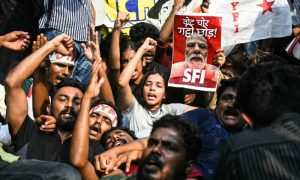
The CJP organised protests at Jantar Mantar in New Delhi, demanding accountability and the resignation of Union Education Minister Dharmendra Pradhan. The movement eventually attracted support from student organisations and prominent activists, including education and climate campaigner Sonam Wangchuk.
Wangchuk Becomes A Symbol
Wangchuk’s involvement transformed the movement’s profile.
The Ladakh-based activist joined the protest and began a hunger strike, turning the campaign into a highly visible act of civil resistance. After spending weeks without food, he was taken to hospital by authorities as concerns over his health grew.
His protest drew comparisons with India’s tradition of non-violent resistance and helped connect a digitally driven Gen Z movement with an older form of civil activism.
The CJP’s demands included accountability over examination irregularities, compensation for families of students who died by suicide and action against those responsible for alleged failures in the examination system.
Why The Movement Was Different
The movement posed a particular challenge for the BJP because its central grievance was difficult to divide along India’s familiar religious or regional lines.
Unlike protests centred on issues affecting particular religious communities, regions or occupational groups, examination fairness affected students and families across social and political backgrounds.
The campaign therefore brought together young people whose political views differed but who shared concerns over education, jobs and their prospects for the future.
The movement also reached beyond students. Parents and members of India’s aspirational middle class became increasingly engaged as concerns over examination integrity and youth opportunities resonated with families across the country.
Police Crackdown Fuels Anger
The protests were met with a heavy security response as demonstrators attempted to march towards Parliament.
Thousands of protesters faced police barricades, tear gas and baton charges during confrontations in Delhi. Reports of police action and Wangchuk’s removal to hospital further intensified public attention around the movement.
For many protesters, the response became part of the broader argument over government accountability and the space available for dissent.
The movement’s supporters argued that the treatment of young demonstrators demonstrated the very concerns about institutional accountability that had brought them onto the streets.
Opposition Parties Join, But Cautiously
India’s opposition parties eventually lent support to the protests, although their involvement was uneven.
Leaders including Rahul Gandhi and Priyanka Gandhi Vadra criticised the government’s response, while opposition MPs disrupted parliamentary proceedings in solidarity with the protesters.
Other parties also sent representatives to the protest site, widening the movement’s political reach.
But the CJP has sought to maintain its identity as a movement rather than becoming an arm of any established political party.
That distinction is important because many young protesters see the established political class as part of the system they are challenging.
A Setback For Modi’s Political Narrative
The resignation of Education Minister Dharmendra Pradhan after weeks of protests represented a significant symbolic victory for the movement.
The government has remained electorally powerful under Modi, but the episode demonstrated that sustained public pressure can force political consequences even under a dominant ruling party.
The CJP has said it intends to remain a pressure group rather than transform itself into a conventional political party, while broadening its agenda beyond examination reform to issues including employment and government accountability.
More Than An Education Protest
The significance of the movement extends beyond NEET.
For India’s young population, education, employment and economic opportunity are closely connected. Examination scandals therefore touch a much broader question: whether hard work and academic achievement still provide a reliable path to a secure future.
The CJP has tapped into that frustration by turning a seemingly insulting remark into a political identity.
Instead of rejecting the “cockroach” label, protesters adopted it, transforming an insult into a symbol of resistance.
What Comes Next?
The movement has already demonstrated that a digitally organised campaign can move rapidly from satire to street mobilisation.
Its longer-term political impact, however, remains uncertain.
India has a long history of powerful protest movements that have won specific demands without developing into sustained political forces. The farmers’ protests and the movement against the Citizenship Amendment Act showed the ability of mass mobilisation to challenge government policy, but also the difficulty of maintaining broad coalitions over time.
The CJP now faces a similar test.
Its decision to remain a pressure movement rather than contest elections could allow it to attract supporters from across the political spectrum. But it also leaves open the question of whether its influence can survive after the immediate anger over examination controversies fades.
For Modi and the BJP, the movement has exposed a potentially important vulnerability: a generation whose concerns over education, employment and opportunity cannot easily be addressed through the political divisions that have shaped much of India’s recent political debate.
The “Cockroach” movement may therefore prove significant not because it has created a new political party, but because it has shown that a large constituency of young Indians can organise around grievances that cut across religion, region and traditional party loyalties.