
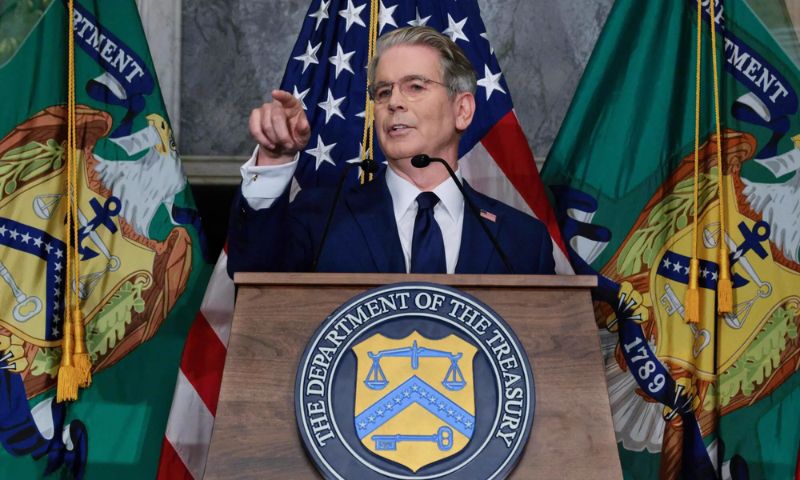
WASHINGTON: US Treasury Secretary Scott Bessent said on Saturday that Washington’s campaign to economically isolate Iran was producing results, citing growing restrictions on Iranian airlines and banks in countries across the region.
“At my direction, teams were dispatched across the globe to engage with countries and demand action against the Iranian regime,” Bessent said on X. “These efforts are delivering results.”
Bessent said Turkiye and Oman had halted incoming flights by Iranian private carrier Mahan Air, while the United Arab Emirates (UAE) had suspended all flights operated by Iranian airlines.
Following the launch of Operation Economic Outcast, @USTreasury imposed targeted financial measures against banks and aviation service providers. At my direction, teams were dispatched across the globe to engage with countries and demand action against the Iranian regime.
These…
— Treasury Secretary Scott Bessent (@SecScottBessent) September 26, 2026
The UAE is a major regional hub for Iranian carriers and has close commercial ties with Iran, including a large Iranian expatriate community. Bessent also highlighted measures targeting Iranian banks.
On Wednesday, the UAE central bank barred branches of Bank Melli Iran from conducting financial transactions to and from Iran, including trade finance and fund transfers. The regulator said the measures followed violations of UAE rules concerning money laundering, terrorism financing and proliferation financing.
Last week, Turkiye revoked the operating licence of Bank Mellat’s Istanbul branch. The decision came amid growing US pressure on countries to tighten financial restrictions on Iran, although the Turkish order cited concerns over depositor rights and financial-system stability rather than US sanctions.
The measures form part of a broader US campaign launched by the Treasury in August under the name Operation Economic Outcast.
The Treasury has described the initiative as an effort to disrupt Iran’s financial and commercial channels, including through secondary sanctions on foreign entities that continue doing business with Tehran.
On September 8, the Treasury sanctioned 36 targets linked to Iran’s aviation sector, including Iranian airlines and foreign companies accused of supporting the country’s aviation networks. Washington says the networks are used to transport weapons, personnel and illicit cargo.
A Wall Street Journal report cited by Bessent said Jonathan Burke, the Treasury’s assistant secretary for terrorist financing, had travelled across the Middle East and Europe over two weeks to press governments to implement what Bessent has called “economic D-Day” measures against Tehran.
READ ALSO: All Iranian Airlines to ‘Shut Down’ Worldwide by Sept 23: US Treasury Chief
The report said the Treasury had held discussions with more than 50 countries. Bessent said on Monday that all Iranian airlines “will be shut down around the world”, as Washington seeks to persuade governments to deny sanctioned carriers access to airports and aviation services.
However, Iranian airlines have continued operating some international services despite the restrictions, including flights to China and other destinations.
Recent measures have sharply reduced Iran’s regional air links but have not completely halted its international aviation operations. The Wall Street Journal has reported that China and Russia continue to accommodate Iranian flights despite the US pressure.
The latest restrictions are part of Washington’s wider effort to limit Iran’s access to international banking, aviation and commercial networks, while countries such as China continue to maintain economic and transport links with Tehran.