
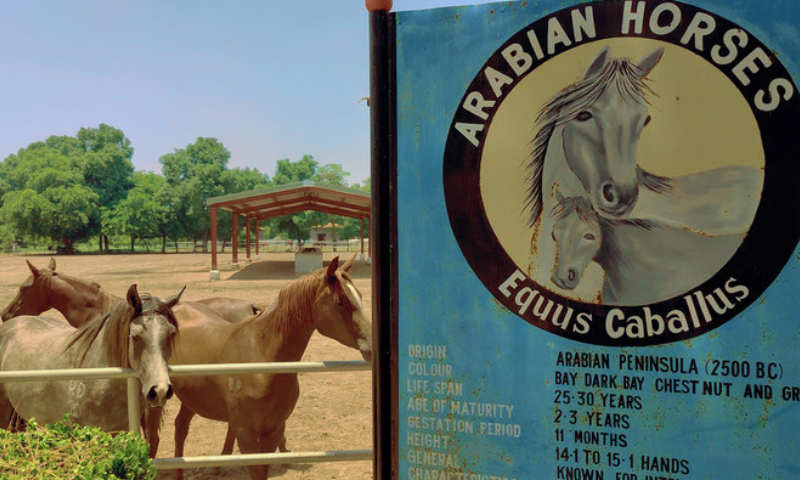
One of the most recognisable horse breeds in the world is the Arabian, with its long, arched neck, exquisite wedge-shaped head, and high tail carriage.
It is also among the oldest, with over 4,500 years of archaeological evidence pointing to the existence of horses in the Middle East that resemble modern Arabians today.
At the Remount Depot Mona military facility in Mandi Bahauddin, Pakistan, you may find approximately 600 Arabian horses that have been carefully trained for dressage competitions and equestrian competitions.
The depot, which was established in 1902 and spans 10,000 hectares of land with roads, buildings, a canal, and a railroad line, is a center for raising and breeding horses, donkeys, and mules.
Nearly 70 years ago, Pakistan began importing Arabian horses, frequently entering them as coveted display animals in contests and collecting a collection as gifts for foreign dignitaries.
According to Brig. Mohammed Naeem, the commandant of the depot, Pakistan has 808 Arab horses that are registered with the World Arabian Horse Organization, 627 of which are from the Remount Depot Mona and only 181 are from throughout the nation.
The 1970-founded WAHO is a nonprofit with 82 associated nations that strives to conserve pure Arabian bloodlines, advance breeding expertise internationally, organize member clubs, provide breed nomenclature standardization, and provide advice on various Arabian horse-related issues.
What, though, makes the Arabian horse so unique?
“Among known breeds of horses, the most ancient breed is the Arabian horse, which originated around 2,500 B.C. from the Arab Peninsula,” Naeem said. He also noted that the animals were renowned for their “exceptional beauty,” especially when they ran and raised their tails, showcasing their “elegant form.”
Although the breed’s exact origins are uncertain, it is believed to have started on the northern edge of the Syrian desert.
They are regarded as one of the most well-known horse breeds in the world, said Naeem.
Pakistan joined WAHO in 1997, and Mona Remount Depot served as the organization’s lone representative there. While the depot’s pursuit of horse breeding began as a hobby in 1956, it successfully transitioned to science in 2021 when it started a test tube program.
We have successfully observed the birth of 15 test tube babies at our facility so far, and another 12 pregnancies are still going on, according to Naeem.
The first Arab horse at the depot was brought in from the US in 1955, and 31 more came later from other nations.
According to Naeem, the cost of an imported Arabian horse may range from $5,000 to $50,000, depending on the animal’s quality and bloodline.
According on the animal’s place of origin and whether it is carried in a single cage or a group cage, import costs also differ. It costs about $10,000 from Gulf states, but up to $20,000 from Western nations including the US.
The brigadier reported that the expense of breeding, growing, and training an Arabian was “significantly lower at the depot due to locally produced fodder and other factors.”
According to Naeem, “the depot’s budget is provided by the Ministry of Defense.”
The brigadier stated that a stable of Arab horses was also preserved for the Pakistani government and army to give as presents to visiting dignitaries.
According to Naeem, 36 animals have been sent to various heads of state from Saudi Arabia, the UAE, Qatar, Bangladesh, Sri Lanka, and other nations.
Over the past few decades, the leaders of Jordan, Qatar, and Saudi Arabia have all given horses to the leaders of Pakistan at various times.
Gen. Mohammed Zia ul Haq, the sixth president of Pakistan, received an Arabian horse from monarch Faisal, he added, adding that Gen. Pervez Musharraf received a horse from the Saudi monarch as well. The tenth president of Pakistan was Musharraf.
According to Naeem, horses that were presents to the Pakistani government were always housed in the depot.
Experts categorize the Arabian as a “hot-blooded” breed because of its sensitivity and intelligence, which facilitate rapid learning and improved communication with riders. The breed is hence prepared for equestrian sports including riding, dressage, polo, and tent pegging.
We have horses particularly trained for vaulting and show jumping that are employed for a variety of tasks, according to Naeem.
The brigadier noted that one of the depot’s Arabian horses has won Pakistan’s best polo pony award six times.
Mohammed Rasaldar, a trainer at the facility who conducts daily training sessions with the horses that begin at 6 a.m. and last throughout the day, said of the animals, “These horses are highly responsive animals.” “They become more connected and receptive as they experience more affection and attention.
“We have a 39-week training program for them where we expose them to different surroundings to help them overcome their concerns…During this session, they also receive instruction for other games.
The horses, according to Mohammed Akhtar, who trains them for polo, obey all commands.
He asserted that although horses are strong animals, they can only be tamed by treating them with a lot of love and care throughout training.