


MUZAFFARABAD: The Azad Jammu and Kashmir (AJK) Joint Awami Action Committee (JAAC) is facing public criticism after it refused to not participate in a government-convened All Parties Conference (APC) in Muzaffarabad, with political parties and the public urging the group to engage in dialogue instead of disrupting public life.
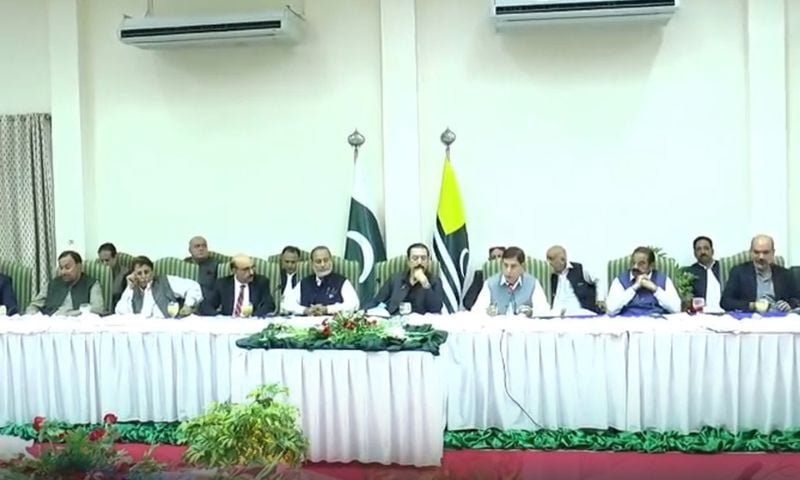
The APC, held at the Prime Minister House in Muzaffarabad, was chaired by AJK Prime Minister Raja Faisal Mumtaz Rathore and was attended by senior political leaders, former prime ministers, opposition figures, cabinet members and representatives of various parties and civil society to discuss the prevailing political situation in the region.
Former prime ministers Raja Muhammad Farooq Haider Khan and Sardar Tanveer Ilyas Khan, former presidents Sardar Muhammad Yaqoob Khan and Sardar Masood Khan, as well as several ministers, legislators, religious scholars and representatives of political and religious parties also participated in the APC.
The APC was convened to build consensus on political and governance issues and to address public concerns through dialogue and institutional engagement.
However, the JAAC chose not to participate in the conference, a decision that was strongly criticised by the public and political leaders who argued that dialogue remained the most effective way to resolve grievances.
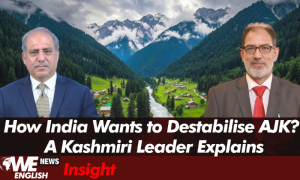
In an interview with WE News English, Altaf Hussain Wani, Chairman of the Kashmir Institute of International Relations, said that the government of Azad Jammu and Kashmir (AJK) should not allow anyone to destabilise the region under the pretext of politics. He warned that agitation and political instability could undermine democratic institutions and provide opportunities for India to exploit the situation.
Wani urged the Azad Jammu and Kashmir Joint Awami Action Committee (JAAC) to abandon agitational politics and engage in dialogue with the government to address public concerns.
His remarks came as an All Parties Conference (APC) convened by the Azad Jammu and Kashmir government was underway in Muzaffarabad to discuss the prevailing political situation in the region. The JAAC refused to participate in the conference despite invitations from the government and political stakeholders.
Wani said citizens had the democratic right to seek better governance, accountability and improved public services. However, he stressed that demands should be pursued through dialogue and constitutional mechanisms rather than through repeated protests and agitation.
He noted that whenever public grievances emerged in AJK, both the Government of Pakistan and the AJK government had responded through negotiations, consultations and relief measures.
According to Wani, governance operates through legal, constitutional and administrative procedures and not all demands can be implemented immediately.
“The government has a process. Every decision has to move through constitutional, legal and bureaucratic channels,” he said, urging JAAC leaders to continue engagement with the government rather than resorting to disruption of public lives.
Wani warned that repeated protests and attempts to create political pressure through agitation could lead to instability and law-and-order challenges.
He said the people of AJK had historically maintained close ties with Pakistan and had made significant contributions to the country’s defence, civil services and national development.
“The relationship between Pakistan and the people of Azad Jammu and Kashmir has been built on trust and shared sacrifices. It should be strengthened through dialogue rather than confrontation,” he said.
He also cautioned against drawing comparisons between Azad Jammu and Kashmir and Indian illegally occupied Jammu and Kashmir, arguing that the two situations were fundamentally different.
According to Wani, Pakistan and the AJK government had consistently engaged with public concerns and sought negotiated solutions, unlike the situation across the Line of Control in Indian occupied Kashmir.
Commenting on JAAC’s demand to abolish the 12 refugee seats in the AJK Legislative Assembly, Wani said the issue should be viewed in its historical and constitutional context.
He noted that the political structure of AJK was established after 1947 with the participation of both residents of AJK and refugees from Indian illegally occupied Jammu and Kashmir.
Many of those refugees, he said, played a central role in establishing the institutions of the AJK government after leaving their homes and official positions to continue the struggle for the Kashmiri people’s right to self-determination.
Wani argued that the refugee seats represent the political rights of displaced Kashmiris and remain connected to the broader Kashmir dispute.
He maintained that any changes to the existing constitutional structure could only be made through the AJK Legislative Assembly and constitutional procedures rather than through street protests.
“If those advocating reforms believe they have public support, they should participate in elections and pursue constitutional change through democratic institutions,” he said.
Wani also expressed concern that political instability in AJK could be used by India to destabilise the region. He said India had historically sought to exploit unrest in AJK.
“The leadership of the Joint Awami Action Committee must carefully consider the broader consequences of its actions and ensure that no opportunity is created for hostile narratives to gain ground,” he said.
The remarks came as an All Parties Conference was held at the Prime Minister House in Muzaffarabad to discuss the political situation in AJK and explore ways to maintain stability and address public concerns.
The conference was attended by AJK Prime Minister Chaudhry Anwaarul Haq, Leader of the Opposition and AJK PML-N President Shah Ghulam Qadir, Pakistan Peoples Party AJK President Chaudhry Muhammad Yasin and All Jammu and Kashmir Muslim Conference President Sardar Attique Ahmed Khan.
Former prime ministers Raja Muhammad Farooq Haider Khan and Sardar Tanveer Ilyas Khan, former presidents Sardar Muhammad Yaqoob Khan and Sardar Masood Khan, Jammu and Kashmir Peoples Party President Sardar Hassan Ibrahim, government ministers, lawmakers, religious leaders and representatives of various political parties also participated.
Wani said the refusal of the Joint Awami Action Committee to attend the APC was regrettable, arguing that dialogue remained the most effective way to address differences and resolve political disputes.
He reiterated that democratic participation, constitutional engagement and political dialogue offered a more constructive path forward than agitation, warning that instability in AJK would serve neither the interests of its people nor the broader Kashmir cause.