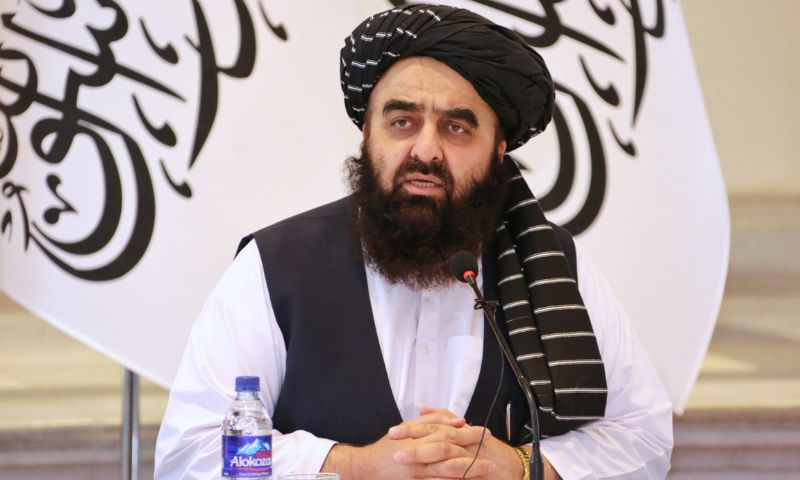
ISLAMABAD: Afghan interim Foreign Minister on Saturday said that the Taliban regime is willing to resolve issues with Pakistan through dialogue and mutual understanding, while assuring that Afghanistan’s territory would not be allowed to be used against Pakistan.
The remarks come amid persistent concerns raised by Pakistan over cross-border terrorism, with Islamabad repeatedly calling for a credible and verifiable mechanism to ensure that terrorist groups do not operate from Afghan soil.
Pakistan has maintained that while dialogue remains important, concrete action against terrorist groups based on Afghan soil is essential to restore trust and ensure lasting regional stability.
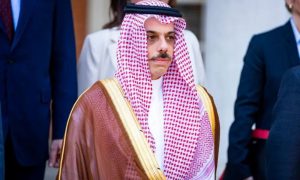
In a statement, Afghan interim Foreign Minister Amir Khan Muttaqi said that the Taliban regime wants to resolve issues with Pakistan through dialogue.
He added that no one will be allowed to use Afghan territory against Pakistan, and serious measures have been taken in this regard.
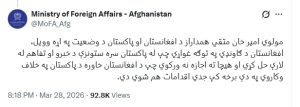
The statement comes nearly a month after Pakistan launched a large-scale counter-terrorism operation, Ghazab lil-Haq, targeting terrorist sanctuaries in Afghanistan.
During the counter-terrorism operation, Pakistan said it destroyed several terrorist hideouts and eliminated a large number of terrorists through precise and targeted strikes.
Pakistan demands verifiable action against terrorists
Earlier this month, Pakistan’s military spokesperson had called for the establishment of a credible and verifiable mechanism to ensure that Afghan territory is not used for terrorist activities against Pakistan.
Pakistan’s military spokesperson, Lieutenant General Ahmed Sharif Chaudhry, in an interview with a private news channel, said Pakistan consistently states that terrorist incidents originate from Afghan territory and asks for a transparent system to verify this.
“Terrorist leadership is being harboured inside government buildings, frequently moved, concealed, and protected from accountability,” he said.
DG ISPR noted that earlier these terrorist groups operated with total impunity, crossing borders freely, while Pakistan was repeatedly told to remain patient.
“That phase is over. Now, restraint and patience must be shown by those sheltering terrorists. Pakistan has demanded direct action, hand over terrorists, dismantle their camps, and shut down recruitment networks,” he said.
Lieutenant General Ahmed Sharif Chaudhry in his remarks, said training camps operate openly and Madrassas are used to mobilise fighters. “Funding of certain Madrassas is tied to sending fighters into Pakistan,” he said.
He went on to say Pakistan’s people and leadership are not naïve; they will not accept violence followed by hollow offers of dialogue.
“There is no justification for killing Pakistani children, bombing mosques, or murdering soldiers who are the nation’s pride,” he added.
The DG ISPR said Pakistan has held talks many times, directly, through friends, and in multilateral forums. “Our demand is simple and fair, that talks and terrorism cannot happen at the same time,” he said.
He stated that it is unacceptable for the Afghan Taliban authorities to call for dialogue while, at the same time, allowing terrorists to operate against Pakistan. He emphasised that talks and terrorism cannot coexist.
He said that no country in the world is willing to guarantee the conduct of the Afghan Taliban.
Terrorist groups in Afghanistan and cross-border attacks
According to findings from United Nations monitoring teams and global security assessments, Afghanistan currently hosts more than 20 international terrorist organisations, with thousands of foreign fighters operating across the country.
Terrorist groups such as Al-Qaeda, Tehreek-e-Taliban Pakistan (TTP), Islamic State of Iraq and the Levant–Khorasan (ISIL-K), and the East Turkestan Islamic Movement (ETIM) continue to benefit from sanctuary and operational freedom.
Regional analysts say the concentration of these groups in one geography is enabling collaboration, shared training, and stronger operational networks.
Data from the Global Terrorism Index 2026 and Pakistani counterterrorism authorities show that violence linked to Afghanistan has sharply increased, particularly along the Pakistan-Afghanistan border.
Officials say more than 70 per cent of terrorist attacks and nearly two-thirds of related deaths in Pakistan in 2025 occurred in border regions.
The TTP terrorist group remained the deadliest group, responsible for over half of terrorism-related fatalities.
Security officials note that the group has expanded its capabilities, including the use of drones and more coordinated assaults targeting both civilians and security forces.
Defence analysts believe this reflects a shift from fragmented insurgency to a more structured and adaptive terrorist campaign.