Despite striking a $1.1 billion pact with the EU, Tunisia has indicated it will not become a “reception center” for the return of migrants from sub-Saharan Africa to Europe.
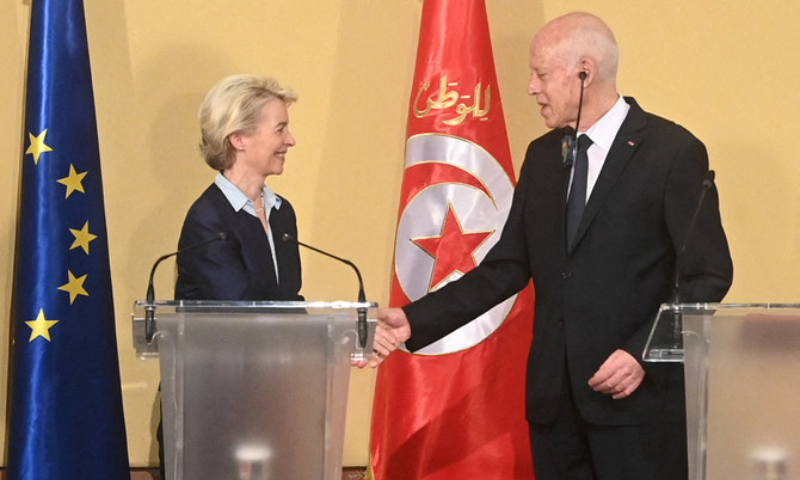
On Sunday, European Commission President Ursula von der Leyen, Italian Prime Minister Giorgia Meloni, and Dutch Prime Minister Mark Rutte signed a migration pact that, according to The Guardian on Monday, will make it easier for thousands of Tunisian migrants to return home and provide legal pathways for others to find employment in the European Union.
Authorities in Tunisia, meanwhile, have remained hard on issues concerning the mandatory return of non-citizen migrants who enter Europe via that country.
With the EU’s approval of a compromise negotiated by Meloni last month, migrants may now be returned to their country of origin after only a few days’ stay.
However, this condition may end up costing Tunisia, which is a transit point for thousands of non-citizen migrants traveling from southern Africa.
President Kais Saied of Tunisia has already stated that his country will not serve as the European Union’s “border guard.”
“That is a point on which the Tunisian authorities feel they have communicated this clearly,” a source in the European Union told The Guardian. “that they… shouldn’t be a reception point for irregular migrants generally coming from Europe.”
Between April and June of this year, the EU received over 14,000 migrants who had traveled from Tunisia.
To aid in its fight against people smuggling, the migration deal will provide Tunisia with $117 million, half of which will be spent on contracts with humanitarian organizations to facilitate the return of deported migrants to their home countries.
Growing domestic conflicts have plagued Tunisia because of its role as a transit hub for migrants, with Saied having previously blamed “hordes” of people from sub-Saharan Africa for accelerating the country’s demographic shift.
As the number of migrants in Tunisia continues to rise, the government has resorted to mass evictions and relocation to remote desert areas along the country’s borders with Algeria and Libya.