According to an expert, Saudi Arabia is emerging as a regional space leader in the new era of space exploration thanks to its astronaut program and chances for research in aerospace medicine.
Saudi Arabia is emerging as a regional space leader, and its astronaut program needs space medicine to support the program. Introducing such a field in the Kingdom will help it rely on its own developed expertise and resources, said Dr. Farhan M. Asrar, a professor of family and community medicine at the University of Toronto and a collaborator with the ISS Immunoprofile Study in conjunction with the Canadian Space Agency and NASA.
The professor continued, “Space medicine encompasses the physiological changes, study or research, prevention, diagnosis, treatment, and management of medical concerns in space. Space medicine is an interdisciplinary and multidisciplinary branch of medicine that looks at managing human health in space and ensures adequate health for those living and working there.
Professor of medicine Farhan M. Asrar from the University of Toronto “Health management is essential to obtaining approval for astronaut space missions. “No astronaut mission will get approved if you have not addressed the health concerns, safety, and risks of the mission,” the professor stated. “Even if you can guarantee that you have the finest technology, the best rocket, and other measures on the planet.
Such initiatives will be a first for the area, he claimed, as nothing like has ever been done in the Kingdom or the Gulf states.
“One will observe that a number of Saudi colleges or institutions have planned events and initiatives relating to space, but those events and efforts have thus far been focused on engineering, communication and satellites, commerce, and astronomy, not on health. They have a few research initiatives on space health and physiology that have been carried out with astronauts, but that is all, and none have concentrated on space medicine as a whole,” he continued.
Highlights: The management of human health in space is the focus of the interdisciplinary and diverse field of medicine known as space medicine.
The practice of aerospace medicine goes beyond providing crew members with clinical care.
Engineers, decision-makers in government, doctors, attorneys, and dietitians will all collaborate in this area.
According to Asrar, creating and establishing space medicine and health does not mean that the emphasis is solely on medical practitioners.
In order to collaborate on space medicine and health, he noted, the area will bring together engineers, lawmakers, health specialists, dietitians, and lawyers.
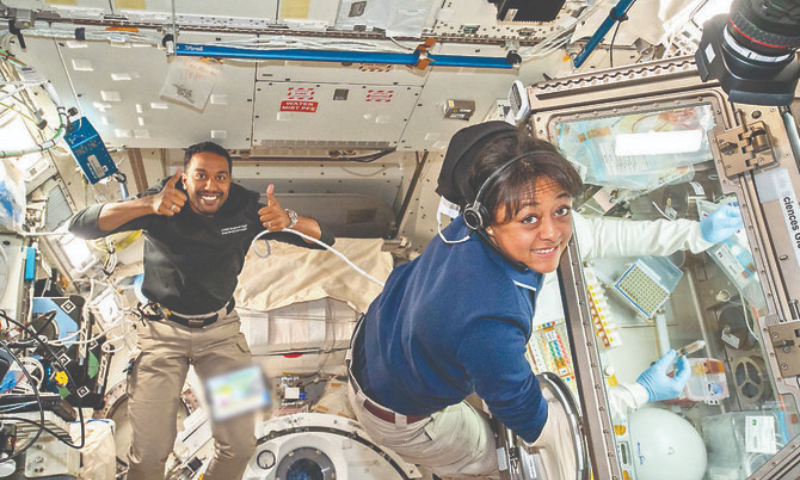
Ali Al-Qarni and Rayyanah Barnawi, two astronauts from Saudi Arabia who just completed the successful Axiom 2 Space Mission, carried out science activities and engaged the public in media.
First Arab woman and Saudi woman in space, Barnawi conducted research into a variety of medicinal uses for nanomaterials, including drug delivery, tissue engineering, and regenerative medicine. On the ISS, she also created the first DNA nanomaterials.
The DreamUp Nanoracks Space Kite payload, which will show how kites behave aerodynamically in microgravity, was also tested by Al-Qarni and Barnawi.
In 1985, Prince Sultan bin Salman became the first Saudi, Muslim, and Arab to enter space. Since then, Saudi Arabia has made progress in the subject, investing heavily in the space industry, launching over a dozen satellites into orbit, including some that were produced domestically, and working with NASA and other space agencies, including those of Russia and the UK.