
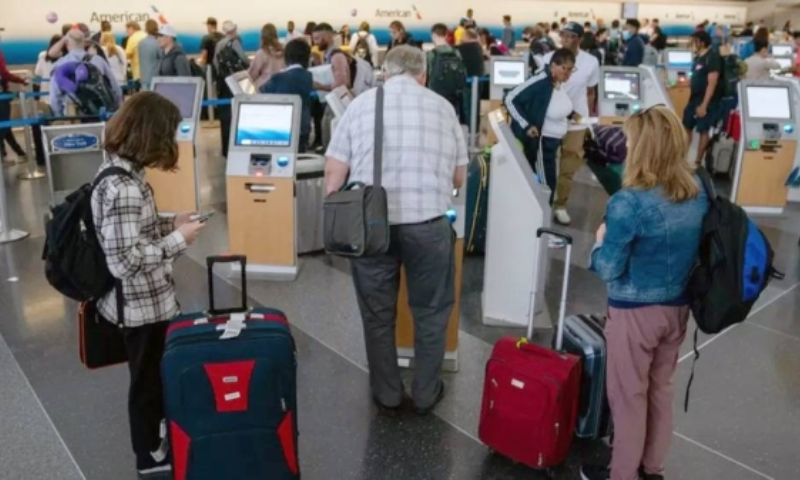
NEW YORK: On the eve of Independence Day, there is travel havoc plaguing US airports, while more than 100 million Americans are under severe weather warnings.
On Monday, more than 1,400 flights were either canceled or delayed.
It comes after one of the busiest weekends for aviation travel in history. The most travelers have ever been examined on Sunday at US airports.
While the south and west continue to sizzle in a heatwave, severe storms are threatening a large portion of the eastern US.
According to information from the FlightAware website, United Airlines continued to be the airline that was most negatively impacted by the delays on Monday, with over 200 flights being postponed.
Over the past week, United had more delays and cancellations than any other US airline, by a considerable margin.
Its CEO, Scott Kirby, was had to issue an apology on Friday after he booked a private flight from New York to Colorado in order to avoid the airline’s delays.
In a message to staff members on Saturday, he said that thunderstorms at United’s busiest hub in New Jersey had resulted in “one of the most operationally challenging weeks I’ve ever experienced.”
The airline is offering 30,000 frequent flyer miles to passengers who were most negatively impacted by the mess, but one Atlanta family who spent five days detained in three different airports said that this does not really constitute an apology.
The US’s extreme weather, according to Secretary of Transportation Pete Buttigieg, has “put enormous pressure on the system” and is the reason why travel has been “so chaotic” in the US.
A total of 1,500 new air traffic controllers will be hired by the Federal Aviation Administration this year, and a further 1,800 will be hired the following year, he told CBS.
Industry representatives had been worried that a new 5G rollout around airports would interfere with airplane technology before the long Fourth of July weekend.
However, a spokeswoman for the Department of Transportation informed CBS News that no significant aircraft delays were caused by the situation.
On Monday, thunderstorms, some with huge hail, were predicted for the eastern United areas from Mississippi to Massachusetts as well as farther north in areas like Montana and Minnesota.
The heatwave will continue to affect the US south, and record-breaking temperatures are anticipated to move up the west coast into California and Oregon.
After storms over the weekend, more than 180,000 people in the US Midwest still lacked electricity, including over 50,000 people in Missouri.