
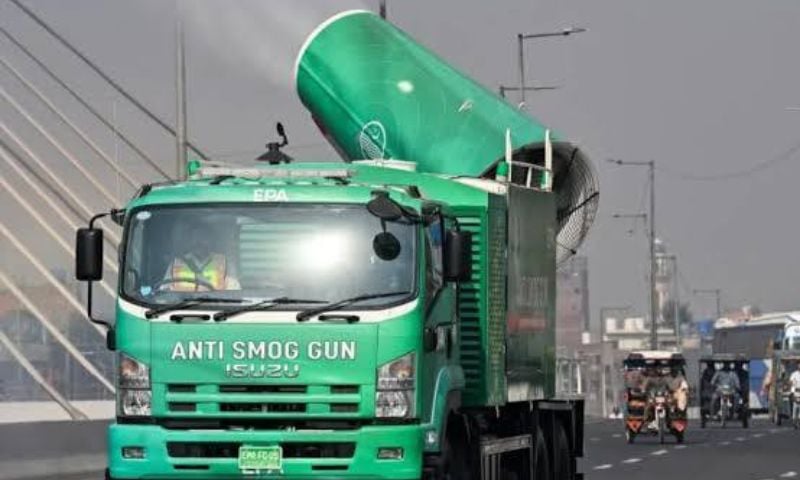
LAHORE: Authorities in Punjab plan to increase the number of anti-smog guns operating across Lahore city from 12 to 20 as part of efforts to tackle air pollution and reduce airborne dust.
Air pollution in Lahore surged to hazardous levels this week, with the Air Quality Index (AQI) reaching 535 and fine particulate matter (PM2.5) concentrations climbing to 343 micrograms per cubic metre, as several other cities across Punjab also recorded dangerously high pollution.
Sajid Bashir, an official, said the machines were being used across Lahore to suppress particulate matter, particularly PM10, while the government’s expanding anti-smog programme would deploy additional equipment in other cities.
Two anti-smog guns have already been deployed in Faisalabad and one in Gujranwala, while four more cities are expected to be included in the next phase.
Sajid Bashir said 30 additional anti-smog guns were also planned for deployment in the coming days.
How They Work
Anti-smog guns spray fine droplets of water into the air to help bring down suspended dust and particulate matter.
Officials said the machines were being operated at different locations across Lahore, with water misting also carried out along city roads.
Sajid Bashir explained that the equipment was designed to tackle PM10 particles, while night-time mist spraying was being used to help settle airborne pollutants during periods of temperature inversion, when cooler air near the ground can trap pollution close to the surface.
According to Bashir, the spray can reach distances of more than 100 metres under suitable conditions.
Water Quality Checks
The official said water used in the machines was sourced from designated WASA ponds and tested in laboratories before use.
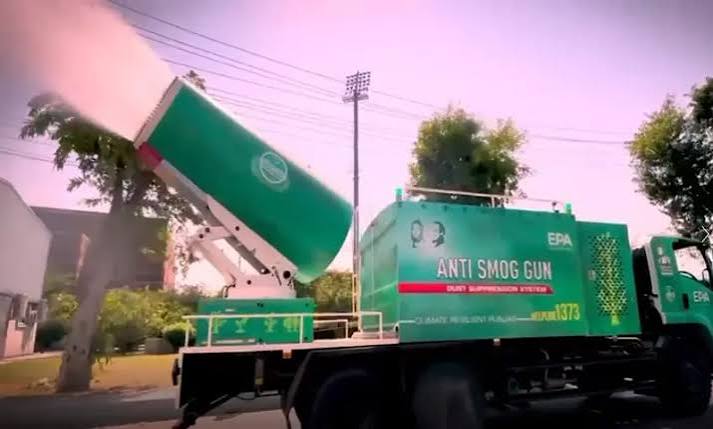
He said the water needed to meet quality requirements because the machines have extremely fine nozzles that can become blocked by unsuitable or dirty water.
Vehicles operated by different public agencies, including the Parks and Horticulture Authority and Rescue 1122, were also being used in the city’s water-spraying operations.
Wider Pollution Challenge
Construction activity, dust from unfinished sites and development projects around Lahore were identified as additional contributors to the city’s pollution problem.
Bashir also referred to smoke and fires as part of the challenge, saying emergency response teams had been deployed to deal with incidents.
However, anti-smog guns primarily target airborne dust and particulate matter. They cannot replace measures to control pollution at its source, including vehicle and industrial emissions, construction dust, waste burning and other sources of harmful pollutants.
Lahore’s battle against smog therefore requires sustained action beyond water spraying, including stronger enforcement of environmental standards and better management of urban pollution sources.