ISLAMABAD: Pakistan’s Minister for Planning and Development, Ahsan Iqbal, on Thursday said that technology has emerged as a key driver of Pakistan’s economic transformation and has offered significant opportunities to deepen Pakistan–Russia cooperation.
Addressing the Pakistan–Russia IT Collaboration Webinar as Chief Guest, the Planning Minister said that under URAAN Pakistan, the country’s national economic transformation plan, E-Pakistan was one of the five strategic pillars, with the ambition of building a one-trillion-dollar economy by 2035.
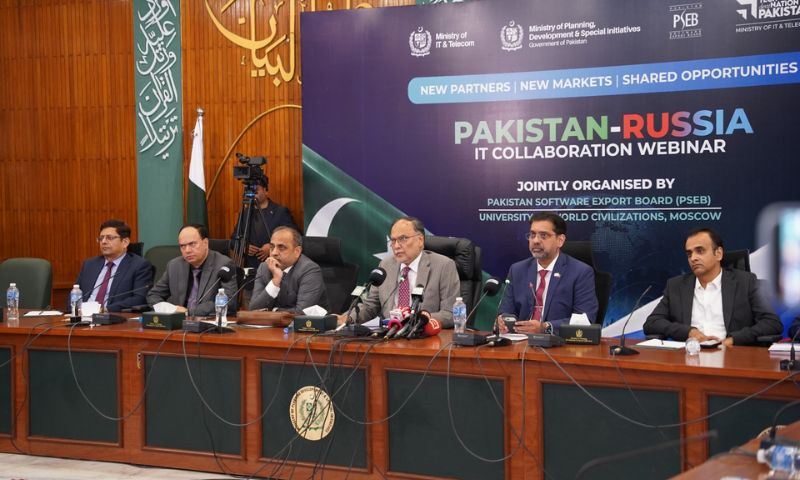
The Pakistan–Russia IT Collaboration Webinar, the third in the Pakistan–Russia Webinar Series, was organised by the Pakistan Software Export Board (PSEB), under the Ministry of IT & Telecommunication, in collaboration with the University of World Civilisations Moscow (UWCM).
Held at the Ministry of Planning, Development and Special Initiatives in Islamabad, with Russian participants joining remotely from Moscow, the event focused on the theme of ‘Building Technology Partnerships, Market Access and Joint Solutions’.
The University of World Civilizations Moscow, in collaboration with the Pakistan Software Export Board, organizes a webinar on building technology partnerships, market access and joint solutions between Pakistan and Russia. Planning Minister Prof. Ahsan Iqbal highlights technology cooperation, cybersecurity, AI skills development and Pakistan’s target of becoming a $1 trillion economy by 2035. The webinar brought together senior officials and representatives from Pakistan and Russia.
@betterpakistan
@PlanComPakistan
@MoitOfficial
@PSEB
#PakistanRussiaRelations #AhsanIqbal #TechnologyCooperation #DigitalEconomy #PakistanTV— Pakistan TV (@PakTVGlobal) November 5, 2026
The Pakistan Software Export Board (PSEB) and the Union of Women in the Cloud and Manufacturing (UWCM) brought together a group of leading companies and industry associations from both countries.
Participants were invited to present their respective capabilities, identify specific business requirements and explore opportunities for practical cooperation.
Six priority areas for Pakistan-Russia technology cooperation
Discussions focused on six key areas of potential collaboration where the two countries’ technology sectors offer complementary strengths: artificial intelligence (AI) and cloud computing; cybersecurity and critical infrastructure protection; digital governance and digital public infrastructure; IT and IT-enabled services trade, investment and business-to-business (B2B) cooperation; digital skills development and workforce exchange; and quantum computing.
Federal Minister for Planning, Development and Special Initiatives Prof. Ahsan Iqbal says Pakistan aims to build a $1 trillion economy by 2035, with technology serving as the driving force behind every sector.
@betterpakistan
#AhsanIqbal #PakistanEconomy #DigitalTransformation #Technology #PakistanTV
— Pakistan TV (@PakTVGlobal) November 5, 2026
Ahsan Iqbal stressed the importance of taking Pakistan-Russia relations beyond traditional areas of cooperation by focusing on technology-led partnerships, joint ventures and the creation of internationally competitive products and digital platforms.
Pakistan expanding its AI and digital capabilities
Highlighting Pakistan’s expanding technology sector, he noted that the country produces more than 75,000 IT graduates annually and aims to train one million AI professionals by 2030. He also referred to the establishment of seven new AI centres aimed at promoting research, encouraging innovation and strengthening collaboration between academia and industry.
The Minister cited Pakistan’s digital identity infrastructure, operated by the National Database and Registration Authority (NADRA), as an internationally recognised achievement.
He also pointed to the growing success of Raast, Pakistan’s instant payment system, which recorded 646 million transactions in a single quarter. These developments, he said, reflected the country’s increasing capacity for digital innovation and financial technology.
Pakistan-Russia partnership to explore emerging technologies
He observed that Russia’s established scientific and engineering expertise, coupled with Pakistan’s growing pool of skilled professionals and experience in delivering IT services to international markets, offered considerable scope for cooperation. Potential areas included artificial intelligence, cloud computing, cybersecurity, digital governance and other emerging technologies.
Stressing the importance of converting discussions into practical economic gains, he encouraged technology companies from both countries to explore viable commercial partnerships, develop joint solutions, expand access to each other’s markets and undertake pilot projects.
He maintained that the initiative’s success should ultimately be reflected in greater trade and investment, technological innovation and employment generation. He added that technology had the potential to emerge as a significant new dimension of the longstanding Pakistan-Russia relationship.
IT and telecom exports reach record $4.6 billion
The initiative also comes at a time of strong growth in Pakistan’s technology sector. IT and telecom exports reached a record $4.6 billion in FY2025-26, representing an increase of approximately 20 per cent over the previous financial year. With exports continuing to expand, the sector is increasingly seeking access to new markets, international partnerships and higher-value business opportunities.
Russian deputy minister highlights digital cooperation
Delivering the keynote address on behalf of Russia, Bella Cherkesova, Deputy Minister of Digital Development, Communications and Mass Media of the Russian Federation, outlined prospects for strengthening the Pakistan-Russia digital partnership, with particular emphasis on policy cooperation, investment and emerging technologies.
Pakistan’s Ambassador to the Russian Federation, Ambassador Faisal Niaz Tirmizi, described bilateral relations as having entered a more developed and diverse phase. He said technology and digital trade could serve as an additional pillar of economic cooperation, adding that Pakistan’s diplomatic mission in Moscow would work closely with PSEB to facilitate greater access for Pakistani technology companies to the Russian market.
Meanwhile, PSEB Chief Executive Officer Faisal Jeddy presented Pakistan’s IT sector capabilities and outlined a practical approach to turning business discussions into commercial agreements. He emphasised the need to identify opportunities, connect suitable companies, establish pilot projects and nominate designated representatives from both sides to ensure effective coordination.
“Partnerships rarely fail for lack of intent; they fail for lack of follow-up,” he said, adding that PSEB intended to address this challenge by ensuring that participating companies left the event with clearly identified business opportunities, designated counterparts and agreed follow-up actions. He assured participants that the organisation would continue to facilitate engagement until discussions translated into commercial contracts.
Industry leaders identify opportunities for joint ventures
Subsequent industry sessions focused on identifying concrete areas for cooperation. In a discussion moderated by Dr Roxolana Zigon of UWCM, RUSSOFT President Valentin Makarov and P@SHA Chairman Dr Shoab Ahmed Khan explored ways to strengthen links between the two countries’ software industries through structured partnerships and joint service delivery. Dr Irina Serenko also highlighted the digital economy as an area offering significant potential for bilateral collaboration.
Another session, moderated by Shahbaz Hameed of PSEB, brought together Ebryx Chief Executive Officer Ahrar Naqvi, Positive Technologies Regional Chief Executive Officer Yegor Rykov, TMC Group Chief Executive Officer and Managing Director Abdul Haseeb, and Russian Quantum Center Director Dr Alexey Akimov.
ALSO READ: Pakistan Tech Firms Target Nordic Markets to Raise IT Exports to $15bn
The discussion examined opportunities for joint development and cooperation in cybersecurity, enterprise software, financial technology, artificial intelligence, cloud computing and other emerging fields. Participants also explored the possibility of developing and delivering joint technology solutions in Pakistan, Russia and international third-country markets.
IT ministry vows support for practical business outcomes
In his closing remarks, Secretary of the Ministry of IT and Telecommunication, Zarrar Hasham Khan, said the meeting had moved beyond expressions of mutual interest by identifying specific business opportunities in cybersecurity, enterprise software, artificial intelligence and cloud computing, with companies from both countries showing readiness to take the discussions forward.
He said the Ministry would now focus on facilitating the proposed partnerships by addressing potential obstacles through improved market intelligence, regulatory support and greater visibility for Pakistani technology firms in the Russian market, while also promoting opportunities for Russian companies in Pakistan.
He emphasised that the priority was to ensure the timely launch of initial pilot projects and said the Ministry would work closely with PSEB and other partners to regularly assess progress and maintain momentum towards achieving tangible results.