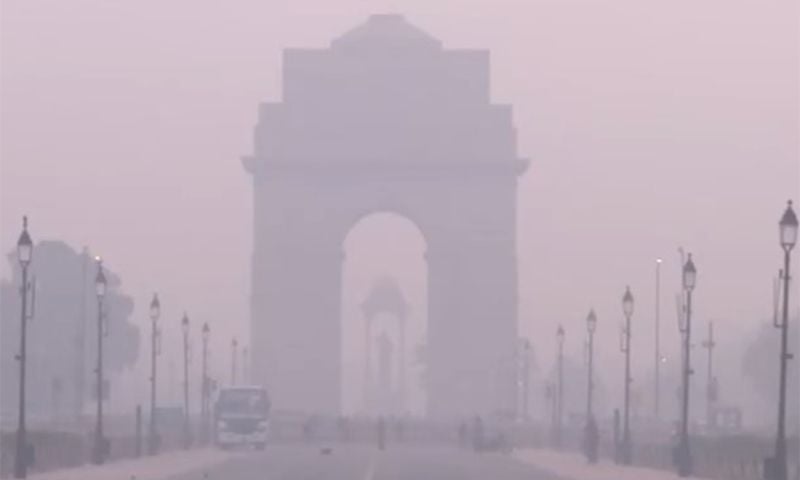
NEW DELHI: A thick layer of polluted air continued to blanket India’s capital and parts of northern India on Thursday, with Delhi recording an average Air Quality Index (AQI) of 370, as pollution levels rose ahead of the Hindu festival of Diwali.
The reading, recorded at 8:00 am on November 5, placed the city in the ‘Very Poor’ category, while several monitoring stations reported pollution levels above 400, entering the ‘Severe’ category, according to India’s Central Pollution Control Board (CPCB).
Jahangirpuri recorded the highest AQI at 459, followed by IIT Delhi at 450 and Punjabi Bagh at 448. Other severely polluted areas included DTU (437), Vivek Vihar (436), Narela (434), Alipur (433) and Rohini (432).
According to The Indian Express, at least 10 monitoring stations in the capital recorded AQI levels above 400. The Hindustan Times reported that 18 of the 59 monitoring stations reporting data recorded ‘Severe’ pollution levels, while 36 were in the ‘Very Poor’ category.
The main pollutant was PM2.5 at most monitoring stations, although PM10 was the dominant pollutant at some locations.
Winter Pollution Returns
Delhi’s latest pollution spike follows an unusually clean October, when the city recorded its lowest average AQI for the month in eight years.
The city’s air quality has deteriorated over several consecutive days. Recent reports indicated that the AQI rose from 60 on Friday to 377 by Wednesday, while the air remained in the ‘Very Poor’ category for four consecutive days, according to the Hindustan Times.
Experts have attributed the deterioration to falling temperatures, slow wind speeds and increased crop-residue burning in Punjab and Haryana states.
A recent storm brought rain and stronger winds, temporarily helping to clear pollutants from the air. However, as weather conditions settled, northwesterly winds returned, carrying smoke from agricultural fires towards the capital.
The annual winter pollution crisis is driven by several factors, including vehicle exhaust, industrial emissions, construction dust, falling temperatures, low wind speeds and the burning of crop stubble in neighbouring states.
The CPCB classifies AQI readings between zero and 50 as ‘Good’, 51 and 100 as ‘Satisfactory’, 101 and 200 as ‘Moderate’, 201 and 300 as ‘Poor’, 301 and 400 as ‘Very Poor’, and 401 and 500 as ‘Severe’.
Delhi smothered by THICK SMOG as air pollution hits 287-DAY HIGH
Air quality plunged to its worst level in 287 days, with the AQI hitting 350 on Tuesday and staying in the ‘very poor’ category. Emergency controls have been stepped up https://t.co/Hfj1uvGNan
— RT (@RT_com) November 5, 2026
The Air Quality Early Warning System has forecast that Delhi could enter the ‘Severe’ category on November 6 and 7, coinciding with Diwali celebrations and the expected use of fireworks.
Diwali Raises Pollution Concerns
The approaching festival has heightened concerns that firecracker emissions could further worsen the city’s already hazardous air.
Diwali, one of India’s biggest religious festivals, is traditionally celebrated with lamps, lights and fireworks. The burning of firecrackers releases fine particles and harmful gases, adding to existing pollution.
On Monday, India’s Supreme Court allowed the manufacture, sale and use of certified green firecrackers in Delhi and neighbouring areas for a limited period.
The pollution problem is not limited to the capital. Mumbai, India’s financial hub, has also experienced elevated pollution levels over the past month, despite its coastal location and winds that generally help disperse pollutants.
Mumbai’s AQI reached 322 on October 24, placing the city in the ‘Very Poor’ category.