JERUSALEM: Israeli exit polls suggest no clear winner in the pivotal general election, with neither Prime Minister Benjamin Netanyahu’s right-wing bloc nor the opposition alliance led by Gadi Eisenkot projected to secure the 61 seats needed for a parliamentary majority.
The outcome sets the stage for potentially protracted coalition negotiations, with Arab parties emerging as possible kingmakers.
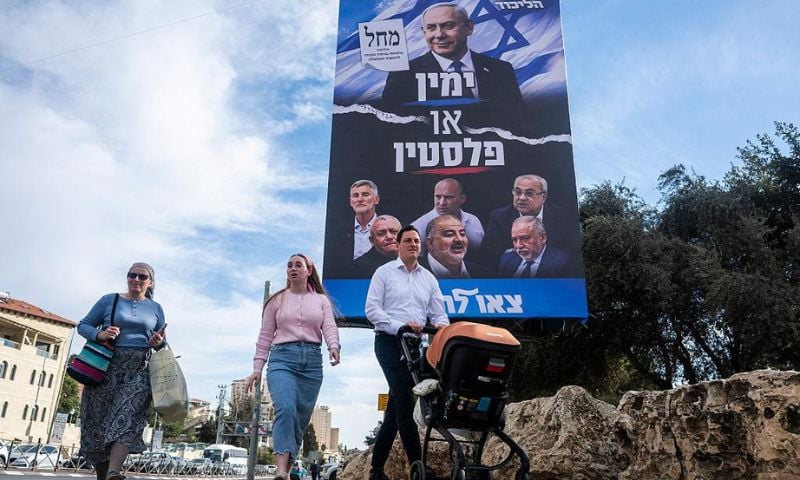
The election, held on Tuesday, recorded the highest voter turnout in decades as Israelis cast their ballots in the first national poll since the Hamas-led attack on October 7, 2023, which profoundly affected the country and triggered a series of military campaigns.
Exit polls released by Israel’s three major television networks projected Netanyahu’s right-wing bloc and Eisenkot’s opposition alliance winning around 51 seats each in the 120-member Knesset, well below the 61 seats required for a parliamentary majority.
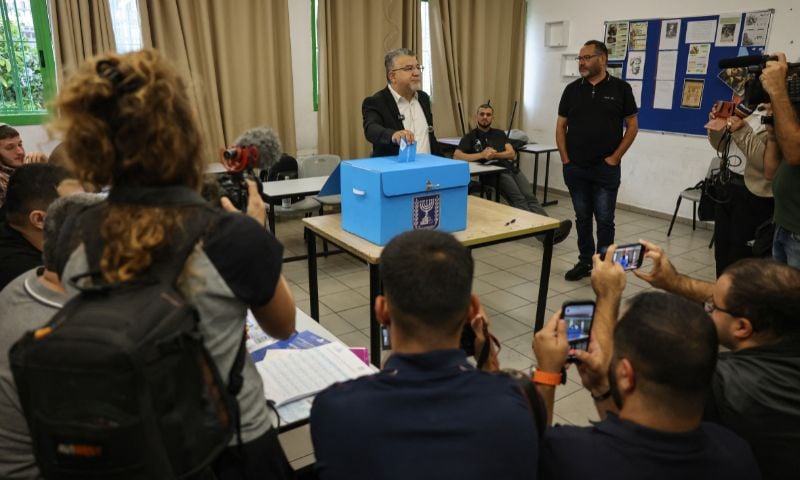
Israeli Arab parties were projected to secure between 17 and 18 seats, marking a significant gain amid increased participation by Arab voters opposed to Netanyahu and the rhetoric of his far-right allies.
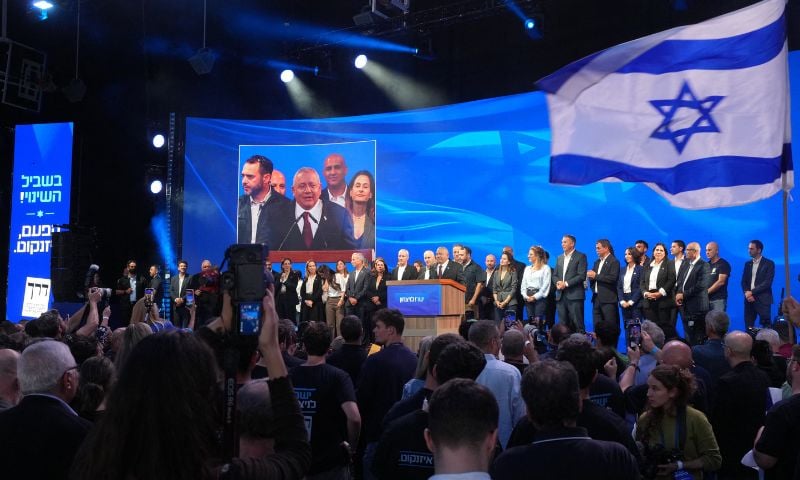
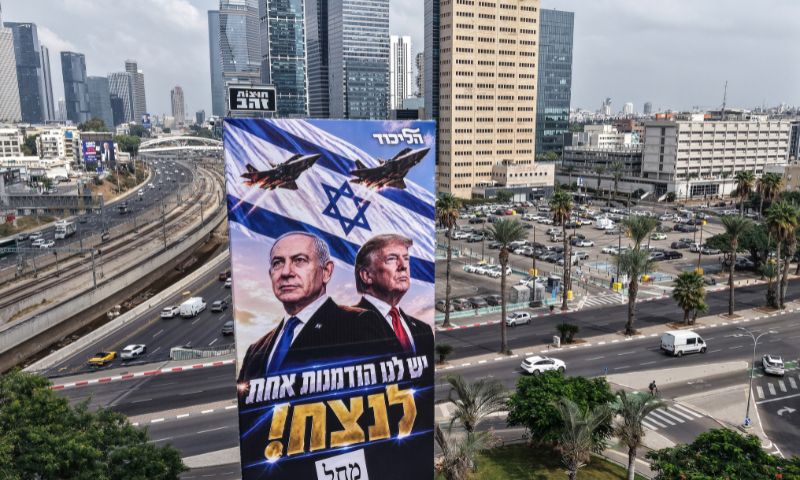
Addressing cheering supporters at a convention centre in Jerusalem after 3am, Netanyahu called for the formation of a “strong government of the right”, urging the country’s Jewish and Zionist majority to unite.
The 77-year-old premier stopped short of declaring victory, instead highlighting Israeli military operations against prominent adversaries and reiterating his readiness to pursue further action against Iran alongside US President Donald Trump.
“Israel has a unique opportunity with our partner President Trump to forever eliminate the existential threat of Iran,” Netanyahu said.
Eisenkot, speaking to supporters in Tel Aviv, warned Netanyahu against exploiting national security concerns for political purposes, amid speculation that the incumbent could use regional tensions to push for a national unity government.
“Netanyahu, don’t you dare use Israel’s security for your political needs,” Eisenkot said. Addressing the country’s security establishment, he argued that its members served the state rather than the prime minister, describing Netanyahu as “a caretaker prime minister, without a mandate or the people’s trust”.
Opposition calls for change
Eisenkot, a former military chief who entered politics relatively recently, has called for a more inclusive political climate and pledged to rein in extremist Israeli settlers accused of attacking Palestinians in the occupied West Bank.
However, he shares several of Netanyahu’s security positions and has supported Israel’s military offensive in Gaza following the October 2023 attacks.
READ ALSO: Israeli Elections: Which Issues Matter?
With voter turnout reaching nearly 78 per cent, the highest since 1999, Eisenkot rejected the prospect of another election and vowed to move swiftly to form a government.
“The public has voted for change,” he said, urging Netanyahu to accept the apparent rejection of his leadership and withdraw from political life.
The projected results nevertheless leave the opposition facing a difficult path to power, with neither major bloc securing enough seats to govern independently.
Arab parties emerge as key players
Israeli Arab parties emerged as potential kingmakers after their projected parliamentary representation rose significantly. Some Arab communities reported exceptionally high turnout amid anger over derogatory remarks directed at the minority by Netanyahu’s far-right allies.
Mansour Abbas, a prominent Arab political leader, said he believed the right-wing bloc had suffered a major setback and indicated that he was open to working with Eisenkot.

However, Eisenkot had pledged during the campaign not to form a government with Arab lawmakers, while Netanyahu questioned the legitimacy of an administration dependent on their support.
Arab lawmakers could nevertheless support an opposition-led minority government in parliamentary votes without formally joining its coalition. Failure to secure sufficient backing could leave Israel facing another election.
Far-right politician Itamar Ben Gvir, who appeared to have performed below some expectations in the exit polls, warned Netanyahu against entering a unity government with Eisenkot. Such an arrangement, Ben Gvir said, would be a “terrible mistake”.
Ben Gvir, a prominent advocate of the expulsion of Palestinians, would likely be excluded from a government formed through a unity arrangement with the opposition.
Gideon Rahat, a political scientist at the Hebrew University of Jerusalem, said Ben Gvir had succeeded in mobilising voters, including Israeli Arabs who turned out in large numbers against the right-wing camp.
“Even if Netanyahu lost, that doesn’t mean Eisenkot won,” Rahat said, highlighting the uncertainty surrounding the formation of the next government.
Netanyahu faces domestic and international pressure
The election comes as Israel faces mounting international criticism over its military campaign in Gaza, the conflict involving Iran, expanding settlements and violence in the occupied West Bank.
Netanyahu is also facing an arrest warrant issued by the International Criminal Court over alleged crimes in Gaza, alongside domestic corruption charges that could carry serious consequences if he loses political power.
Eisenkot, 66, has presented himself as an alternative to Netanyahu’s long-standing leadership, offering a more restrained personal style while maintaining a broadly security-focused political outlook.
The son of working-class Moroccan Jewish immigrants, he would become Israel’s first prime minister of Middle Eastern or North African descent if he succeeds in forming a government.
His family history also featured prominently during the campaign. Before voting, Eisenkot paid his respects privately at the grave of his son Gal, who was killed while fighting in Gaza, a personal loss that has drawn sympathy from many Israelis.
Tens of thousands of Israelis were also estimated to have travelled from abroad to participate in the election, which many viewed as crucial to the country’s political future.
Among them was Eilana Zisblit, 55, who returned from Canada, where she has lived for almost three decades, to vote for a centre-right party aligned with Eisenkot’s bloc.
“The country is going in a really, really bad direction. Both for Jews and Arabs living in the country, and for Jews living abroad,” she said, according to AFP. She said the time to act was “now, or the country really won’t survive anymore”.
With neither bloc projected to command a parliamentary majority, the coming negotiations are likely to determine whether Eisenkot can assemble a viable coalition, Netanyahu can retain power, or Israel will be forced to return to the polls.