Key Points
- Pakistan’s National Command Authority adviser warns that missile developments and unresolved disputes are increasing nuclear risks.
- Islamabad says the May 2025 conflict exposed the dangers of escalation strategies between nuclear-armed neighbours.
- Strategic analyst Syed Muhammad Ali urges reciprocal restraint, transparency and diplomatic engagement to prevent miscalculation.
ISLAMABAD: Pakistan has warned that growing military competition, emerging weapons technologies and unresolved disputes between India and Pakistan are increasing the danger of a nuclear crisis in South Asia.
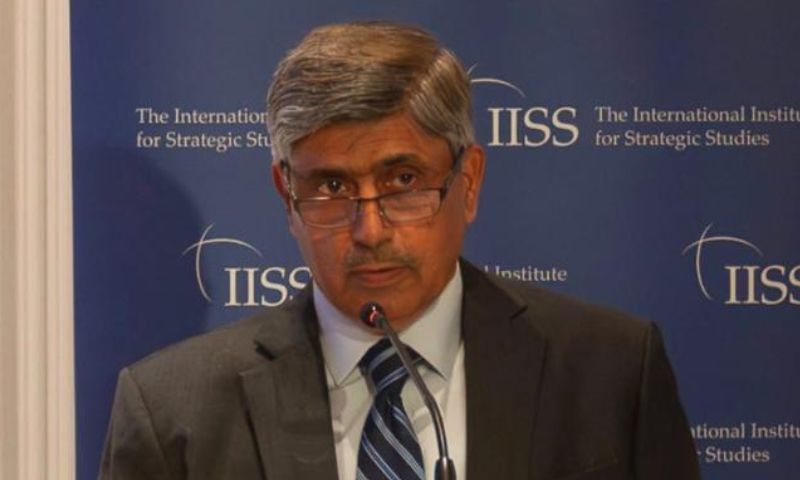
Addressing the inaugural session of a Track 1.5 workshop on nuclear deterrence and strategic stability in South Asia at the International Institute for Strategic Studies (IISS), National Command Authority Advisor Lt Gen Mazhar Jamil calls for political engagement and stronger crisis-management arrangements.
The adviser to Pakistan’s National Command Authority said regional stability must be assessed through the political aspirations. “Assessment should also consider the strategic cultures and security perceptions of the states involved, rather than solely Cold War-era frameworks,” he said.
“Wars that begin with confidence and control often end with the realisation that control was illusory,” Jamil said, warning that such a realisation could come too late to manage safely in a nuclearised region.
He argued that political stability was the foundation of strategic stability and that military adventurism and hegemonic ambitions were particularly dangerous in South Asia, where India and Pakistan have fought three wars and continue to face the unresolved Kashmir dispute.
Jamil said Kashmir should be resolved in accordance with United Nations Security Council resolutions.
He lamented India’s reliance on military force over political engagement, arguing that the dispute remained a nuclear flashpoint with consequences for the wider region.
These assertions reflected Pakistan’s official position on the conflict.
Missile developments raise escalation risks
Jamil identified India’s expanding missile and nuclear programmes, advanced military technologies and the absence of effective arms-control arrangements as additional sources of instability.
He criticised the 2008 Nuclear Suppliers Group waiver granted to India, arguing that international nuclear cooperation had enabled the expansion of its capabilities without corresponding restraints.
He also raised concerns about Indian intercontinental ballistic missiles, submarine-launched ballistic missiles and nuclear facilities operating outside International Atomic Energy Agency safeguards.
Jamil cited the accidental launch of an Indian BrahMos missile into Pakistan on March 9, 2022, saying India took 48 hours to inform its nuclear-armed neighbour.
He also described the use of dual-capable missile systems during the May 2025 confrontation as a source of potential miscalculation.
Such systems, which may have conventional or nuclear roles, complicate threat assessments because an adversary may be uncertain about an attack’s intended nature.
Jamil said geographical proximity and the absence of institutionalised confidence-building measures made these risks particularly acute.
He further questioned the implications of India’s deployment of nuclear warheads on submarine-launched missiles, arguing that continuous at-sea deterrence could raise doubts about New Delhi’s declared no-first-use policy. He said these concerns underscored the need for greater transparency and restraint.
May 2025 conflict shapes Pakistan’s deterrence policy
Jamil devoted considerable attention to the May 2025 conflict, arguing that India’s assumption that it could control escalation had proved mistaken.
He said Pakistan’s response to Indian strikes on May 6, 7 and 8 was calibrated, focused on military targets and guided by a clear political objective.
He described Pakistan’s Quid Pro Quo Plus (QPQ+) policy as a framework for delivering a strong conventional response to aggression, backed by Full Spectrum Deterrence (FSD), which Pakistan presents as a central pillar of its strategic posture.
“Pakistan’s response illustrated that deterrence need not rest on rhetoric,” Jamil said, arguing that disciplined military operations could communicate resolve without requiring an uncontrolled escalation.
He maintained that Pakistan subsequently accepted a ceasefire rather than prolonging the confrontation. He also warned that portraying Pakistan’s nuclear deterrent as a bluff could encourage dangerous miscalculations in future crises.
The address also raised concerns about India’s suspension of the Indus Waters Treaty, describing the water dispute as an additional source of tension alongside Kashmir.
Jamil also criticised India for supporting proscribed anti-Pakistan terrorist organisations, including the Tehrik-e-Taliban Pakistan and the Balochistan Liberation Army.
Analyst calls for dialogue and crisis management
Strategic affairs analyst Syed Muhammad Ali, while commenting on Lt Gen Mazhar Jamil’s address, said that “ the recent Track 1.5 meeting at the International Institute for Strategic Studies (IISS) provided Pakistan an opportunity to internationally highlight the persistent challenges to strategic stability in South Asia, particularly the unresolved regional disputes, Indian strategic ambitions of regional dominance and doctrinal inconsistencies with rapid technological developments.”
“The Kashmir issue remains central to regional tensions and requires a peaceful resolution in accordance with relevant UN Security Council resolutions and aspirations of Kashmiri people. Meanwhile, advances in missile capabilities, dual-use systems, and uncertainties surrounding nuclear doctrines increase the risks of miscalculation and escalation between two nuclear-armed neighbours.”
“The March 2022 Indian BrahMos missile incident further deepened Pakistan’s concerns regarding New Delhi’s command-and-control, safety, security and transparency,” Ali stated.
“The May 2025 conflict demonstrated Pakistan’s Quid Pro Quo Plus (QPQ+) policy, which is based on Islamabad’s resolve to deliver a swift, effective multi-domain response against any form or type of aggression. This policy is reinforced by a Full Spectrum Deterrence posture, which aims to preserve strategic balance and deter further aggression. However, escalation prevention also requires effective crisis-management mechanisms and diplomatic engagement.” Ali said while explaining Pakistan’s strategic posture.
“Pakistan does not seek war but remains committed to defend its sovereignty and national security. Sustainable peace requires reciprocal restraint, meaningful dialogue, and a political settlement of outstanding disputes, particularly Kashmir. Regional stability must take precedence over military ambitions to ensure that the future of two billion South Asian people is not jeopardised by irresponsible strategic behaviour.” Ali maintained.
Earlier, Lt General Jamil concluded by calling for political dialogue on all outstanding disputes, including Kashmir, and proposing a robust crisis-management mechanism as an initial step.
He also urged impartial international mediation, saying the welfare of South Asia’s two billion people should not be jeopardised by military competition.
“Pakistan, as a responsible nuclear state, is ready to move forward towards political dialogue to resolve all conflicts, including Kashmir,” he said.