
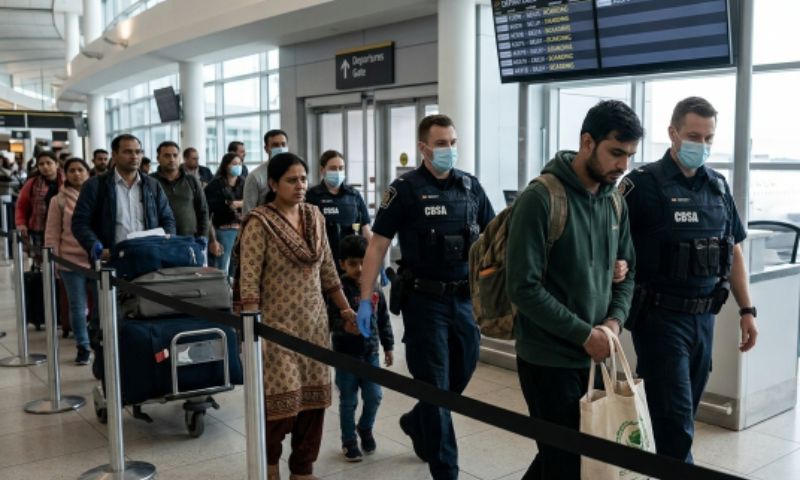
OTTAWA: Indian nationals topped the list of people removed from Canada in the first half of 2026, with 3,323 removals recorded between January and June, according to official data from the Canada Border Services Agency (CBSA), cited by the Press Trust of India (PTI).
The figure is already nearly 88 per cent of the 3,779 Indian nationals removed in all of 2025, suggesting the annual total could exceed last year’s record if the current pace continues.
India overtook Mexico as the leading nationality among people removed from Canada during the period. Mexico accounted for 1,573 removals in the first six months of 2026.
The figures come as Canada tightens its immigration system following years of rapid growth in temporary residents, including international students and temporary foreign workers.
Why are removals rising?
CBSA figures show a sharp increase in removals of Indian nationals from Canada over the past five years. The agency recorded 603 removals in 2021, 786 in 2022, 1,132 in 2023, 2,004 in 2024 and 3,779 in 2025. The 3,323 removals recorded in the first half of 2026 exceed the annual totals for every year between 2021 and 2024.
The increase coincides with Canada’s efforts to reduce temporary migration and strengthen oversight of immigration applications and residency conditions.
Indian nationals have been particularly affected by changes in the immigration environment because they constitute a significant proportion of Canada’s international student and temporary-worker populations.
Immigration rules
The Canadian government has been seeking to bring down the number of temporary residents after a period of substantial growth in international student enrolments and temporary foreign workers.
The policy shift has also affected the international education sector, where Indian students have traditionally represented a major proportion of foreign enrolments.
According to figures cited by Indian media, Indians accounted for 8.1 per cent of incoming international students in September 2025, compared with 51.6 per cent in 2023.
Separately, India’s Union Education Ministry recorded a 41 per cent decline in the number of Indian students choosing Canada, from 233,532 in 2023 to 137,608 in 2024.
Tighter immigration policies, rising living costs, stricter financial requirements, fewer part-time employment opportunities and strained bilateral relations have been cited as contributing factors behind the decline.
Why are Indians being removed?
Foreign nationals can face removal from Canada for various reasons, including visa overstays, non-compliance with immigration requirements, rejected asylum or refugee claims, and immigration or visa fraud. However, the available figures do not establish how many of the Indian nationals removed during the first half of 2026 fell into each category.
The CBSA maintains information on the reasons for removal, but the reported data do not provide a country-by-country breakdown of those reasons. Consequently, the figures establish the number of Indian nationals removed, but do not demonstrate that a particular violation accounts for the increase.
READ ALSO: Canada Deports Dozens of Indian Nationals in Crackdown on Extortion-Related Crimes
Canada has several types of removal orders, depending on the circumstances of an individual’s case. A departure order generally requires a person to leave Canada within 30 days. Failure to comply can result in the order becoming a deportation order.
An exclusion order restricts re-entry for a specified period, generally one or five years, depending on the circumstances. A deportation order generally bars a person from returning unless they obtain the required written authorisation from Canadian authorities.
Thousands more cases
The number of Indian nationals whose cases are already being processed for removal provides further insight into the scale of enforcement.
According to CBSA data, 7,669 Indian nationals were listed in Canada’s “removal in progress inventory”, making them the largest nationality group in that category.
The figure does not mean that all these individuals have already been removed or will necessarily be deported in 2026. Instead, it represents cases in which the removal process is under way. Nevertheless, the inventory indicates that a substantial number of Indian nationals remain subject to ongoing removal proceedings.
Implications for Indians
The latest figures come amid a broader tightening of Canada’s immigration system, creating a more demanding environment for international students and temporary foreign workers.
Maintaining valid immigration status and complying with the conditions attached to visas and permits are essential. Overstaying a visa or failing to meet immigration requirements can lead to enforcement action, while a rejected asylum or refugee claim may also result in removal, subject to applicable legal procedures.
The decline in Indian student enrolments further reflects the changing relationship between Canada’s immigration policies and its appeal as a destination for international education.
Although Canada continues to admit international students and temporary workers, its increasingly restrictive approach means that applicants and existing residents face greater scrutiny of their eligibility and compliance with immigration rules.
Could removals exceed the 2025 record?
The pace recorded during the first six months of 2026 suggests that removals of Indian nationals could surpass the 3,779 recorded last year. However, the final annual total will depend on how many cases are completed during the remaining months.
The 7,669 people in the removal-in-progress inventory cannot be treated as a forecast of removals, as cases may proceed at different speeds and some may not result in removal during the year.
The figures also offer a comparison with the United States. According to India’s Ministry of External Affairs, 1,273 Indian nationals were deported by the US between January 1 and July 22, 2026.
Canada’s 3,323 removals during the first six months were more than two-and-a-half times the US total reported for that period, although the reporting windows differ slightly. Taken together, the figures point to a significant shift in Canada’s immigration enforcement landscape.
Indian nationals now account for the largest share of removals by nationality in the reported period, while falling student numbers and a substantial removal pipeline underscore the effects of Ottawa’s tighter approach to temporary migration.
The available data, however, do not establish that Indian nationals are being targeted specifically because of their nationality. They show the scale of removals and the growing number of cases under way, while the individual grounds for removal remain unclear from the published country-level figures.
Extortion crackdown
Canada deported more than 80 people, the vast majority of them Indian nationals, in June 2026 as part of a major operation against organised crime and extortion-related offences, according to the Canada Border Services Agency (CBSA). Nearly 140 others were facing removal proceedings over their alleged involvement in such crimes.
Surge amid fraud concerns
Canada’s tougher immigration policies have significantly affected Indian students seeking to study in the country, as authorities intensify efforts to combat visa fraud and reduce temporary migration.
In early 2025, Canada reduced its allocation of international study permits for the second consecutive year as part of broader measures to control temporary migration and address abuses of the student visa system.
Immigration department data showed that around 74 per cent of Indian study permit applications were rejected in August 2025, compared with approximately 32 per cent in August 2023. By comparison, the overall refusal rate for study permit applications was about 40 per cent during the corresponding periods.