
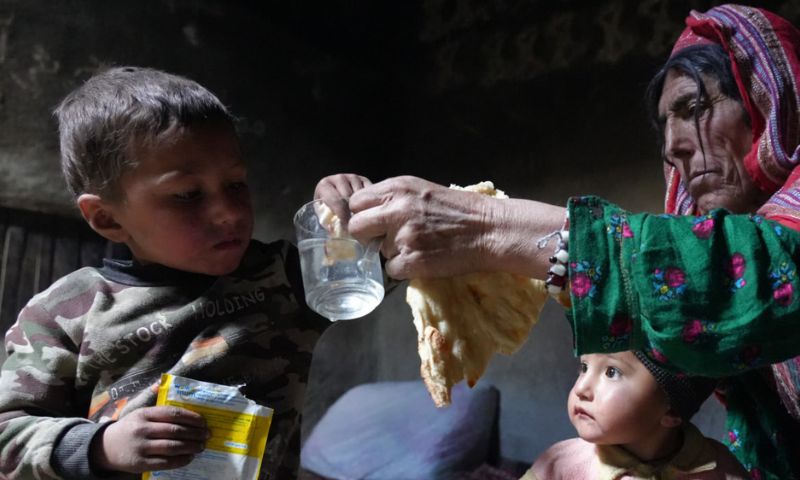
KABUL: Food insecurity and child malnutrition are worsening in Afghanistan under the Taliban regime, with nearly 19.2 million people projected to face acute hunger this winter and malnutrition cases expected to rise to four million in 2027, according to the United Nations World Food Programme (WFP) and the Food and Agriculture Organisation (FAO).
Despite an improved agricultural season, widespread unemployment, rising food and transport costs, and declining humanitarian assistance are leaving millions of Afghans struggling to afford adequate food as winter approaches.
According to the latest Integrated Food Security Phase Classification (IPC) analysis, around 38 per cent of Afghanistan’s population will face high levels of acute food insecurity between November 2026 and April 2027.
The projected figure is up from 17.4 million people during the corresponding period a year earlier.
The report warns that approximately five million people will face emergency levels of hunger, double the number projected for April-September 2026.
These people urgently need food assistance and emergency agricultural support to prevent deaths and the collapse of their livelihoods. The most severe food insecurity is projected in Badakhshan, Badghis, Daykundi, Ghor, Samangan, Sar-e-Pul and rural areas of Ghazni.
Child malnutrition set to surge
Malnutrition is emerging as one of the most serious aspects of Afghanistan’s humanitarian crisis, with women and children bearing the brunt of the worsening conditions.
The number of people expected to suffer from malnutrition is projected to reach four million in 2027, an increase of nearly 10 per cent compared with 2026. Around one-quarter of these cases are expected to be severe and potentially life-threatening.
The UN agencies warned that prevention and treatment services were failing to keep pace with the growing number of cases, leaving women and children increasingly vulnerable.
The deteriorating situation highlights the difficulties facing Afghan families under the Taliban administration, as widespread poverty and limited employment opportunities continue to undermine their ability to secure nutritious food.
Multiple crises deepen hunger
The food crisis has been compounded by several economic and humanitarian pressures. More than 1.2 million Afghans have returned from Iran and Pakistan this year, placing additional strain on communities already struggling with limited resources.
Border closures and disruptions to shipping through the Strait of Hormuz and other major trade routes have also contributed to rising prices for essential goods.
Meanwhile, severe funding shortages are restricting humanitarian operations at a time when the need for assistance is increasing. The combination of rising costs, limited employment and reduced aid is pushing more families towards severe hunger.
Better harvests fail to ease hardship
Favourable rainfall improved crop production and helped restore pastures in 2026, benefiting many farming households. Forecast above-average rainfall associated with the anticipated El Niño season could further support water supplies, pasture recovery and winter and spring crops.
However, improved harvests have failed to translate into better food security for millions of Afghans.
Persistent unemployment and low household incomes mean many families cannot afford a nutritious diet, even when food is available in local markets. Poorer farmers are also facing high fertiliser and agricultural input costs, alongside low crop prices, which could force them to reduce planting or use fewer inputs.
The agencies warned that wetter conditions could also increase the risks of localised flooding, soil erosion, crop damage and plant and animal diseases.
With agricultural employment expected to decline during winter, many households are likely to face further income losses and greater dependence on humanitarian assistance.
UN agencies urge urgent action
The FAO and WFP have called for urgent funding to expand food assistance, emergency agricultural support, and the prevention and treatment of malnutrition.
They stressed that assistance must reach vulnerable families before winter restricts access to remote communities and farmers miss critical planting opportunities.
Richard Trenchard, FAO representative in Afghanistan, said the strong harvest demonstrated the potential of Afghan farmers, but families without reliable incomes continued to struggle to afford nutritious food.
READ ALSO: Five Years of Taliban Rule: Afghanistan’s Humanitarian Crises Deepens
He said timely food assistance and emergency agricultural support could reduce acute food insecurity, while helping families grow or afford nutritious food could prevent malnutrition before children required medical treatment.
Trenchard also called for investment in food processing and local agribusinesses to connect farmers with markets and create employment opportunities.
John Aylieff, WFP country director in Afghanistan, warned that hunger and malnutrition were worsening as resources available to address the crisis continued to shrink.
He said the growing gap between humanitarian needs and available funding was pushing more families towards the brink, adding that urgent assistance could help them survive the winter with dignity.
The agencies warned that Afghanistan could face another year of worsening hunger and malnutrition without immediate support, as millions remain exposed to poverty, unemployment and a deepening humanitarian crisis.