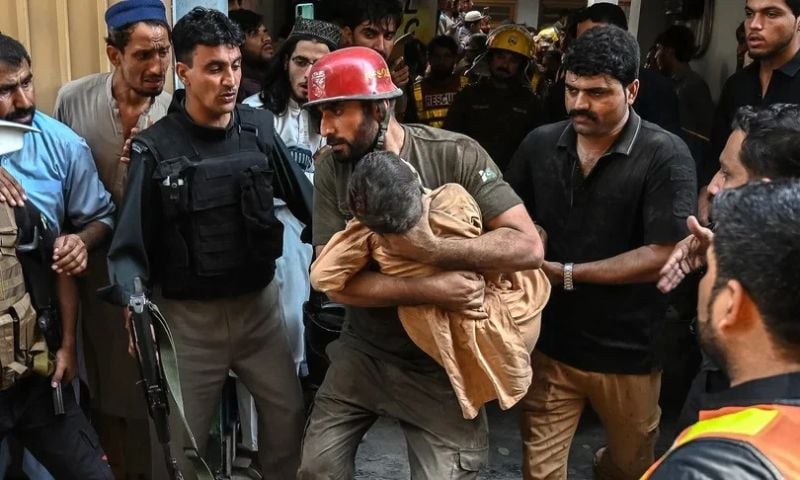
PESHAWAR: A deadly school building collapse in Peshawar has raised urgent questions about construction standards, regulatory oversight and accountability in Pakistan’s private education sector, exposing the potentially devastating consequences when children’s safety is not treated as an absolute priority.
Look at the site of the collapsed school building in Peshawar, where all three floors have crumbled into rubble. Authorities say substandard construction materials were the main cause of the collapse. #PeshawarTragedy #SchoolTragedy #Pakistan https://t.co/IK5De81joV
— Sajjad Tarakzai (@SajjadTarakzai) October 15, 2026
The collapse at a private school on Thursday, October 15, killed at least 35 children and a teacher and injured many others. Police said the building was structurally weak, while investigators alleged that substandard construction materials had been used. The school owner was arrested as authorities launched an investigation into the circumstances surrounding the tragedy. The precise cause of the collapse remains subject to investigation.
Beyond the immediate tragedy, the incident has reignited concerns about whether private schools across Pakistan are being adequately inspected, whether building regulations are consistently enforced and whether authorities have the resources and resolve to intervene before unsafe structures become death traps.
Hold them accountable to set an example for others
Speaking to WE News English, former chairman of the Private Educational Institutions Regulatory Authority (PEIRA) and Executive Director of the Inter Boards Coordination Commission (IBCC), Dr Ghulam Ali Mallah, said regulatory authorities were responsible for establishing and enforcing minimum quality standards for educational institutions.
He explained that PEIRA issues registration certificates to institutions and seeks to maintain standards through annual registration renewals. However, during his tenure as chairman, he observed that the authority faced staff shortages and limited human resources, making effective monitoring and vigilance particularly important.
Calling the Peshawar incident a tragedy, Mallah said both the school administration and the relevant regulatory authority had responsibilities in ensuring the safety of educational facilities.
PEIRA regulates private educational institutions in Islamabad, while the Khyber Pakhtunkhwa Private Schools Regulatory Authority (KP-PSRA) is responsible for the registration and regulation of private schools in the province. The distinction is important because the Peshawar case raises questions about the performance of the provincial regulator and coordination with the authorities responsible for building safety.
Residents and bereaved families have demanded a thorough investigation and strict punishment for anyone found responsible.
Resident Sher Ahmed blamed what he described as substandard construction materials and called for a comprehensive inquiry.
“With profound grief and sorrow, I urge the authorities to conduct a thorough investigation and take strict action against anyone found responsible so that such tragedies can be prevented in the future,” he said.
Mohammad Zaman, who lost two nephews in the collapse, demanded exemplary punishment for those found culpable.
“Make an example of them, a lesson for all, so that no one dares open a school just to make money without providing facilities,” he said.
Their demands reflect wider concerns among parents that the rapid expansion of private education must not come at the expense of safe classrooms, structurally sound buildings and basic protective measures.
CCPO Peshawar, Dr. Mian Saeed Ahmed, briefs the media on the school roof collapse tragedy in Peshawar. https://t.co/IA0FCLLr9X
— Pakistani Markhor (@Markhor_Paki) October 15, 2026
Conflicting accounts underline need for investigation
School owner Khan Muhammad attributed the collapse to several days of rainfall and said the building had been constructed around a year and a half earlier. He also said he had visited the affected classroom that morning before the incident.
According to his account, he called teachers and began evacuating children after the collapse occurred. He said approximately 30 children were present in the affected classroom and that around 350 students were enrolled at the school.
Police officials, however, reported that between 110 and 115 children were inside the building when the roof collapsed. A senior police official described the roof as weak and said T-iron beams and planks had been used in its construction.
An investigating officer alleged that substandard materials had been used, leading to the school owner’s arrest. These claims require verification through a technical assessment, construction records, witness accounts and other evidence gathered by investigators.
The difference between the owner’s account and the police estimate of the number of children present also highlights the need to establish the building’s occupancy, the number of classrooms in use and whether the premises were suitable for the number of students enrolled.
Rainfall may have placed additional stress on a building, but determining whether it triggered the collapse, exposed existing structural weaknesses or combined with other factors requires an independent engineering investigation.
@CMShehbaz A heartbreaking tragedy 💔
The investigation must go beyond identifying the cause of this tragedy. Those responsible for negligence must be held accountable, and structural safety inspections of schools should become mandatory nationwide. https://t.co/eQa4A0GXqX— Dr Shama Junejo (@ShamaJunejo) October 15, 2026
Registration is not a guarantee of structural safety
The Peshawar tragedy raises a fundamental question: does a school’s registration certificate establish that its building is structurally safe, or can an institution continue operating even when its premises require a fresh safety assessment?
Registration is an essential regulatory requirement, but it cannot substitute for professional structural inspections, compliance with approved building plans and verification that construction meets applicable engineering standards.
Private school regulation also involves responsibilities that may be divided among education regulators, municipal authorities, development agencies, building control departments and civil defence or fire safety officials. Education authorities may oversee registration and school operations, while other agencies are responsible for building approvals, structural compliance and emergency safety requirements.
Where these responsibilities overlap without clear coordination, a school may satisfy one administrative requirement without necessarily having undergone every inspection needed to establish its physical safety.
In Pakistan, safety seems to matter only AFTER a tragedy. School buildings collapse, hospitals catch fire, and public spaces become unsafe, then come the condolences, inquiries, and empty promises!
Who approves these unsafe buildings? Who inspects them? And who is held accountable?— Critic Alexandrite🦅 (@Alexandrite786) October 15, 2026
In Khyber Pakhtunkhwa, the provincial regulatory framework provides for the registration, regulation and supervision of private schools. The KP-PSRA also identifies monitoring and inspection as part of its regulatory work. The central question following the collapse is whether the relevant requirements were applied effectively to the school and whether any warning signs were identified, documented or ignored.
Authorities should establish whether the school had valid registration, approved building plans, relevant completion or occupancy documentation and any required structural safety clearances. They should also determine when the premises were last inspected, which officials conducted the inspection and what action was taken if deficiencies were found.
Why school buildings can become unsafe
Substandard construction can result from several factors, including poor-quality materials, inadequate structural design, unqualified contractors, weak supervision during construction and unauthorised alterations. A building initially intended for residential use may also become unsuitable if converted into a school without assessing its load-bearing capacity, circulation routes and occupancy limits.
Structural safety depends on more than the visible condition of walls or ceilings. Engineers must assess foundations, columns, beams, slabs, connections, material strength and the ability of the building to withstand expected loads. The addition of floors, classrooms, water tanks or other heavy structures without proper assessment can create risks that are not always apparent to teachers, parents or school administrators.
Rainfall can expose weaknesses through water infiltration, deterioration of materials or added loading where drainage is inadequate. However, weather alone should not be accepted as the explanation for a collapse until technical experts establish the sequence of failure and determine whether the building complied with applicable standards.
In the Peshawar case, the reported use of T-iron beams and planks makes a professional assessment of the roof’s design, materials, workmanship and load-bearing capacity especially important. Investigators should also examine whether the building’s actual use and occupancy matched the plans and approvals, if any, issued for the premises.
🚨 The Peshawar school tragedy has claimed 29 lives, including children. Questions over emergency response and ambulance availability demand answers. KP deserves better!
#Peshawar #KPK #Pakistan #BreakingNews https://t.co/KxKcMqJFmm
— globaltruth (@globaltruth3d) October 15, 2026
Staff shortages and the limits of inspections
Mallah’s observations about limited staffing at PEIRA point to a broader regulatory challenge: authorities cannot effectively monitor every institution if they lack sufficient inspectors, technical expertise, transport, funding and reliable records.
A system that relies heavily on registration renewals may also struggle to identify hazards that emerge between inspections. Structural damage, unauthorised construction, overcrowding and changes in building use can develop after an institution receives its initial approval.
Effective oversight requires risk-based inspections, with greater scrutiny of older buildings, recently altered structures, buildings with visible damage and schools operating at high occupancy. Structural assessments should be conducted by qualified engineers rather than relying solely on general administrative inspections.
Authorities also need a mechanism for parents, teachers and staff to report cracks, sagging roofs, water leakage or other warning signs without fear of retaliation. Such complaints should trigger documented assessments and timely action.
Where an immediate danger is identified, regulators must have the capacity to restrict access, order evacuation or suspend operations until the building is declared safe by qualified professionals.
Accountability must extend beyond the school owner
School owners and administrations have a primary duty to provide safe premises, maintain buildings, employ competent professionals and avoid overcrowding. They should retain construction approvals, inspection reports, maintenance records and evidence of compliance with relevant safety requirements.
Private school associations also have a role to play. While they cannot replace government regulators or building control authorities, they can promote minimum safety standards among members, facilitate professional safety audits, encourage transparent reporting and oppose the operation of institutions that neglect essential safeguards.
Regulatory authorities, meanwhile, must demonstrate that inspections are meaningful, complaints are investigated and violations lead to proportionate action. Where officials knowingly overlook serious hazards, accountability should extend to any proven administrative negligence or misconduct.
An independent inquiry into the Peshawar collapse should establish the precise cause of structural failure, examine the school’s registration and construction history, identify any missed inspections and determine whether the building was being used in accordance with approved plans. Its findings should be made public, subject to applicable legal requirements, so that responsibility is established on evidence rather than speculation.
Read Also: Peshawar School Tragedy: Governor Orders Province-Wide Safety Inspections
A nationwide safety audit cannot wait
The tragedy should prompt provincial governments and relevant authorities across Pakistan to review the safety of private schools, particularly those operating in converted residential buildings, multi-storey structures or premises that have undergone unauthorised alterations.
Such an exercise should begin with a verified inventory of school buildings and their registration status, followed by risk-based inspections and structural assessments where necessary. Schools found to pose an immediate danger should not continue operating until the identified risks have been addressed and their safety independently verified.
The review should also assess whether regulatory authorities have enough staff and technical capacity to carry out inspections, whether records are shared between education and building control departments, and whether there are clear procedures for closing unsafe premises and permitting them to reopen.
Parents should be able to verify a school’s registration and access meaningful information about its safety compliance. Schools should also have emergency evacuation plans, safe exit routes and procedures for protecting children during emergencies.
Pakistan’s private education sector provides schooling to millions of children, but access to education must never be separated from the right to learn in a safe environment. A school is not safe merely because it has classrooms, teachers and a registration certificate; its structure must be capable of protecting the children entrusted to its care.
Peshawar Heartbreak 💔
A tragic roof collapse at a private school in Peshawar has claimed the lives of 17 innocent children and a brave female teacher. Many more are battling for their lives at Lady Reading Hospital. https://t.co/5givdDIR0e— Rabia Malik (@rabiatalks) October 15, 2026
Read Also: Peshawar School Roof Collapse Kills 34 Students, One Teacher
The Peshawar collapse has left families grieving and communities demanding justice. A credible investigation, transparent accountability and effective enforcement could help prevent another tragedy. Without those measures, calls to “make an example” of those responsible risk becoming another expression of public anger rather than a turning point for school safety.
Pakistan Reports 32 Building Collapse Incidents in 2026, Raising Safety Concerns
Pakistan has recorded 32 reported cases or groups of roof and building collapse incidents between January and October 15, 2026, involving homes, schools, tuition centres, shops and buildings under construction or renovation. The incidents have killed numerous people, including children, women and labourers, and injured many others. Reported contributing factors include heavy rainfall, deteriorating structures, excessive roof loads and construction work, although the causes have not been independently established in every case.
The recurring tragedies raise serious concerns about building safety, compliance with construction standards and the effectiveness of inspections and enforcement across Pakistan.
Fatal collapses at schools and tuition centres particularly highlight the urgent need for structural safety assessments, stricter oversight of construction at occupied premises, regular inspections and accountability for negligence. A coordinated nationwide review of vulnerable buildings could help identify hazards before they result in further loss of life.