
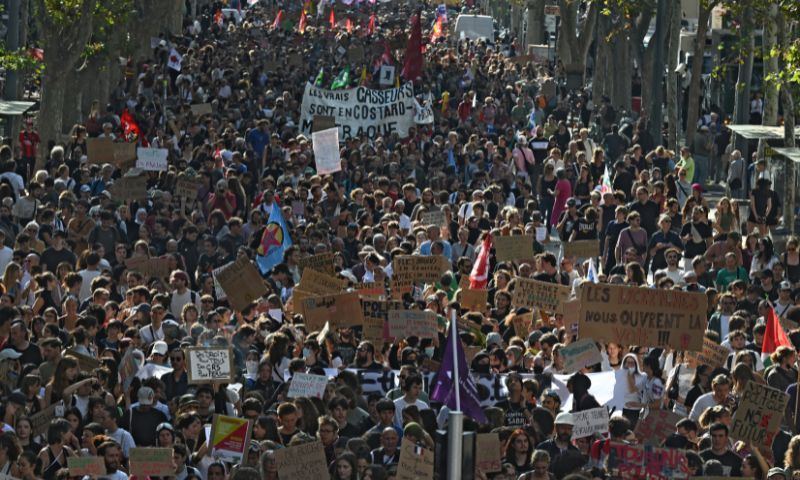
PARIS: French high school students on Monday began preparing for a fresh wave of protests this week, seeking to sustain their campaign for better educational conditions despite government concessions aimed at bringing the demonstrations to an end.
The latest demonstrations, scheduled for Tuesday, could prove a turning point in the movement, which began in mid-September. The government, meanwhile, hopes the protests are losing momentum after a sharp decline in school blockades and gatherings outside secondary schools last week.
More than 96 per cent of France’s lycées were open on Friday, according to the education ministry, suggesting that the disruption was easing.
Meanwhile, French President Emmanuel Macron said: “I will never condone or justify violence, whether committed by high school students or by former students and others who exploit the situation to engage in arson, destruction or other acts of violence.”
French President Macron:
I will obviously never approve of or justify any violence, whether among high school students or by people who are no longer students and who come to take advantage of all this to burn, destroy or commit acts of violence.
That is unacceptable. https://t.co/Kf7Qyzmlut
— Clash Report (@clashreport) October 12, 2026
However, the authorities are concerned that the student unrest could coincide with demonstrations against the rising cost of living planned for Saturday, following calls by online activists.
The prospect has revived memories of the Yellow Vest movement, which began in 2018 in response to a planned fuel tax increase and escalated into mass demonstrations and clashes with police, posing a major challenge to President Emmanuel Macron during his first term.
Government offers concessions
The government is still assessing the financial and political consequences of the student protests. A government source told journalists last week that the cost of damage caused by the demonstrations was estimated at at least €30 million.
The justice ministry said on Friday that more than 6,800 people had been detained since the protests began, with minors accounting for 86 per cent of those detained.
Clashes between some demonstrators and riot police left several students seriously injured, prompting criticism of police tactics. The government subsequently suspended the use of stun grenades after one student lost a hand in an incident involving the weapon. Police are also investigating 18 alleged cases of misconduct by officers.
In an effort to address students’ grievances, the government announced several measures last week. Education Minister Edouard Geffray said late on Thursday that around 3,000 substitute teachers would be deployed in the coming days to cover staff shortages at the 114 most severely affected secondary schools.
READ ALSO: Thousands Gather Across France As Students, Teachers Clash With Police
Prime Minister Sébastien Lecornu also pledged on Sunday to amend the proposed 2027 budget to address some of the demands submitted through an online platform established by the government to collect students’ views.
Students demand further investment
The concessions have failed to satisfy the organisations leading the campaign. The Union of High School Students dismissed the government’s initial announcements as “crumbs” and reiterated its demand for an additional €10 million investment in the country’s secondary schools.
Meanwhile, France’s 10,000 medical students have voiced concerns about the potential impact of continued school blockades on examinations. The exams play a crucial role in determining their future medical specialities, and students fear that further disruption could jeopardise this important stage of their education.
The scale of the protests has fluctuated in recent days. Demonstrations last Thursday drew 71,500 participants across France, according to interior ministry figures, while nearly 256,000 people took part in the previous Tuesday’s day of action.
Public support for the movement also appears substantial. A poll conducted by Ipsos-BVA and published on Sunday found that 54 per cent of respondents supported the high school students’ protests.
Respondents expressed particular sympathy with complaints about overcrowded classrooms and the need to renovate France’s deteriorating school buildings, two of the central issues driving the campaign.