Key Points
- US measure creates uncertainty for skilled international workers
- Microsoft and Adobe sponsoring foreign employees restricted
- Major IT outsourcing companies affected by the suspension
- Investigators examine 9 universities over use of cultural exchange visas
ISLAMABAD: The US has suspended major technology companies from a programme sponsoring foreign workers for permanent residency and launched investigations into nine universities over international exchange visas.
The Trump Administration’s move escalated the crackdown on skilled-worker immigration.
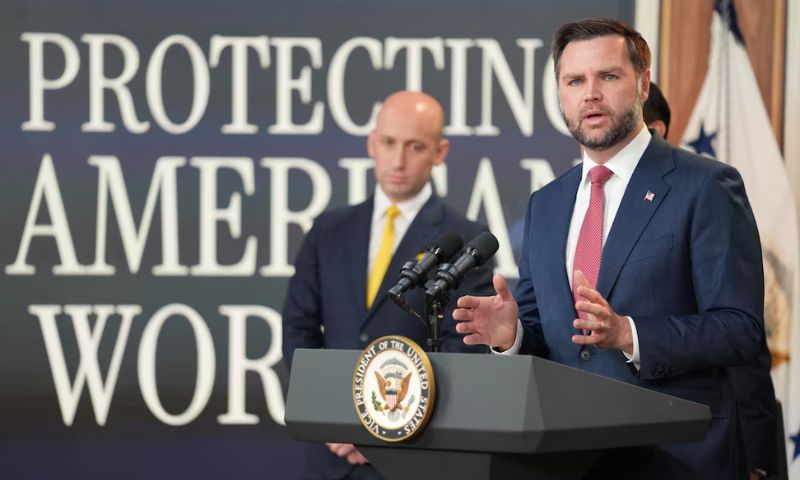
Vice President JD Vance announced the measures on Thursday, accusing companies of exploiting immigration programmes while laying off American employees.
The action affects Microsoft, Adobe and major information technology service providers, including Cognizant, Infosys, Tata Consultancy Services, Wipro, HCL and Capgemini, according to US media reports.
The suspensions concern the labour-certification process known as PERM, which employers generally must complete before sponsoring eligible foreign workers for employment-based green cards. A green card grants lawful permanent residence in the United States.
The measures do not prohibit general recruitment of foreign workers or automatically cancel existing visas.
However, they could disrupt the affected companies’ ability to help employees move from temporary work status to permanent residency.
Vance said Microsoft had laid off 6,000 American workers in the previous year while obtaining 6,300 H-1B visas and nearly 3,000 green cards. He argued that the company’s use of foreign-worker programmes undermined opportunities for US employees.
H-1B visas permit American employers to hire foreign professionals for specialised occupations, including technology, engineering and scientific roles.
The programme is vital to the technology industry, which relies on international recruitment to fill positions requiring specialised skills.
Microsoft said it was cooperating with the administration and that most of its H-1B filings concerned existing employees rather than new hires.
The company also defended its compliance with visa requirements and said its workers received competitive compensation.
US universities face separate visa investigations
The Labour Department’s inspector general has also launched investigations into nine universities over their use of J-1 visas, which allow foreign nationals to enter the United States temporarily for educational and cultural exchange programmes.
The institutions Vance named included Harvard University, Yale University, Stanford University, Brown University, the University of Pittsburgh, the University of California, Davis, the California Institute of Technology, Arizona State University and the Massachusetts Institute of Technology.
Investigators are examining whether the institutions improperly used the programme. Officials have not publicly detailed specific allegations against each university.
The Labour Department said that subpoenas have been issued as part of the inquiry. Some universities have said that they are cooperating with investigators and defended the contributions of international scholars, students and employees to teaching, research and innovation.
The J-1 investigations are separate from the action against technology companies and their employment-based green-card sponsorships, although both form part of the administration’s scrutiny of programmes involving foreign workers and visitors.
Immigration policy puts tech under pressure
The latest measures add to a series of efforts by the Trump administration to tighten legal immigration rules, including proposed higher costs for employers seeking H-1B workers.
Technology companies, however, have long argued that access to international talent is essential to innovation and maintaining their global competitiveness.
The suspensions could make affected companies less attractive to international recruits seeking a long-term future in the United States.
They could also create uncertainty for existing employees whose plans for permanent residency depend on employer sponsorship.
The cases are likely to draw further attention to the balance between protecting domestic employment and retaining international talent in a technology industry that competes globally for specialised workers.