
Key Points
- Dubai crude reached $110.70 a barrel in Pakistan’s latest Oct 8 Platts data
- Petrol and diesel assessments rose to $136.17 and $159.98 a barrel, respectively
- Hurricane-related US production cuts add another supply risk
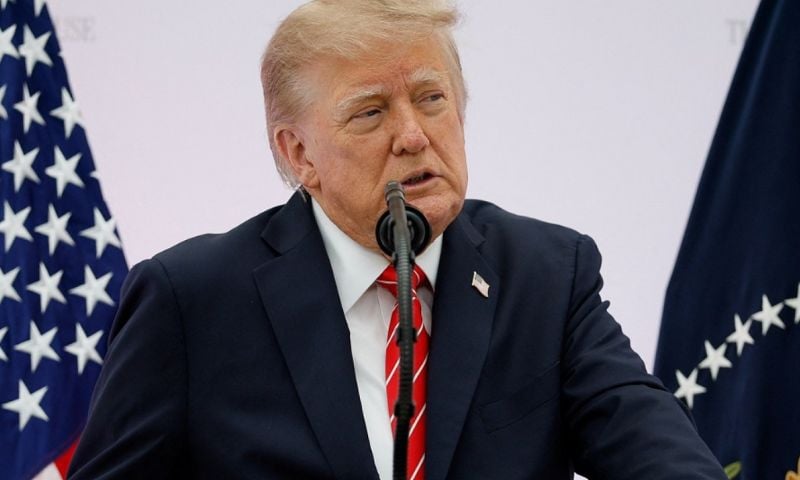
ISLAMABAD: Oil prices fell on Friday after US President Donald Trump said Washington would not attack Iran before the November 3 midterm elections.
The statement eased fears of further military escalation even as tanker attacks and disrupted shipments through the Strait of Hormuz continued to threaten supplies.
Brent crude futures declined 72 cents, or 0.7 per cent, to $103.53 a barrel, while US West Texas Intermediate (WTI) fell 52 cents, or 0.6 per cent, to $90.97 by 0220 GMT, according to market data.
Brent nevertheless remained on course for a weekly gain after Thursday’s 4.1 per cent rally, while WTI was heading towards a slight weekly loss.
The retreat followed a volatile session in which Brent rose to $104.28 at settlement on Thursday after tanker attacks renewed concerns over Middle Eastern oil shipments.
Trump’s comments about productive discussions with Iran eased immediate pressure on prices.
Crude and fuel prices tell different stories
The latest data published by Pakistan’s Oil and Gas Regulatory Authority (OGRA), based on Platts assessments, show that Dubai crude was assessed at $110.70 a barrel on October 8, up from $105.93 on October 7.
The same October 8 data put petrol at $136.17 a barrel and high-speed diesel at $159.98. These are dated market assessments, not live Friday quotations or retail prices.
READ ALSO: Pakistan Hikes Petrol Price by Rs2.31, Diesel by Rs0.78 Per Litre
The figures show that a decline in Brent and WTI futures does not necessarily mean the cost of obtaining oil and refined products is falling by the same amount or moving in the same direction.
Crude grades differ in quality and location, while petrol and diesel prices also reflect refinery capacity, product availability and transport costs.
The distinction has become more pronounced during the conflict. A Financial Times analysis published Thursday, citing Argus Media data, said Brent futures represented only about 60 to 70 per cent of the landed crude cost in Asia, compared with roughly 90 per cent in normal conditions.
For diesel, futures represented about half the price, against a typical 80 to 90 per cent. The gap between physical crude prices and futures exceeded $20 a barrel in September, the analysis said.
Refined fuel oil remains expensive
The latest regional export-market assessments available for this report, dated October 7, show that refined products were trading at substantial premiums to crude benchmarks.
In the Arabian Gulf, 92-octane gasoline was assessed at $133.81 a barrel and 95-octane gasoline at $140.16. Low-sulphur diesel stood at $151.46. Likewise, jet fuel reached $157.54 per barrel.
In Singapore, 92-octane gasoline was assessed at $147.31 a barrel, 95-octane gasoline at $153.66, diesel at $168.36 and jet fuel at $173.48.
These figures are regional export-market assessments, not retail prices, and they are not October 9 live quotations. Importers must also account for freight, insurance, handling charges, taxes and distribution expenses.
Hormuz flow and US oil production
The Strait of Hormuz remains a central concern because it carries a substantial share of the world’s oil and fuel shipments.
Attacks on tankers in the Gulf and near Oman have raised concerns about further delays, higher insurance premiums and cargo availability for refiners. Even when crude remains available, the cost of transporting it safely can raise the final price.
The US market also faces a weather-related disruption. The Wall Street Journal reported on Friday that preparations for an approaching storm had curtailed around a quarter of Gulf of Mexico oil production.
Washington has also imposed fresh sanctions targeting individuals, networks and vessels involved in transporting Iranian crude oil, petroleum products and petrochemicals, adding another complication to the market outlook.
Friday’s decline therefore reflects reduced immediate fears of a US attack rather than a resolution of the supply problems affecting the market.