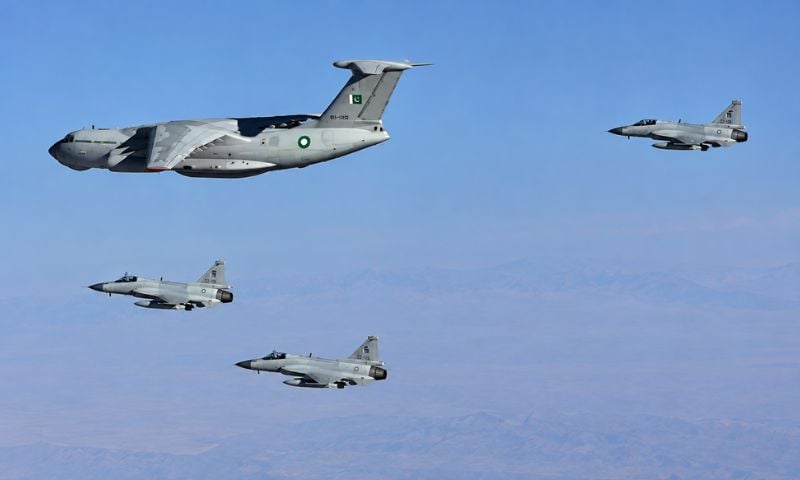
ISLAMABAD: Pakistan’s Ministry of Information has rejected a report claiming that Pakistan Air Force (PAF) aircraft were being used against Yemen’s Houthis, describing the report as “fake and fabricated”.
The ministry issued the denial on Thursday after The New York Times published a report on October 7 citing an unnamed source as saying that PAF fighter jets were being employed against the Houthis amid escalating tensions between the group and Saudi Arabia.
In a post on X, the ministry said the ” NYT —- story attributing employment of PAF aircraft against Houthis is fake and fabricated, ”.
𝐅𝐚𝐜𝐭 𝐂𝐡𝐞𝐜𝐤 | 𝐌𝐢𝐧𝐢𝐬𝐭𝐫𝐲 𝐨𝐟 𝐈𝐧𝐟𝐨𝐫𝐦𝐚𝐭𝐢𝐨𝐧 & 𝐁𝐫𝐨𝐚𝐝𝐜𝐚𝐬𝐭𝐢𝐧𝐠
▪️ NYT above referred story attributing employment of PAF aircraft against Houthis is fake and fabricated. International Media houses are again asked to avoid speculative reporting with regards to employment of Pakistan’s Military Forces under Makkah Joint Defence Agreement.
▪️ Details of any employment, if necessary will be given by concerned authorities.
𝐓𝐫𝐮𝐭𝐡 𝐏𝐫𝐞𝐯𝐚𝐢𝐥𝐬 𝐨𝐯𝐞𝐫 𝐅𝐚𝐥𝐬𝐞𝐡𝐨𝐨𝐝
— Fact Checker MoIB (@FactCheckerMoIB) October 8, 2026
“International media houses are again asked to avoid speculative reporting about the employment of Pakistan’s military forces under the Makkah Joint Defence Agreement,” the ministry said.
“Details of any deployment, if necessary, will be given by the authorities concerned,” it added.
Deployment Reports Denied
Earlier this week, the ministry also described a Reuters report claiming that between 30,000 and 40,000 Pakistani troops would be deployed to Saudi Arabia as “speculative”.
𝐅𝐚𝐜𝐭 𝐂𝐡𝐞𝐜𝐤 | 𝐌𝐢𝐧𝐢𝐬𝐭𝐫𝐲 𝐨𝐟 𝐈𝐧𝐟𝐨𝐫𝐦𝐚𝐭𝐢𝐨𝐧 & 𝐁𝐫𝐨𝐚𝐝𝐜𝐚𝐬𝐭𝐢𝐧𝐠
▪️Having taken note of speculative reports by Reuters on Makkah Joint Defense Agreement, it is reiterated that Pakistan has already made Pakistan’s commitment to security of Haramain Sharifain and KSA abundantly clear, which is non negotiable.
▪️It has also been underscored that the operational details of the actualisation of the collective deterrence are a matter of operational confidentiality and may not be made subject of media speculation.
▪️It would be therefore prudent to avoid such highly speculative reports based on non-attributable and unknown sources, rather Reuters would be better served to refer to official statements of MoFA and other authorities in this regard. Queries if any may be referred to them instead of coming out with invented numbers and details.— Fact Checker MoIB (@FactCheckerMoIB) October 6, 2026
The latest denial comes after Pakistan, Saudi Arabia and Turkiye agreed at an emergency meeting of the Makkah Defence Alliance in Riyadh on Monday to move towards the rapid deployment of military forces and capabilities in the kingdom.
Signed on August 7, the defence pact aims to strengthen collective deterrence and provides for an attack against one signatory to be treated as an attack against all.
A statement issued by Pakistan’s Foreign Office after Monday’s meeting said the member states had decided to begin implementing their collective defence commitments.
The statement said the countries would take the necessary measures to provide agreed military forces and capabilities and ensure their rapid deployment in Saudi Arabia, in accordance with approved arrangements and each country’s national legislation.
The measures, it added, were intended to strengthen military readiness, integration and the collective capacity to confront threats.
Pakistan’s Military Presence
Defence Minister Khawaja Asif, who attended the Riyadh meeting as part of Pakistan’s delegation, said on Geo News programme Aaj Shahzeb Khanzada Kay Saath that Saudi Arabia had made gains and recovered some areas in Yemen during the fighting with the Houthis.
Asked about a possible operational role for Pakistan and Turkiye, Asif said both countries had a “presence in theatre”, but only Saudi troops were involved in combat operations.
On Wednesday, Inter-Services Public Relations Director General Lieutenant General Ahmed Sharif Chaudhry confirmed that Pakistani troops were stationed in Saudi Arabia, saying they had been present in the kingdom “for decades” across multiple domains.
Pakistan has repeatedly expressed solidarity with Saudi Arabia. On September 18, Chaudhry said Pakistan would go to “any extent” to defend the Gulf state, describing Islamabad’s commitment to Saudi security as “unconditional”.
Asif has also said Pakistan would stand by Saudi Arabia “practically and diplomatically” if the situation involving Yemen’s Houthis escalated, adding that Islamabad would fulfil its obligations under the Makkah Defence Alliance in accordance with the agreement.
Pakistan has maintained that the alliance is defensive in nature and intended to strengthen collective deterrence.
Official spokesperson of the Coalition to Restore Legitimacy in Yemen, Major General Turki Al-Maliki, on Thursday said that three ballistic missiles launched by the Houthi militia towards Riyadh and Khamis Mushait were intercepted and destroyed.
“A ballistic missile launched by the terrorist Houthis— towards Khamis Mushait was intercepted and destroyed,” Coalition spokesperson Major General Al-Maliki said in a post on X.
Muslim nations and regional organisations have strongly condemned Houthi attacks targeting two airports in Saudi Arabia, which killed three people and injured dozens, calling the strikes a grave violation of Saudi sovereignty and a direct threat to regional security.
According to the General Authority of Civil Aviation (GACA), Abha International Airport and King Khalid International Airport in Riyadh were targeted in two separate attacks on October 6 and 7, 2026, the Saudi Press Agency (SPA) reported.
At Abha International Airport, the blatant attack resulted in two fatalities, a Moroccan and an Algerian female resident, as well as 28 injuries ranging from minor to serious among Saudi citizens, a Bangladeshi resident, and a Filipino resident, GACA stated.
At King Khalid International Airport, the attack resulted in one fatality, a resident of Sudanese nationality, as well as eight injuries ranging from minor to critical among five Saudi citizens, two Egyptian residents, and a Pakistani resident, according to GACA.