GENEVA: Pakistan has raised concerns at the United Nations over the use of water as a tool of political pressure, describing India’s actions concerning the Indus Waters Treaty as a “weaponisation of water” and warning that shared water resources must not be used for coercion, political leverage or war.
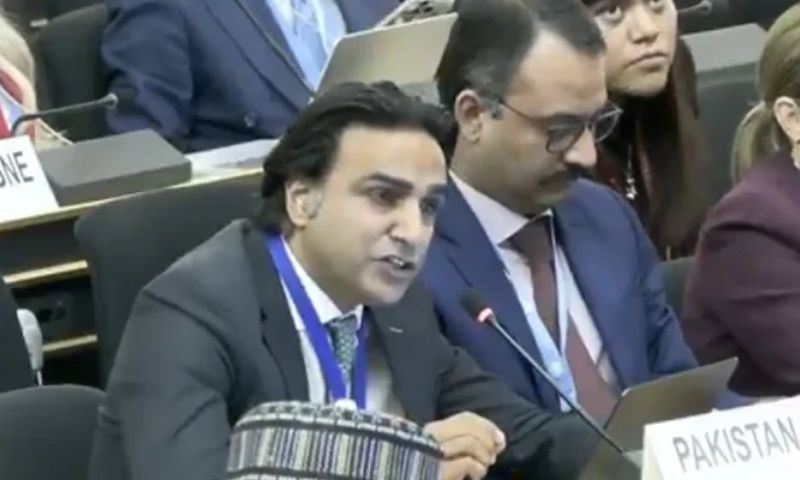
Pakistan’s First Secretary Adeel Mumtaz Khokhar made the remarks during the 63rd session of the UN Human Rights Council as it considered a resolution on the human rights to safe drinking water and sanitation.
Delivering Pakistan’s Explanation of Vote on #HRC63 resolution L.34 on the human rights to safe drinking water and sanitation, First Secretary @adeelmkhokhar highlighted:
• The resolution makes transboundary water cooperation explicit, in line with SDG 6.5, which calls for integrated water resources management at all levels, including through transboundary cooperation.
• Cooperation is not a favour between neighbours. Where waters are shared, so are responsibilities.
• No upper riparian should use water as an instrument of political leverage or coercion. Legal instruments, including obligations under international law, must be upheld in good faith.
• Appreciated the significant majority of States that supported retaining references to transboundary water cooperation, reaffirming it as a priority widely shared across the Council.
• Pakistan will continue to highlight the critical importance of transboundary water cooperation in the Council’s work and its indispensable role in realizing the rights to safe drinking water and sanitation.
@ForeignOfficePk
— Pakistan Mission Geneva (@PakUN_Geneva) October 6, 2026
The resolution, presented by Germany and Spain, was adopted without a vote. Pakistan said it had played an active role in retaining an explicit reference to transboundary water cooperation in the final text. The official UN record confirms that Khokhar addressed the council during consideration of the resolution.
According to Pakistan, India had sought to remove the reference, arguing that transboundary water cooperation fell outside the scope of a resolution dealing with human rights.
Pakistan maintained that cooperation over shared water resources was directly linked to the human rights to safe drinking water and sanitation.
Speaking during the consideration of the resolution, Khokhar outlined Islamabad’s position on shared water resources and the Indus River system. “Where water is shared, responsibilities are also shared,” Khokhar said.
He said cooperation over shared waters between neighbouring countries was not a matter of favour or concession but a shared responsibility. “No upstream country can use water as a tool of political pressure or influence,” Khokhar said.
READ ALSO: UN Chief Appreciates Pakistan’s Contribution to International Peace, Dialogue and De-escalation
He stressed that water should be managed according to the principles of cooperation and mutual responsibility rather than being used as an instrument of political pressure.
Khokhar also described India’s unilateral action concerning the Indus Waters Treaty as a “weaponisation of water” and said water must never become an instrument of coercion, political leverage or war.
Pakistan also thanked states for retaining the reference to transboundary water cooperation in the final resolution.
The UN identifies the measure as draft resolution A/HRC/63/L.34, titled The human rights to safe drinking water and sanitation, submitted by Spain and Germany. The resolution was adopted without a vote. The 63rd session of the Human Rights Council ran from September 7 to October 7, 2026.