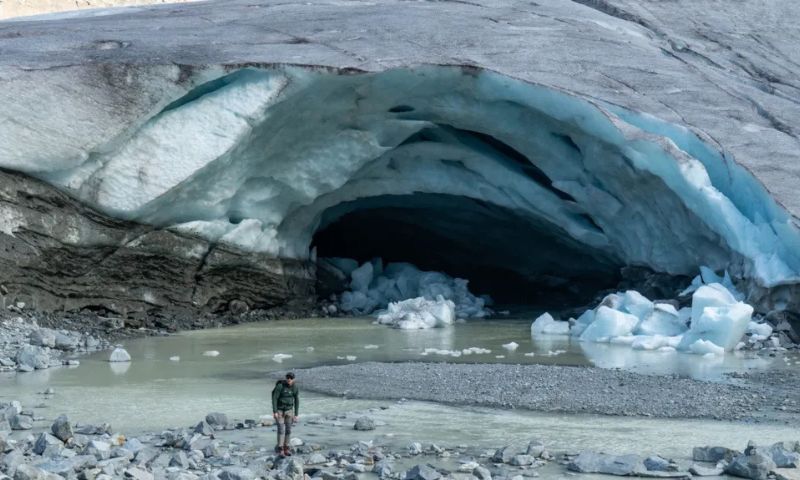
ISLAMABAD: Swiss glaciers have lost an estimated 5.5% of their remaining ice over the past 12 months, at one of the fastest rates of melting ever recorded, according to new data from Glacier Monitoring Switzerland.
Scientists described the loss as “extraordinary”, warning that the pace of melting could have serious consequences for water supplies, farming, hydropower and transport in the coming decades.
Until recently, glaciologists considered the loss of 2% of glacier ice in a single year to be extreme. The latest estimate is almost three times that level.
“It’s really just disastrous,” said Dr Matthias Huss, director of Glacier Monitoring Switzerland, which produced the report.
Heatwave Impact
Swiss glaciers entered the summer with unusually low snow cover after a mild winter. Much of the remaining snow disappeared during intense heatwaves in May and June, exposing darker glacier ice that absorbs more solar energy and accelerates melting.
Dr Fabien Maussion, a glaciologist at the University of Bristol who was not involved in the report, said the scale of the loss was alarming.
“Ten years ago, I wouldn’t have thought that it’s possible to lose glaciers so quickly,” he said.
Scientists estimate Swiss glaciers released about 2.2 trillion litres of meltwater between July and September. While the additional water helped ease shortages during a hot and dry summer, researchers warned that it represented the loss of ice accumulated over decades or centuries.
“Every drop of water that runs off during these heatwaves is kind of old water that’s been stocked in the glacier ice centuries or decades ago,” Huss said.
Water And Stability
The rapid loss of glacier ice could create long-term pressure on water resources, particularly during future heatwaves when demand for irrigation and hydropower is high.
The Rhine also reached record-low levels in parts of Switzerland this summer, affecting shipping routes and increasing transport costs.
Researchers found signs of severe melting even at elevations of around 3,500 metres, where glaciers would normally retain substantial snow cover.
“At some glaciers we’ve seen four metres of ice loss at the highest point, where they should be covered by several metres of winter snow at this time of the year,” Huss said.
Scientists warn that continued warming could make some Alpine glaciers impossible to preserve. Some smaller glaciers, including Plattalva in eastern Switzerland, have already disappeared.
However, researchers say rapid reductions in greenhouse gas emissions could still limit future glacier losses, particularly in the Himalayas and polar regions.
“If these ice masses can be saved or stabilised, we can limit the rise of global sea levels,” Huss said, warning that rising seas could affect billions of people living along coastlines.