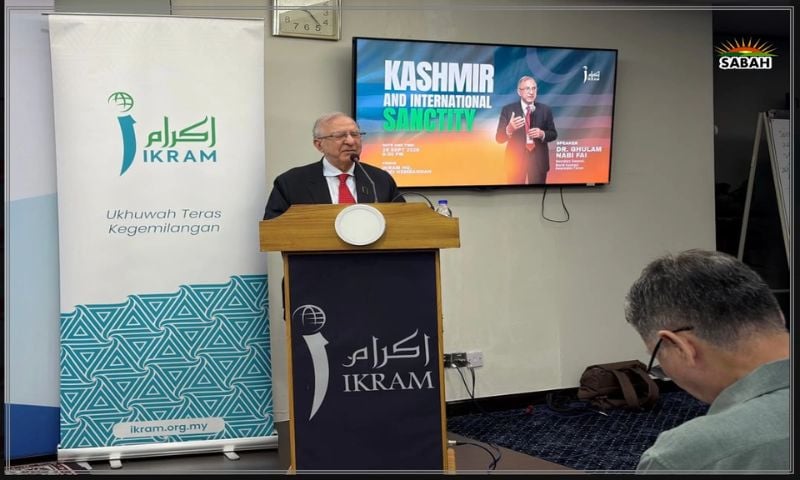
KUALA LUMPUR: Dr Ghulam Nabi Fai, Chairman of the World Forum for Peace and Justice, has urged the international community to move beyond statements and take meaningful diplomatic action to resolve the Kashmir dispute in line with relevant United Nations resolutions.
Speaking at a discussion on “Kashmir and International Sanctity” at the headquarters of Pertubuhan IKRAM Malaysia (IKRAM), a Malaysian Islamic organisation, in Kuala Lumpur, Dr Fai said the dispute over Indian Illegally Occupied Kashmir remained an international issue requiring sustained engagement by the global community.
IKRAM President Hj Badlishah Shams Bin Baharin, who welcomed the participants, highlighted the seriousness of the dispute, noting that India and Pakistan had fought three wars over Kashmir. He said the demand of the Kashmiri people for the right to self-determination had been addressed in United Nations Security Council deliberations.
Dr Fai said Kashmir had international, human rights, peace and security dimensions, but what distinguished it from many other conflicts was its “international sanctity”.
He described the Kashmir question as one of the world’s oldest unresolved international disputes, saying nearly eight decades of experience had shown that it would not disappear on its own.
“It is not the inherent difficulties of a solution, but the lack of the will to implement a solution, that has caused the prolonged deadlock over the Kashmir dispute,” he said. Dr Fai particularly highlighted what he called the gap between international recognition and meaningful action.
“World powers still recognise Kashmir as an international issue, but they have yet to articulate their understanding into a tangible plan of action so that the Kashmir issue is resolved,” he said.
He referred to the historical record of international involvement, particularly through the UN Security Council. He noted that Resolution 47, adopted on April 21, 1948, addressed the restoration of peace and order and provided for a plebiscite in Jammu and Kashmir.
According to Dr Fai, the resolution and subsequent international involvement demonstrated that Kashmir had not been treated at the outset as merely a bilateral or internal matter.
He also referred to statements and initiatives by several international leaders concerning Kashmir, including US presidents John F Kennedy, George W Bush and Barack Obama, as well as Nelson Mandela, Vladimir Putin, Margaret Thatcher, Keizo Obuchi and former World Bank president James Wolfensohn.
Referring to the recent Pahalgam crisis, Dr Fai said US President Donald Trump had again offered to mediate between India and Pakistan over the Kashmir dispute. Taken together, he said, such positions showed that the international community had repeatedly acknowledged the importance of resolving the Kashmir dispute for peace and stability in South Asia.
READ ALSO: UN Must Move Beyond Speeches to Restore Trust: Chairman World Peace Forum
“The question before the international community is therefore not whether Kashmir has an international dimension,” Dr Fai said. “The historical record makes that abundantly clear. The real question is whether the international community is prepared to translate its recognition into a sustained, credible and peaceful process aimed at resolving the dispute.”
He stressed that there could be no military solution to the Kashmir dispute and said any durable settlement must take into account the aspirations and rights of the people of Kashmir.
Dr Fai called for conditions conducive to dialogue, including an end to violence, respect for fundamental freedoms, the release of political prisoners, the repeal of what he described as draconian laws, and meaningful engagement among India, Pakistan and Kashmiri representatives. He also urged major world powers to play a constructive role in encouraging a peaceful negotiating process.
Given Kashmir’s impact on India-Pakistan relations and the wider security of South Asia, he said, the international community had a legitimate interest in helping the parties move from confrontation towards dialogue and a durable settlement.
“The unresolved Kashmir dispute is not only a question for India and Pakistan,” Dr Fai said. “It is a question of peace, security, human rights and international credibility.” He added that if the international community recognised the international sanctity of Kashmir, it should also have the political will to act on that recognition.