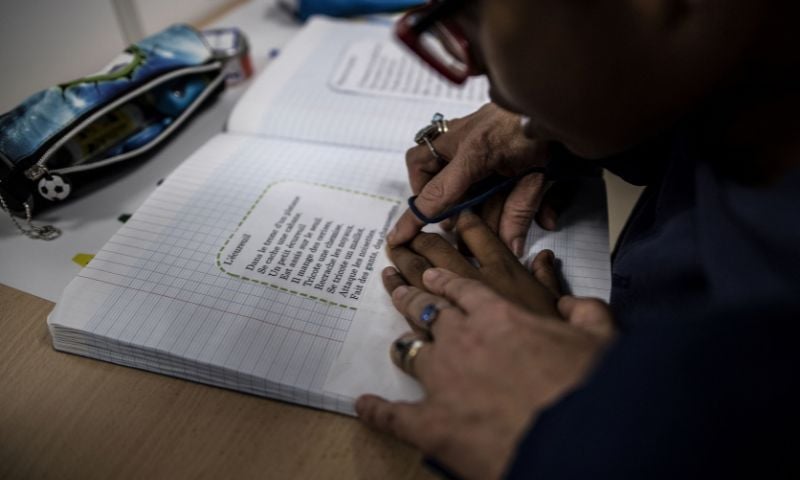
PESHAWAR, Pakistan: For 10-year-old Jawad Ahmed, therapy had begun to bring back a measure of calm to a childhood increasingly marked by anger, hyperactivity and self-harm.
For his father, Javed Ahmed, a salesman at a cloth shop in Jamil Chowk, Peshawar, keeping that fragile progress alive meant stretching a modest income to cover the cost of treatment and the daily journey from the outskirts of Peshawar to the city.
Then, just as Jawad began showing signs of improvement, his father died in a road accident.
With Javed gone, the Rs50,000 a month the family had been spending on his son’s therapy suddenly became an impossible burden — turning a struggle for treatment into a struggle to keep alive the hope that Jawad would not lose the progress he had made.
A costly struggle
Jawad, the second of Javed’s four children, had been experiencing behavioural problems before he was diagnosed with autism spectrum disorder (ASD), a neurodevelopmental condition that affects communication, social interaction and behaviour. The family had noticed changes in Jawad’s behaviour at an early age but delayed seeking treatment because of limited awareness about the condition and financial constraints.
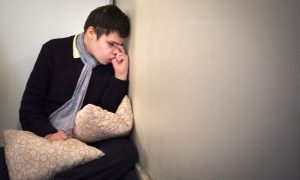
After visiting several public-sector health facilities in search of free therapeutic services, but finding them severely ill-equipped, Javed was left with little choice but to shoulder the financial burden of enrolling his son at a private autism centre.
Peshawar has a public-sector Autism Centre in Hayatabad, while several private facilities also provide therapy. There is no official data on the number of such private centres. Monthly charges vary between institutions, but the cost can be at least Rs20,000, with some centres charging considerably more.
“Raising a child with autism is a very challenging task for families, who often face physical, emotional and financial burdens while arranging treatment.” – Ehtesham Khan, father of an autistic son
“Raising a child with autism is a very challenging task for families, who often face physical, emotional and financial burdens while arranging treatment,” says Ehtesham Khan, a Peshawar-based journalist and father of an autistic son.
Khan says that public-sector hospitals lack adequate facilities for autism therapies, while private centres charge thousands of rupees each month for services including behavioural therapy, speech therapy and physiotherapy, as well as treatment for conditions such as Attention-Deficit/Hyperactivity Disorder (ADHD).
He says these expenses were far beyond the reach of many families, including middle-class families.
The cost of neglect
“There are countless stories that reflect the difficulties faced by many families raising children with autism, particularly those who depend on private facilities for regular therapies,” says Ajwa Hassan, a speech therapist at Peshawar Autism Centre, a private facility providing therapeutic services to children with autism.
“There are countless stories that reflect the difficulties faced by many families raising children with autism, particularly those who depend on private facilities for regular therapies.” – Ajwa Hassan, speech therapist
Hassan says that around 50 children had previously received treatment at the centre on a donation basis, but due to a shortage of funds, the facility is now operating on a shoestring budget and can provide such support to only about 10 children.
Autism is a complex neuro-developmental disorder that is usually detected in children between 18 months and three years of age. Early intervention can significantly improve outcomes for children with autism, she says.
Ajwa Hassan adds that while there is no reliable national data on the prevalence of autism in Pakistan, based on her work as a therapist, she has observed an increase in the number of children seeking services in recent years. She also says that many parents remain in the dark regarding the signs of autism.
A 2022 study published in the International Journal of Surgery: Global Health reported an estimated global prevalence of ASD of 0.6 per cent and 0.4 per cent in Asia.
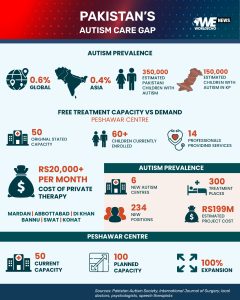
The Pakistan Autism Society estimated in 2020 that around 350,000 children in the country were living with autism. However, there is currently no official government estimate of the number of children with autism in Pakistan.
There has also never been a comprehensive government-led national survey or assessment of autism prevalence in the country. The Pakistan Bureau of Statistics does not collect specific national data on autism or developmental disabilities, and the Ministry of National Health Services, Regulations and Coordination has not estimated the number of children requiring autism-related services.
The absence of reliable national data makes it difficult to determine the scale of demand for diagnostic and therapeutic services.
In Pakistan, the lack of comprehensive prevalence data remains a major challenge for planning services, while stigma and limited awareness discourage families from seeking professional assessment and support, the 2022 study noted.
There is also no official national figure for the number of children with autism registered with public-sector hospitals or special-education institutions. The centre in Peshawar has around 60 children registered with it, while details from other cities and provinces are not available.
Similar specialised facilities exist in Sindh and Punjab, while a Centre for Excellence for Autism is being established in Islamabad at the Rehabilitation Centre for Children with Developmental Disorders.
The knowledge gap
“In developed countries, reported autism rates are higher than in many Asian countries, partly due to greater public awareness, regular screening, improved diagnostic services, better access to healthcare and more established reporting systems,” observes Laiba Saba, a psychologist who completed an International Behaviour Therapist (IBT) course in Sweden based on Applied Behaviour Analysis (ABA).
“In developed countries, reported autism rates are higher than in many Asian countries, partly due to greater public awareness, regular screening, improved diagnostic services, better access to healthcare and more established reporting systems.” – Laiba Saba, psychologist
Saba says factors associated with autism include a combination of genetic, biological and environmental factors.
She also refers to the term “virtual autism,” which is sometimes used to describe autism-like symptoms associated with excessive screen exposure among children.
Other associated factors include complications at birth or having certain genetic or chromosomal conditions, such as fragile X syndrome or tuberous sclerosis, which can be associated with autism.
There is currently no recognised national university-based training programme specifically for autism therapists, according to Saba. She says psychology graduates can acquire additional training and knowledge before working in autism-related therapies.
Growing demand for services
The growing demand for autism assessment and treatment has also been observed at public-sector hospitals.
Dr Muhammad Qasim Khan, Head of the Paediatrics Department at Mardan Medical Complex (MMC), organised a special awareness workshop at the hospital in September 2026 for faculty members, medical officers, postgraduate trainees and clinical staff to improve their understanding of autism symptoms, diagnosis and treatment.
Dr Khan says some studies estimate that around 150,000 children in Khyber Pakhtunkhwa could be affected by autism, although he believes a fresh province-wide survey is needed to determine the actual number.
The figure is an estimate rather than an official province-wide count, reflecting the broader lack of reliable prevalence data.
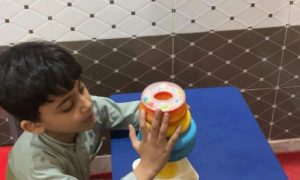
Based on the patients visiting MMC, he says children from Swabi, Bajaur, Malakand, Swat and even Chitral are brought to the hospital for assessment.
There is currently no dedicated autism therapy facility at a public-sector health facility in Mardan, apart from a privately run centre operated by BASES (Behaviour and Special Education Services), Dr Khan says.
He adds that space has been reserved for establishing an autism centre at Benazir Children Hospital in Mardan, but approval and funds are still up in the air.
“Autism remains a neglected health issue and, given the growing number of children affected in the country, it is time to take urgent steps to promote greater awareness, early recognition, timely intervention and community support.” – Dr Muhammad Qasim Khan, pediatrician
“Autism remains a neglected health issue and, given the growing number of children affected in the country, it is time to take urgent steps to promote greater awareness, early recognition, timely intervention and community support,” Dr Khan stresses.
When specialists are scarce
Another challenge is the shortage of trained specialists.
“There is a severe shortage of certified therapists and specialists in the assessment and treatment of autism, while many private rehabilitation centres also lack adequate facilities,” says Rutaba Arif, a specialist in autism assessment trained in the Autism Diagnostic Observation Schedule, Second Edition (ADOS-2).
There are also no available national statistics on the number of qualified autism therapists, clinical psychologists, speech therapists and occupational therapists practising in Pakistan.
Saba says there is no recognised national standard specifically for the training or certification of autism therapists. She notes that the shortage of ADOS-2 specialists in Khyber Pakhtunkhwa had previously forced many parents to travel at great expense to Islamabad, Rawalpindi and Lahore for autism assessment. The service is now available in Peshawar, where a few more specialists have also started providing assessment services.
Free services remain limited
Rizwan Ahmed, Project Director of the Centre for Excellence for Special Children with Autism in Khyber Pakhtunkhwa, says the facility had been providing rehabilitation services in Peshawar since 2023.
He says that the centre had the capacity to provide therapies to 50 children but had gone the extra mile by enrolling more than 60 children from Peshawar, Charsadda, Swabi and Khyber districts.
Children enrolled at the centre receive free therapies, including Applied Behaviour Analysis, speech therapy, occupational therapy and sensory integration, through a team of around 14 professionals comprising psychologists, speech therapists, occupational therapists and a physiotherapist.
The pressure on existing services has prompted the provincial government to expand autism treatment facilities.
According to the provincial development programme for fiscal year 2026-27, the Khyber Pakhtunkhwa government has approved the establishment of autism centres at six divisional headquarters — Mardan, Abbottabad, Dera Ismail Khan, Bannu, Swat and Kohat — with an estimated cost of Rs199 million. Each centre will have a capacity for 50 children.
The project will create 234 positions, including six diagnostic specialists as well as speech and behavioural therapists and support staff. Rizwan adds that the project would also increase the enrolment capacity of the Peshawar centre from 50 to 100 children.
Despite these planned expansions, the country still lacks a reliable national count of autism cases and a comprehensive assessment of the number of professionals and facilities available to meet the demand.
For families like Jawad’s, however, access to treatment cannot wait for new facilities to become operational. His father had managed to keep his therapy going despite the financial strain. After his death, the family’s struggle is no longer only about paying for treatment; it is about keeping the embers of hope alive.