Key Points
- Saleh Mohammad Registani has returned to Afghanistan after a prolonged absence.
- The senior National Resistance Front commander appeared in a recent video from the Hindu Kush.
- He said resistance against the Taliban continues and other fronts are active across Afghanistan.
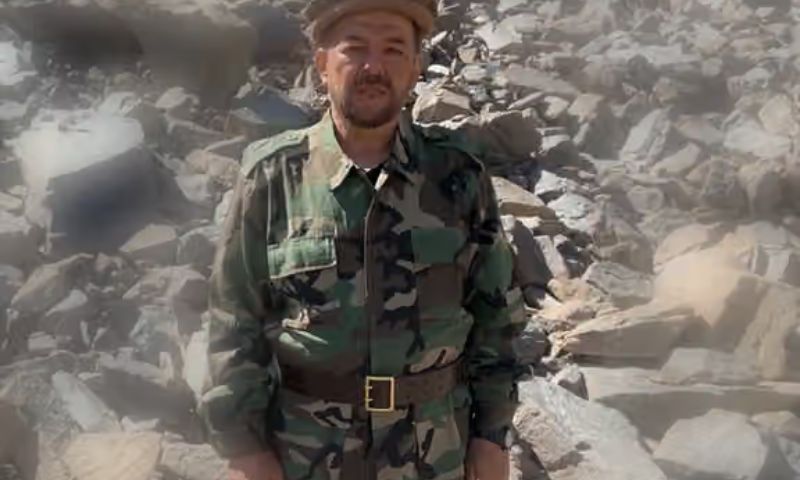
ISLAMABAD: Senior Afghan resistance commander Saleh Mohammad Registani has returned to Afghanistan and said he would continue the fight against the Taliban, according to the National Resistance Front.
The National Resistance Front, an anti-Taliban armed resistance group, released a video showing Registani in a mountainous area. The group confirmed that the video was recent and that Registani had returned to Afghanistan after a prolonged absence.
In the video, Registani said he was again in his homeland, the Hindu Kush, a major mountain range running through Afghanistan and several neighbouring countries. He said the resistance against the Taliban was continuing.
Multiple Afghan resistance fronts
He also said several other resistance fronts had emerged in different parts of Afghanistan and were fighting the Taliban.
The National Resistance Front has operated mainly in northern Afghanistan since the Taliban returned to power in August 2021.
Registani is a senior commander of the National Resistance Front and a veteran of Afghanistan’s earlier conflicts. He fought alongside Ahmad Shah Massoud during the Soviet occupation and later served as a military official and member of Afghanistan’s parliament.
The Taliban captured Kabul in August 2021 after the collapse of the US-backed Afghan government. Taliban forces subsequently took control of Panjshir, the country’s last major area of organised resistance at the time.
After losing territorial control, the National Resistance Front continued armed operations from mountainous areas. Its leaders have maintained that opposition to Taliban rule remains active despite the loss of its previous strongholds.
Registani returns amid continued political and security tensions inside his country and renewed violence along the border. Pakistan has carried out recent strikes against terrorist targets across the border, in retaliation for the terrorist attacks.
The latest announcement does not establish the size or operational capability of the forces Registani says are active. His return, however, publicly places a senior National Resistance Front commander and indicates that the group continues to present armed opposition to Taliban rule.
READ ALSO: Taliban Regime Faces Growing Afghan Resistance Across Five Provinces
The crisis has deep roots in decades of war, political instability and competing regional interests.
After the Soviet withdrawal in 1989, fighting continued among rival factions, eventually enabling the Taliban to seize Kabul in 1996 and establish an Islamic Emirate.
The group was removed from power in 2001 after the US-led military intervention following the September 11 attacks. A new political order was established with international backing, while Taliban forces waged a terror war for two decades.
The US and Taliban signed an agreement in Doha in 2020 that paved the way for the withdrawal of foreign troops.
The Taliban returned to Kabul in August 2021 after the collapse of the internationally backed government and security forces.
Since then, the country has faced political isolation, economic hardship, humanitarian pressures and restrictions on women and girls.
Armed opposition has continued through groups including the National Resistance Front, while the Islamic State Khorasan branch has carried out attacks.
Relations with neighbouring Pakistan have also deteriorated over cross-border terrorism, with Islamabad complaining that the Taliban authorities were allowing Tehrik-i-Taliban Pakistan terrorists to operate from their territory.
The armed opposition to the Taliban regime has also gained renewed visibility, with resistance commanders returning to mountainous areas, local networks reporting attacks on Taliban positions, and opposition groups seeking to coordinate operations against the regime.