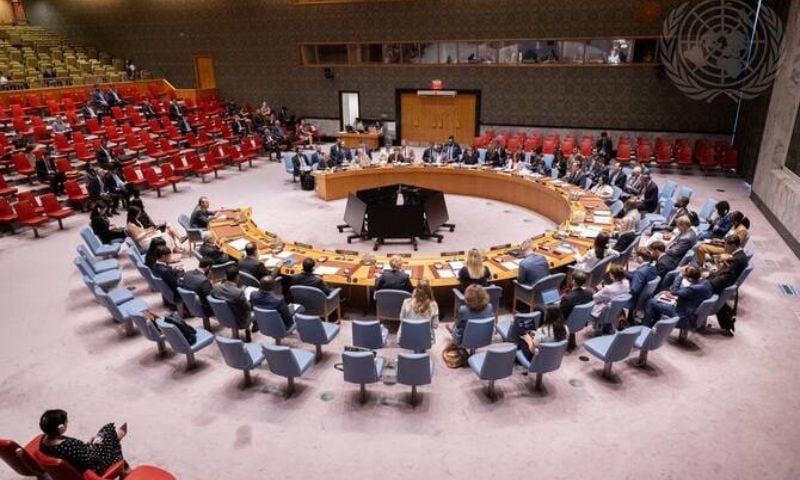
UNITED NATIONS: The United Nations Security Council meeting on Afghanistan has described the Taliban regime as a threat to global peace and security, citing concerns over terrorism, human rights and regional stability.
The key concerns remain deeply interconnected: the presence of terrorist groups operating from Afghan soil, the Taliban regime’s failure to demonstrate verifiable counter-terrorism measures, systematic restrictions on women and girls, exclusionary governance, the detention of foreign nationals for political leverage, and growing regional security risks.
United Nations Assistance Mission in Afghanistan (UNAMA) noted that these challenges persist despite the Taliban’s assertions of improved security and governance.
Taliban a sadist regime
US Ambassador to the United Nations Mike Waltz accused the Taliban of using American and other foreign nationals as bargaining tools and described the group as a “sadist” regime while addressing the UN Security Council on Afghanistan.
Waltz said Washington would not tolerate the detention of US citizens by the Taliban or allow American nationals to be used as leverage in efforts to secure international recognition.
“The United States will not tolerate the Taliban taking American citizens hostage. Period,” Waltz told the council.
“Nor will we be intimidated or coerced by a Taliban that cruelly uses American citizens as bargaining chips or some kind of leverage in its ill-fated pursuit of international legitimacy,” he added.
Terrorism has been at the core of Afghanistan’s problems. This finds its roots in the deep nexus between the Taliban and terrorist groups such as the TTP, BLA and its Majeed Brigade, ISIL-K, ETIM, and their affiliates that are operating with impunity on Afghan soil and the… pic.twitter.com/QgCs0ZDaPC
— Permanent Mission of Pakistan to the UN (@PakistanUN_NY) September 16, 2026
He called on Security Council members to condemn the detention of US citizens and other nationals and demand their release.
“We should also condemn the Taliban’s sheltering, as many of you have said today, of terrorist groups, and the utter destruction of their once great country under their cruelty.”
Waltz said the US State Department had designated Afghanistan under Taliban rule as a “State Sponsor of Wrongful Detention”, accusing the authorities of detaining citizens of multiple nationalities for ransom or political concessions.
He also recounted the case of an Afghan interpreter who, according to Waltz, was threatened by the Taliban after fleeing Afghanistan.
ALSO READ: Taliban is Sadist Regime Terrorising Afghan People and the World: US Envoy Warns UN Security Council
The US envoy said the Taliban had also been responsible for arbitrary arrests, torture, ill-treatment and extrajudicial killings.
Afghanistan a safe haven for terrorist groups
Pakistan’s Permanent Representative Asim Iftikhar Ahmad identified terrorism as a fundamental driver of Afghanistan’s crisis, stating that Afghanistan has again become a safe haven for terrorist groups.
He highlighted the terrorist activities of Tehrik-e-Taliban Pakistan (TTP), Balochistan Liberation Army (BLA), Majeed Brigade, Islamic State Khorasan Province (ISIS-K), and East Turkestan Islamic Movement (ETIM), the Taliban’s links with terrorist organisations, abandoned weapons and drones, and Afghanistan’s illicit economy facilitating terrorism financing and money laundering.
Statement by Ambassador Asim Iftikhar Ahmad,
Permanent Representative of Pakistan to the UN,
At the Meeting of the UN Security Council on the Situation in Afghanistan
(16th September 2026)
*********Thank you Mr. President,
I would like to thank the Officer in Charge and Deputy… pic.twitter.com/W0ki4aXxDa
— Permanent Mission of Pakistan to the UN (@PakistanUN_NY) September 16, 2026
Russian Representative Vassily Nebenzia expressed concern over TTP, ISIS-K and ETIM, including foreign terrorists with combat experience from Syria and Iraq. China’s Sun Lei called for decisive and non-discriminatory action against ISIS-K, Al-Qaeda, ETIM and TTP.
Denmark’s Erik Larsen highlighted the presence of TTP, Al-Qaeda and ISIS-K as a serious concern for Afghanistan, neighbouring countries and international peace and security, calling for concrete and verifiable Taliban action against terrorist groups. Denmark’s statement similarly called for sustained and verifiable action against terrorism.
Taliban discrimination against women
UK Deputy Permanent Representative Kate Foster condemned Taliban discrimination against women and girls and called for meaningful action against terrorist groups.
France’s Jérôme Bonnafont highlighted Islamic State Khorasan Province (ISKP), Al-Qaeda and TTP as major threats and criticised five years of Taliban rule for deepening division and blocking Afghanistan’s development.
Terrorist groups a continuing threat
UNAMA Deputy Special Representative Georgette Gagnon identified terrorist groups as a continuing threat and linked tensions between Pakistan and Afghanistan to their presence. She also stated that major challenges are connected to the Taliban regime’s own policies.
Former Afghan representative Nasir Ahmad Faiq criticised the Taliban for allowing terrorist groups to operate from Afghan territory, citing more than 20 terrorist groups, failure to establish an inclusive political system and accountable institutions, and stressing that territorial control cannot substitute for political legitimacy or public acceptance.
Across the Council, the message was consistent. Afghanistan cannot achieve sustainable stability while terrorist organisations retain operational space, women and girls remain subjected to sweeping restrictions, and political participation remains narrowly concentrated.
Five years of Taliban rule have therefore failed to resolve the core problems confronting Afghanistan and have instead allowed terrorism, repression and regional insecurity to remain deeply interconnected. The session also reinforced that Afghan territory must not be used to threaten neighbouring states, while meaningful counterterrorism action must be concrete, measurable and verifiable.