Key points
- Huawei will launch the 960DT in the first quarter of 2027 and the Ascend 960PR in the third quarter
- Its UnifiedBus technology is designed to connect large numbers of AI chips
- Huawei has shipped more than 1,000 AI computing systems to over 370 customers
ISLAMABAD: China’s Huawei Technologies will launch two new artificial intelligence chips in 2027, advancing its effort to build a large domestic AI computing ecosystem amid continuing restrictions on Chinese access to advanced US semiconductor technology.
Huawei rotating chairman David Wang said the company would launch the 960DT in the first quarter of 2027, followed by the Ascend 960PR in the third quarter. Huawei announced this at its annual technology event in Shanghai on Thursday.
The new processors form part of Huawei’s broader strategy to expand AI computing capacity in China and challenge the dominance of US chipmaker Nvidia in the market for high-performance AI processors.
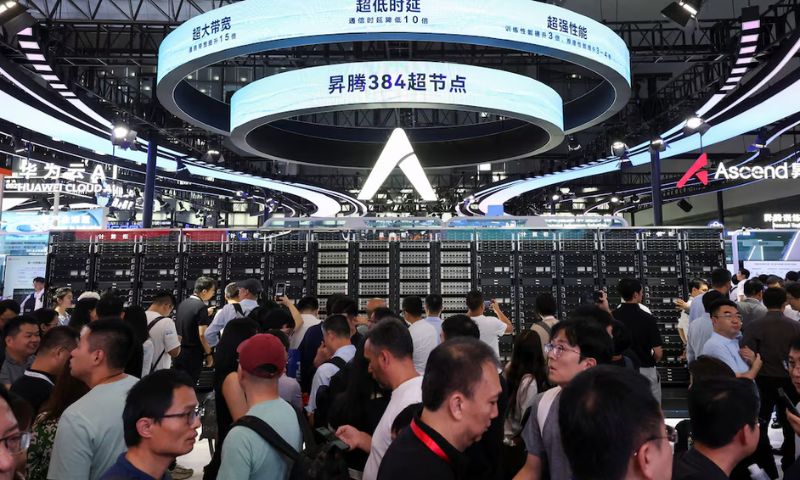
Huawei is also developing UnifiedBus, a technology designed to allow large numbers of AI chips to communicate and operate together as a single computing system. Wang said Huawei had developed 11 semiconductors using the technology and had built large systems capable of linking up to one million AI processors.
Advanced AI models require huge amounts of computing power that need more than a single processor, making the announcement significant. Connecting thousands of chips would enable companies to build computing clusters capable of training and running increasingly large AI models.
Huawei said it had already shipped more than 1,000 AI computing systems, known as supernodes, to more than 370 customers. The systems combine multiple AI processors and are designed to handle large-scale computing workloads.
The company’s chip programme is developing against the backdrop of tightening US restrictions on advanced semiconductors and manufacturing technology available to Chinese companies. Those controls have encouraged China to accelerate the development of domestic alternatives to Nvidia’s AI processors.
Huawei’s progress is also taking place amid supply constraints affecting China’s AI chip industry. Chinese AI chipmakers have raised prices because of a global shortage of high-bandwidth memory, a critical component used in advanced AI processors.
Huawei recently raised the price of its upcoming Ascend 950DT accelerator card to more than 250,000 yuan, or about $37,255.
Huawei’s new roadmap indicates that the company is pursuing not only faster individual processors but also the infrastructure needed to connect them at very large scale.
The company plans to continue an annual generation cycle, with the Ascend 970 scheduled for 2028 and the Ascend 980 for 2029, according to Chinese technology industry reports.
The expansion places Huawei at the centre of China’s effort to develop an alternative AI computing supply chain.
Nvidia remains a major global supplier of AI processors, supported by a large software ecosystem.
Huawei is to expand its position through domestically developed chips, interconnect technology and integrated computing systems.
Huawei’s 2027 launches will therefore provide another measure of China’s ability to expand AI computing capacity under restrictions on access to some leading foreign semiconductor technologies.
China-US tech rivalry
The US-China rivalry over semiconductors has become a central front in the wider contest for technological and economic influence.
READ ALSO: US Partially Revokes Licenses for Exports to China’s Huawei
Washington has tightened controls on exports of advanced chips and semiconductor-making equipment to China. US has used national security concerns as an excuse to limit their potential use in advanced military and artificial intelligence applications.
Beijing has responded by directing greater resources toward domestic chip design, manufacturing and computing infrastructure, while encouraging Chinese companies to reduce dependence on foreign suppliers.
The competition extends beyond individual processors to software, equipment, memory and supply chains.
Both countries are also seeking stronger positions in emerging AI markets, making semiconductor capabilities increasingly important to their broader economic and strategic competition.