Key Points
- Foreign Minister Dar and Grossi discuss the evolving regional situation
- Both agree implementing the Islamabad MoU is the best course to defuse tensions
- IAEA chief offers technical support if needed
- Dar reaffirms Pakistan’s commitment to international law and treaties
ISLAMABAD: Pakistan and the International Atomic Energy Agency have agreed that implementing the Islamabad MoU (Memorandum of Understanding) between the US and Iran is the only way to de-escalate and achieve a peaceful resolution to the conflict.
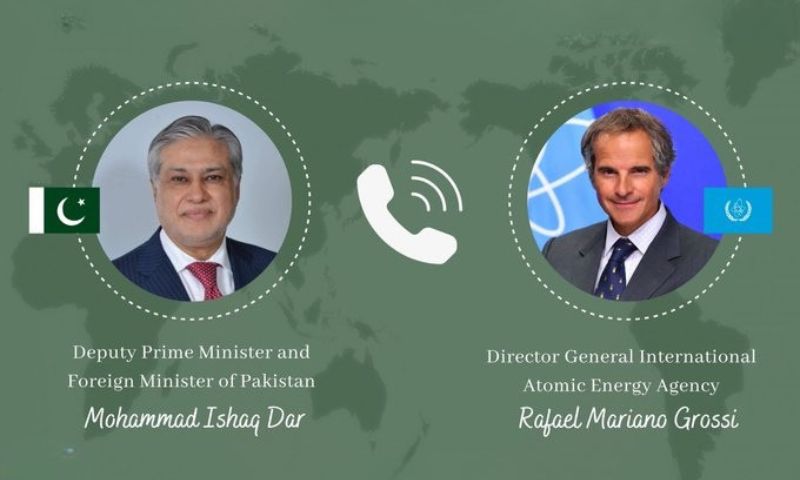
This transpired during a telephonic conversation between Deputy Prime Minister and Foreign Minister Senator Mohammad Ishaq Dar and International Atomic Energy Agency (IAEA) Director General Rafael Grossi late Monday night.
The two sides discussed the evolving regional situation and agreed that implementation of the Islamabad Memorandum of Understanding (MoU) remained the best course of action to defuse tensions.
Deputy Prime Minister/Foreign Minister Senator Mohammad Ishaq Dar @MIshaqDar50 spoke with Ambassador Rafael Grossi, Director General of the IAEA and candidate for UN Secretary-General, late last night.
They discussed the evolving regional situation and agreed that implementation… pic.twitter.com/N1l5KQQgTr
— Ministry of Foreign Affairs – Pakistan (@ForeignOfficePk) September 15, 2026
According to a Pakistan Ministry of Foreign Affairs statement on Tuesday, Grossi offered technical support if needed.
Dar reaffirmed Pakistan’s enduring commitment to advancing the purposes and principles of the United Nations Charter and to respecting international law and treaties.
The deputy prime minister and foreign minister also highlighted the crucial importance of the UN system in realising the global peace and development agenda.
Dar wished Grossi well in his campaign for the office of United Nations secretary-general.
Grossi, who heads the IAEA, is a candidate for the post of UN secretary-general.
Islamabad MoU
The Islamabad MoU is the product of months of Pakistani diplomatic efforts to bring Washington and Tehran towards a negotiated settlement after the US-Iran war erupted on February 28, 2026.
Pakistan, which shares a border with Iran while maintaining close relations with the United States and Gulf states, positioned itself as a mediator rather than a party to the conflict.
READ ALSO: Ishaq Dar Reaffirms Pakistan’s Commitment to Diplomacy Between US and Iran
Islamabad intensified its diplomatic engagement after the war threatened to spread across the region and disrupted energy supplies and shipping through the Strait of Hormuz, one of the world’s most important oil transit routes.
Pakistani officials maintained contact with both Washington and Tehran and worked with the two sides on a framework for ending hostilities.
The efforts culminated in US-Iran talks hosted by Pakistan in Islamabad, bringing senior representatives of the two countries together for direct negotiations — a major diplomatic development after decades of hostility between Washington and Tehran.
Pakistan’s mediation subsequently contributed to the agreement, known as the Islamabad MoU.