
ISLAMABAD: Foreign ministers of eight Muslim nations on Wednesday welcomed the steps taken by the United Kingdom and other Western countries against illegal Israeli settlements in the occupied Palestinian territory.
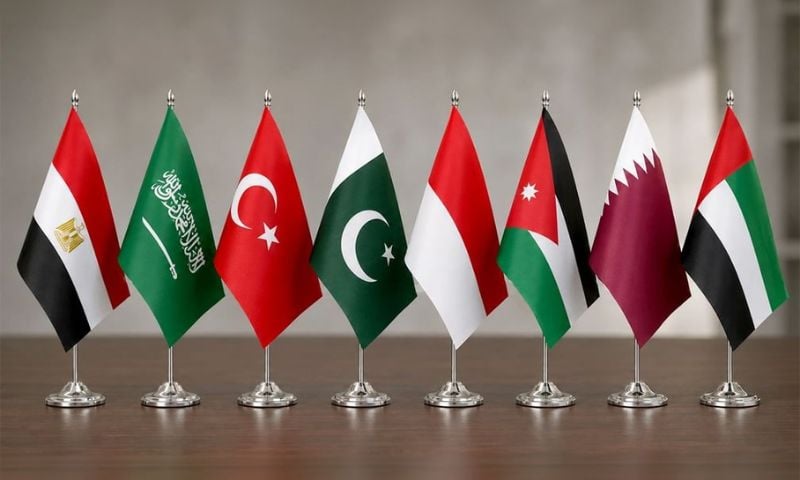
The foreign ministers of Saudi Arabia, Pakistan, Turkiye, Egypt, Indonesia, Jordan, Qatar and the United Arab Emirates hailed the decision by the Western nations to ban the import of goods from illegal Israeli settlements in the Occupied Palestinian Territory and to introduce restrictions on services linked to such settlements, said a joint statement shared by Pakistan’s foreign ministry.
On Tuesday, the UK announced sanctions on illegal Israeli settlements in the occupied West Bank, accusing Israel’s government of turning a blind eye to the “ethnic cleansing” of Palestinians by illegal settlers.
UK Foreign Secretary Ed Miliband said the move marked the “beginning of a new approach” to the Israeli-Palestinian conflict, which “not only calls out injustice and suffering but acts”.
🔈 PR No. 2️⃣4️⃣1️⃣/2️⃣0️⃣2️⃣6️⃣
Joint Statement by the Foreign Ministers of Pakistan, Türkiye, Egypt, Indonesia, Jordan, Qatar, Saudi Arabia and UAE
🔗⬇️ pic.twitter.com/8JpzJeM8L2
— Ministry of Foreign Affairs – Pakistan (@ForeignOfficePk) September 9, 2026
Miliband said the official view of the government was that the Israeli occupation of the West Bank was unlawful because of the “entrenchment of its control, its intention to extend permanent sovereignty, and its expansionist agenda via illegal settlements”.
Muslim foreign ministers, in a joint statement, expressed the hope that this decision will help mobilise the international community to take similar actions in line with international law and hold accountable settlement organisations and individuals engaged in illegal settlement activities.
Two-state solution
The foreign ministers of eight Muslim countries praised the Joint Statement on the Two-State Solution issued by the foreign ministers of Canada, Denmark, Finland, France, Iceland, Ireland, Norway, Poland, Portugal, Spain, Sweden and the United Kingdom, confirming their intention to introduce national and/or support European restrictions on trade in goods with settlements that are illegal under international law, or to actively consider these and other measures in accordance with their respective national procedures.
They encourage the international community to build on these steps and adopt concrete measures to bring an end to activities that support or sustain illegal Israeli settlements in the Occupied Palestinian Territory.
The Ministers consider the announced intentions to be consistent with international law and relevant United Nations resolutions, including United Nations Security Council Resolution 2334 (2016), as well as the Advisory Opinion of the International Court of Justice of 19 July 2024.
This includes the obligation of all States not to recognise as lawful the situation arising from Israel’s unlawful occupation, and not to render aid or assistance in maintaining the situation created by that occupation.
ALSO READ: UK, France and Canada Sanction Israeli Settlements in Occupied West Bank
In this regard, they reiterated their call on Israel to rescind all measures taken in connection with settlement activities, as well as any other measures aimed at altering the geographic and demographic character of the Occupied Palestinian Territory.
Gaza integral part of Occupied Palestinian Territory
The ministers underscored that Gaza is an integral part of the Occupied Palestinian Territory and call for the full and immediate implementation of President Trump’s Comprehensive Plan to End the Gaza Conflict, to ensure security and stability, address the humanitarian situation, facilitate reconstruction and recovery, and lay the foundations for lasting peace.
The ministers noted that the only viable path to achieving a just, lasting, and comprehensive peace is the implementation of the two-State solution, through the realisation of an independent, sovereign, contiguous, and viable Palestinian State, based on the 4 June 1967 lines, with East Jerusalem as its capital, in accordance with international law and the relevant United Nations resolutions.