
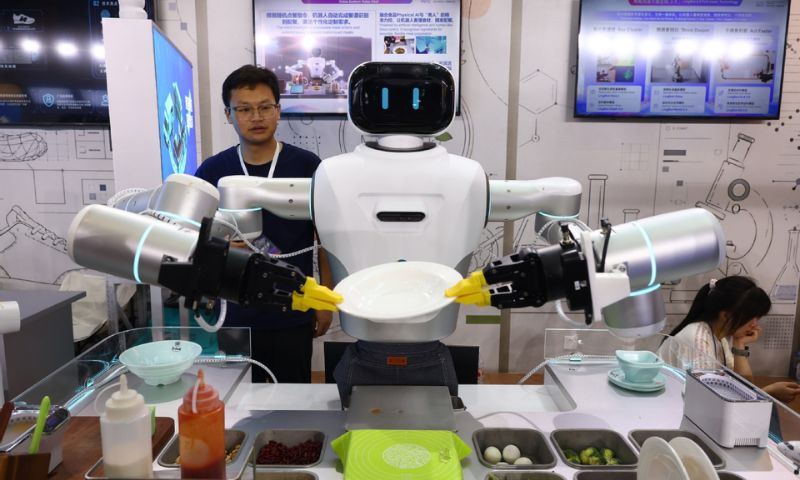
BEIJING: AI-powered “robochefs” are rapidly moving from technology demonstrations into commercial kitchens across China, with cooking robots now operating in hundreds of cities and thousands of restaurants as the country accelerates automation in its food industry.
One Chinese robotics company says its machines are already deployed in more than 300 cities and thousands of stores, underscoring how quickly automated cooking is scaling beyond experimental use.
JUST IN: AI-powered “robochefs” are surging in China, with one company saying its cooking robots are already deployed in more than 300 cities & 4,000 stores. pic.twitter.com/Oo21DCJeFd
— Polymarket (@Polymarket) September 7, 2026
Recent industry reports put some leading systems across nearly 350 Chinese cities and more than 20 overseas markets.
AI Robochefs Learn to Cook Like Humans
Unlike earlier kitchen machines that simply followed fixed programmes, newer systems use artificial intelligence to monitor food while it is cooking.
Xianglu Robotics, for example, has developed an AI cooking model that can assess ingredient temperature, moisture and changes inside the wok, then automatically adjust heat, cooking time, stirring speed and seasoning.
ALSO READ: AI Could Become Existential Threat To Humanity: UN Rights Chief
At a recent demonstration, one robot adapted after extra water was unexpectedly added to mapo tofu and also compensated when partially frozen pork was cooked alongside thawed meat.
Another Chinese cooking robot developed in Changsha can prepare chilli fried pork in just over two minutes.
Its system uses algorithms to control temperature to within one degree Celsius while digitally reproducing recipes created by professional chefs.
China Pushes Kitchen Automation
The technology is increasingly being deployed in restaurant chains, school and workplace canteens, hospitals and central kitchens.
China’s cooking-robot market was projected to surpass 3.7 billion yuan ($540 million) in 2025 and could exceed 11.7 billion yuan by 2030, according to an industry report cited by Chinese state media.
Developers argue robots are not necessarily intended to eliminate chefs. Instead, human chefs can design recipes while machines reproduce them consistently across multiple outlets.
The trend reflects China’s broader robotics boom, as AI-powered machines increasingly move from factories into everyday services — including restaurant kitchens.