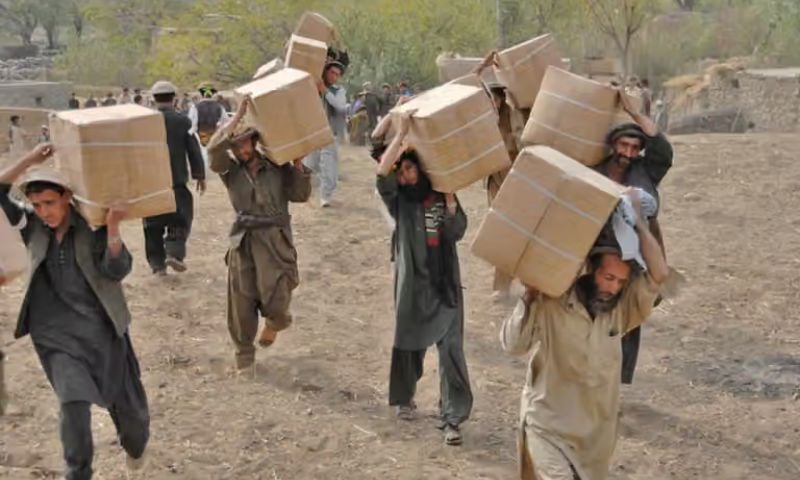
KABUL, Afghanistan: The UN Office for the Coordination of Humanitarian Affairs (OCHA) recorded at least 30 incidents of the Taliban regime’s interference with humanitarian operations in Afghanistan in July, including the detention of two aid workers in Herat, the UN agency said on Thursday.
In a report issued on Thursday, the UN agency said it recorded 16 incidents involving restrictions on humanitarian access in July, 12 cases of violence against staff or interference with aid organisations’ assets and facilities, and two restrictions on aid workers’ movement.
OCHA said most of the incidents of the Taliban regime’s interference in humanitarian operations occurred in southern and western Afghanistan.
Of the 16 cases involving interference in humanitarian activities, four concerned delays or difficulties in signing memorandums of understanding, while three involved interference in the selection of aid recipients.
The report added that the Taliban regime interfered with the implementation of humanitarian programmes on three occasions.
According to the UN agency report, the Taliban regime asked humanitarian organisations for staff lists and other sensitive information in two cases.
OCHA also recorded interference in staff recruitment, requirements for female employees to be accompanied by a mahram, restrictions on the participation of female aid workers and obstruction of access for people seeking assistance.
The United Nations said Taliban regime restrictions involving memorandums of understanding had negatively affected humanitarian activities in Balkh, Faryab, Jowzjan and Kandahar provinces.
The UN agency said discussions with Taliban regime members were continuing in several cases in an effort to resolve the problems.
The UN office also reported 11 gender-based restrictions imposed by the Taliban regime in July. According to OCHA, these measures affected both humanitarian operations and vulnerable communities.
The United Nations said last month that Taliban regime interference and restrictions on humanitarian activities in June had risen by 50 percent compared with the previous month. It said at least 21 humanitarian activities were suspended as a result, disrupting aid delivery in affected areas.
The report said the Taliban regime had initially authorised women in Uruzgan to take part in data collection but withdrew the permission before the process began.
OCHA said Uruzgan was the only province covered by the initiative, and permission for women’s participation was revoked at the last moment.
According to the report, 18 incidents resulted in the temporary suspension of humanitarian programmes, while two led to the temporary closure of aid offices.
OCHA said 11 of the incidents had been resolved by the end of July, while 19 remained unresolved.
Regionally, southern Afghanistan recorded the highest number of incidents, with nine, followed by the west with eight, the east with four and the north with three. The central and north-eastern regions each recorded two incidents.
OCHA said the figures showed continuing challenges to humanitarian access, including Taliban regime interference, restrictions on women’s participation, programme approvals, staff movement and the safety of aid workers.