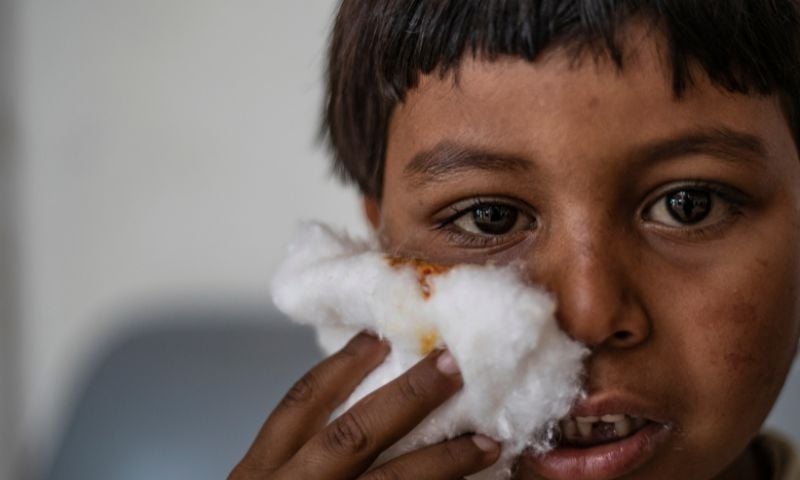



PESHAWAR, Pakistan: For Farhan Mujeeb, a teenage daily wage labourer from Nowshera, the 40-kilometre journey to Peshawar was not just another trip to a hospital.
It was a journey in search of something as basic as a vial of medicine.
Accompanied by his elderly grandmother, Mujeeb arrived at Lady Reading Hospital (LRH) in July, his body marked by multiple lesions caused by cutaneous leishmaniasis (CL) — a parasitic disease that can leave permanent scars and disfigurement.
The medicine he needed, Glucantime, was unavailable in health facilities back home, leaving him with little choice but to travel to Peshawar, where the province’s largest public-sector hospital became his last resort.
But getting the first dose was only the beginning. To complete his treatment, Mujeeb would have to return to a hospital or clinic day after day for nearly a month — a daunting prospect for a boy who depends on daily wages to help feed his family.
A desperate run for medicines
Most patients arriving at LRH show signs of advanced skin infection and require a complete course of meglumine antimoniate injections, administered both intramuscularly and directly into the lesions, Dr Umama tells WE News English.
“Most patients arriving at LRH show signs of advanced skin infection and require a complete course of meglumine antimoniate injections, administered both intramuscularly and directly into the lesions.” – Dr Umama, Lady Reading Hospital, Peshawar
LRH does not receive many patients as the disease is mostly reported in rural areas. However, on average five to six patients arrive daily through referrals, as most of them could not find the injections at health facilities in their hometowns.
But with Glucantime supplies running short at the hospital, patients were often advised to buy Fosine tablets — an oral formulation of miltefosine used to treat leishmaniasis — from the open market, Dr Umama adds.
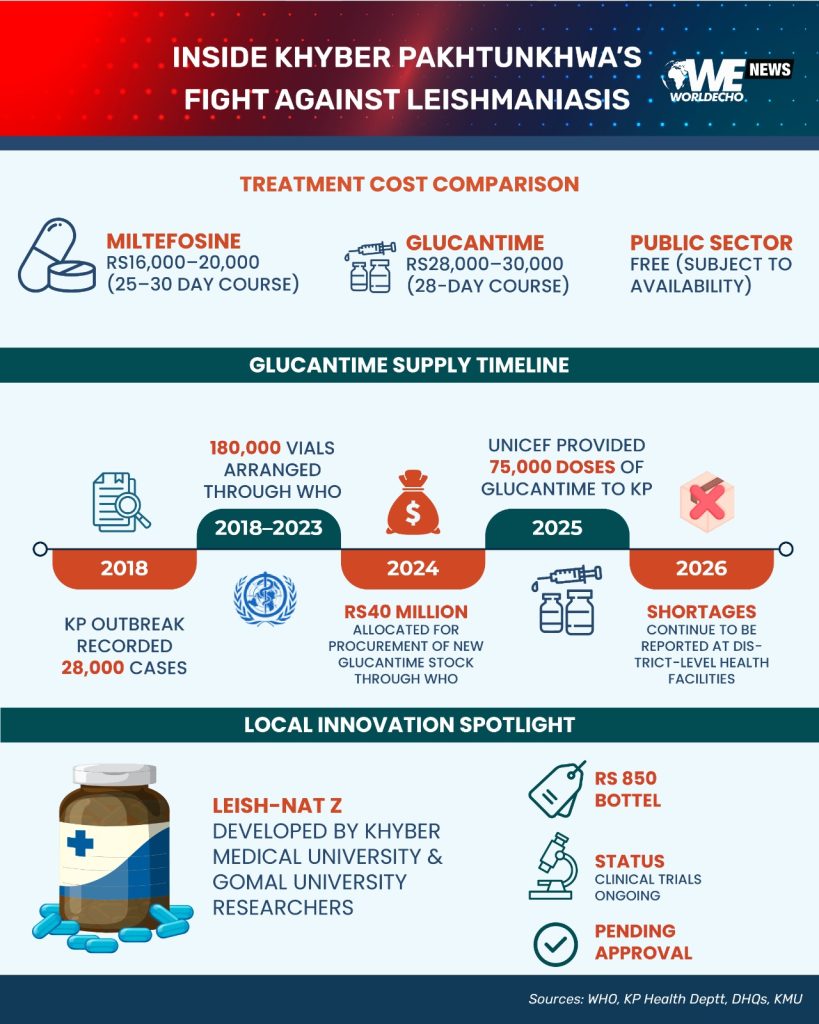
However, the high cost of oral miltefosine, which generally needs to be taken for 25 to 30 days and costs between Rs16,000 and Rs20,000, makes it difficult for economically disadvantaged patients to complete the treatment, she elaborates.
“Such patients were advised to visit Naseerullah Khan Babar Memorial Hospital in Peshawar, where Médecins Sans Frontières (MSF) provides free treatment for cutaneous leishmaniasis.”
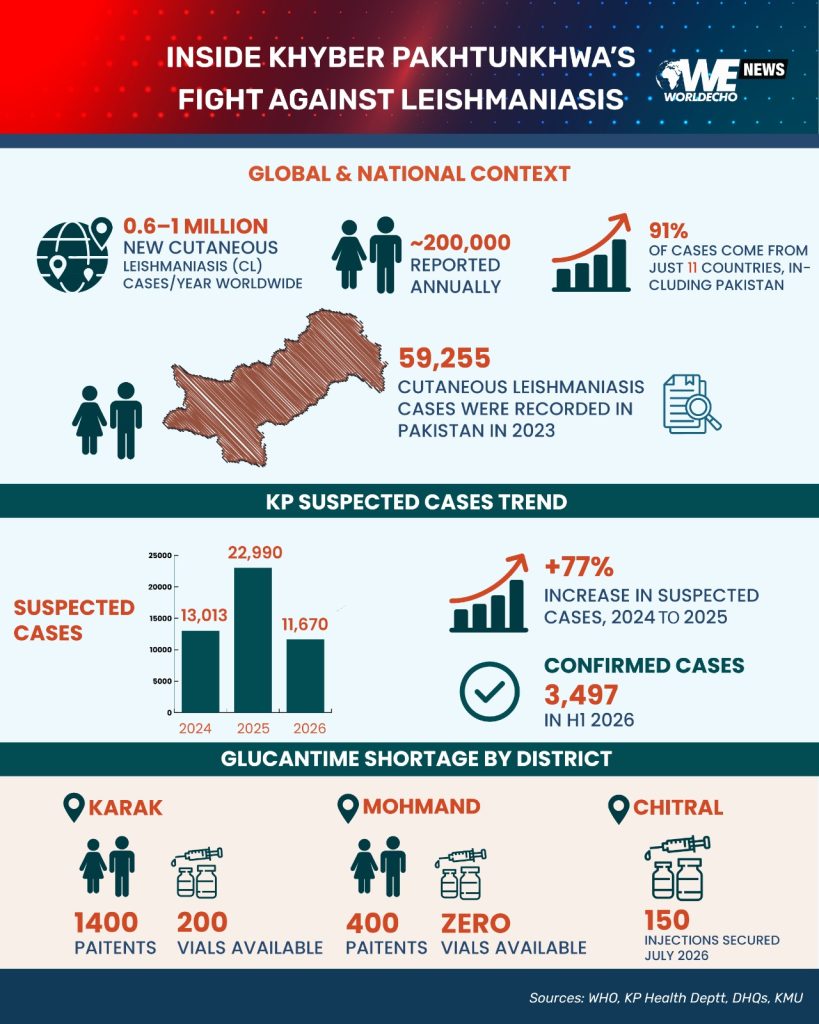
The disease continues to pose a significant public health challenge in Pakistan. The World Health Organization (WHO) recorded 59,255 cases of cutaneous leishmaniasis in the country in 2023.
An estimated 600,000 to one million new CL cases occur globally each year, according to the World Health Organization (WHO), although only around 200,000 cases are reported. In 2023, approximately 91 per cent of reported cases came from just 11 countries, including Pakistan, which recorded an estimated 59,255 cases.
In Khyber Pakhtunkhwa, the Integrated Disease Surveillance and Response System (IDRS) of the Public Health Department has registered 13,013 suspected CL cases in 2024, as many as 22,990 in 2025 and 11,670 up to June 2026, says Dr Muhammad Gul Sartaj, Provincial Surveillance Officer at IDRS.
“CL is a neglected disease and does not receive the attention it requires. It is also communicable, and cases are increasing because of inadequate preventive measures by the Health Department.” – Dr Muhammad Gul Sartaj, IDRS
“CL is a neglected disease and does not receive the attention it requires. It is also communicable, and cases are increasing because of inadequate preventive measures by the Health Department,” he says.
Muhammad Ajmal, an entomologist at the Khyber Pakhtunkhwa Vector Control Programme, says around 3,497 confirmed cases have been registered in the province during the first half of 2026.
Patients bear the brunt
Khaliq Ahmed, Malaria Supervisor in Lower Chitral district, tells WE News English that cutaneous leishmaniasis cases are rising in Chitral, while patients face difficulties accessing treatment because of medicine shortage.
In view of the increasing demand for Glucantime vials, he visited Peshawar in July 2026 and met with concerned officials to seek timely arrangements for ensuring adequate supplies of the medicine at public sector health facilities. But he managed to secure just 150 injections.
In Karak district, around 1,400 CL patients are registered with the District Headquarters Hospital, while the available stock of Glucantime injections stands at only 200 vials, leaving a significant gap between treatment requirements and available supplies, says District Health Officer (DHO) Dr Muhammad Shoaib.
He adds that patients with severe skin infections were prioritised for the available injections, while other patients were advised to arrange the medicine from the open market.
“For the last four months, we’ve not received any supply of Glucantime injections at the District Headquarters Hospital, despite having around 400 registered patients, mostly children, suffering from cutaneous leishmaniasis.” – Fazal Rahim, Leishmaniasis Focal Person, Mohmand
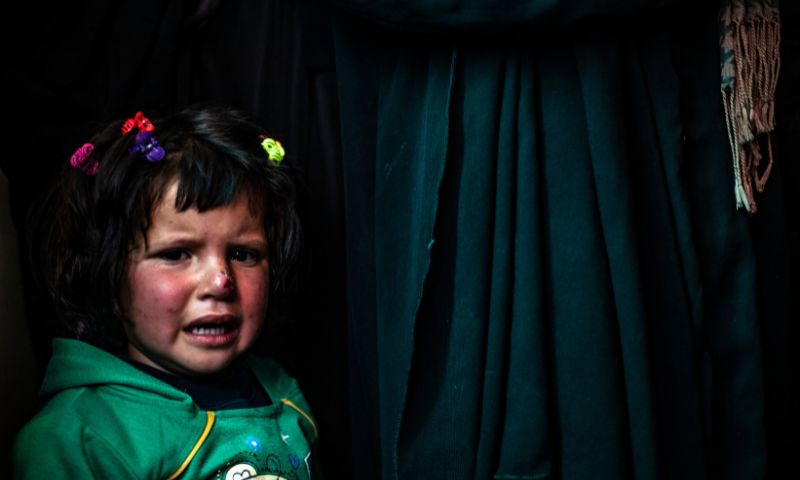
“For the last four months, we’ve not received any supply of Glucantime injections at the District Headquarters Hospital, despite having around 400 registered patients, mostly children, suffering from cutaneous leishmaniasis,” says Fazal Rahim, Leishmaniasis Focal Person for Mohmand tribal district, bordering Peshawar.
In the absence of Glucantime, he explains, patients at the hospital were also being offered cryotherapy, a procedure that uses extreme cold liquid nitrogen to freeze and destroy abnormal or infected tissue.
He says the hospital administration arranges around 10 to 12 litres of liquid nitrogen every month, transported in special containers from Peshawar, for use in treating CL patients. Liquid nitrogen is applied directly to the lesions, usually in five sessions conducted at weekly intervals, to destroy infected tissue.
For patients already struggling to reach treatment centres, the shortage means they must make do with whatever options are available — often at a considerable personal and financial cost.
In response to a 2018 outbreak that saw 28,000 reported cases, the Health Department arranged 180,000 vials through WHO, which were utilised till 2023.
However, in 2024 the Health Department made arrangement to purchase of new stock of Glucantime through the WHO at a cost of Rs40 million. Apart from purchasing vials, the government also received supplies from different international organisations like MSF and UNICEF.
In 2025, UNICEF provided 75,000 doses of Glucantime to Khyber Pakhtunkhwa Health Department.
Despite these interventions, shortages continue to surface, suggesting that the problem is not simply one of procurement but also of maintaining a reliable, uninterrupted supply chain.
A growing resistance threat
The emergence of early signs of drug resistance in Leishmania parasites has added another layer of concern over the effective treatment of cutaneous leishmaniasis, particularly amid shortages of commonly used medicines.
Scientists at the University of Peshawar’s Institute of Zoological Sciences have detected early signs of resistance in Leishmania parasites to antimonial drugs, says Qaiser Jamal, a PhD researcher in leishmaniasis and in charge of the Laboratory of Parasitology and Tropical Diseases.
“Recent research conducted through several MPhil studies, along with an ongoing PhD study, has indicated early signs of resistance in Leishmania to antimonial drugs,” Dr Jamal says.
Dr Fazalur Rehman, Director of the Khyber Pakhtunkhwa Vector Control Programme, attributes the shortage of Glucantime partly to the province’s dependence on international organisations for procurement and supply of the medicine.
Dr Fazal adds that the Khyber Pakhtunkhwa Health Department has recently arranged, through UNICEF, a new supply of meglumine antimoniate to help overcome the shortage.
“The Health Department has also decided to introduce cryotherapy at all District Headquarters Hospitals to reduce dependence on externally supplied Glucantime,” he adds.
A local cure emerges
Amid medicine shortages and concerns over emerging drug resistance, researchers from Khyber Medical University (KMU) and Gomal University are also working on a locally developed treatment that could offer an alternative to conventional antimonial drugs.
Dr Momin Khan — Associate Professor in the Department of Microbiology at Khyber Medical University (KMU) — and Dr Adnan Ameen — Chairman Department of Pharmacognosy at Gomal University, Dera Ismail Khan — have jointly developed an indigenous herbal ointment, Leish-Nat Z, as a potential treatment for cutaneous leishmaniasis.
“After obtaining encouraging results at different stages of testing, we are now conducting clinical trials for approval of our herbal ointment,” says Dr Momin Khan.
Dr Momin says a project for industrial-scale production of `Leish-Nat Z’ had also been submitted to the Higher Education Commission (HEC) of Pakistan.
If approved, he says, the project would facilitate large-scale production and supply of the locally developed ointment, potentially providing an economical and accessible treatment option for leishmaniasis patients.
The price of `Leish-Nat Z’ is estimated to be around Rs850 per bottle and can reportedly be used by more than one patient for a full treatment.
For patients like Mujeeb, however, the need is immediate. Every unavailable vial and every costly trip to another district can mean another delay in treatment — and another step away from recovery.