
Key points:
- Lower bond yields ease pressure on equities
- Japan, South Korea and Hong Kong lead gains
ISLAMABAD: Asian stocks rebounded on Thursday as investors took some comfort from signs that the latest escalation between the United States and Iran may not develop into a prolonged conflict.
Pakistan’s Foreign Office on Wednesday stated that the country was still hopeful of an early peace deal despite the latest exchange of strikes between the US and Iran.
Similar hints from the warring parties also eased pressure partially on stocks and financial markets after a sharp sell-off earlier in the week.
The MSCI Asia-Pacific stocks index excluding Japan gained around 0.5 per cent, with major markets across the region moving higher.
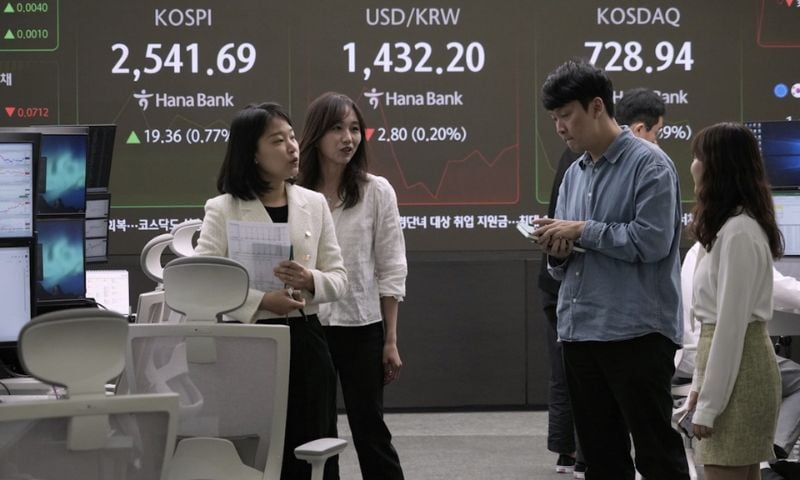
South Korea’s Kospi was among the strongest performers, rising about 1.7 per cent.
Japan’s Nikkei gained around 0.2 per cent, and Hong Kong’s Hang Seng advanced about 0.7 per cent.
Japan’s broader Topix index rose around 0.5 per cent.
Australian stocks were little changed. Markets in Shanghai, Singapore, Taipei and Jakarta also moved higher, according to market reports.
The recovery followed gains on Wall Street on Wednesday, where the S&P 500, Dow Jones Industrial Average and Nasdaq Composite all advanced about 0.5 per cent or more.
Technology stocks provided support to US equities, helping improve sentiment across Asian markets.
Investors were also encouraged by a retreat in government bond yields after a sharp rise in recent sessions.
READ ALSO: Asian Stocks Tumble As US-Iran Fighting Lifts Oil
The yield on the benchmark 10-year US Treasury eased to around 4.78 per cent after approaching levels that had raised concerns about tighter financial conditions.
The latest improvement in sentiment came after US President Donald Trump indicated that the current US military campaign against Iran could be relatively short-lived.
The comments helped reduce some of the market’s immediate concern that the conflict could develop into a prolonged confrontation with wider economic consequences.
The geopolitical situation remains uncertain, however, and investors are continuing to monitor developments closely.
Stocks prompt reaction
Markets have reacted promptly to each escalation in the conflict, particularly because of its implications for inflation, interest rates and global economic growth.
The subsequent stabilisation of bond markets has allowed some of those losses to be reversed.
In Japan, the Nikkei was supported by financial and trading companies.
The country’s 10-year government bond yield fell by several basis points, easing pressure generated by the recent global bond sell-off.
The Japanese yen was also in focus after strengthening reasonably against the US dollar.
The currency reached around 157.95 per dollar on Thursday, extending gains triggered partly by expectations that the Bank of Japan could adopt a more hawkish stance on interest rates.
Bank of Japan board member Hajime Takata has called for a flexible approach to rate increases to address inflation, prompting markets to increase expectations of a possible rate hike this month.
A stronger yen could affect Japanese exporters, but its appreciation also reflects changing expectations about monetary policy.
South Korean stocks posted the region’s strongest gains, helped by improvement in risk appetite and strength in technology stocks.
The Kospi’s advance followed a difficult start to the week, when concerns over the US-Iran conflict and rising bond yields weighed heavily on Asian equities.
Hong Kong stocks also recovered, tracking gains on Wall Street and elsewhere in the region.
Investors remained attentive to technology companies and broader growth-sensitive sectors as concerns over borrowing costs eased.
In India, the benchmark Sensex and Nifty opened higher, extending the regional recovery.
The Sensex rose more than 200 points in early trading, while the Nifty moved above 23,950, according to market data.
The market’s attention is now shifting towards US economic data that could determine the Federal Reserve’s next interest-rate decision.
Stock investors are awaiting Friday’s US non-farm payrolls report, one of the most closely watched indicators of the health of the world’s largest economy. The data could significantly influence expectations for the Federal Reserve’s September meeting.