


NEW DELHI, India: Indian Air Force pilot Abhinandan Varthaman, whose MiG-21 fighter jet was shot down during a 2019 aerial engagement with Pakistani fighter jet, has joined Indian regional airline FLY91 as a commercial pilot, raising questions over his suitability for commercial flying.
The Daily Pioneer reported that the pilot is currently training to fly turboprop aircraft for the regional carrier.
The airline confirmed his association but declined to provide further details about his routes or schedule, stating that Abhinandan himself does not wish to share more about his professional or personal journey, a silence that has become his most defining characteristic since the events of 2019.
Abhinandan was commissioned into the Indian Air Force in June 2004. He flew the Su-30MKI before moving to a MiG-21 Bison squadron.
On February 27, 2019, the day after India’s Balakot airstrike, Abhinandan was flying a MiG-21 Bison in an aerial engagement with Pakistani fighter jets when his aircraft was shot down. He ejected and landed on the Pakistani side, where he was captured. He was held for about three days before being released on March 1.
What made Varthaman a household name across India was not his combat prowess, after all, he was shot down and captured, but his composure in videos released by Pakistan during his captivity.
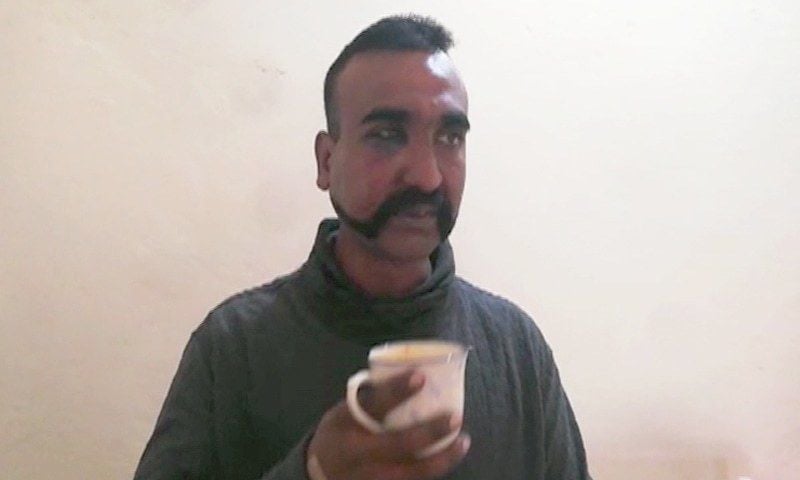
And who could forget his now-famous words? “The tea is fantastic,” he said with a smile while sipping tea in Pakistani custody, a moment that Indians clung to as proof of their hero’s unshakable spirit, never mind that he was a captured pilot being filmed by his captors.
India’s media machinery went into overdrive, turning a captured pilot who lost his aircraft into a national icon. He was awarded the Vir Chakra, India’s third highest wartime gallantry award, and promoted to Group Captain in December 2021. In the seven years since the incident, he has said almost nothing publicly about it.
The ‘hero’ myth unravels
For years, Indian media and Bollywood turned Abhinandan Varthaman into a larger-than-life figure, a symbol of Indian valour and resilience. Yet, the reality remains that he was shot down by Pakistani forces, his aircraft destroyed, and he was captured and held prisoner for three days.
His only claim to fame was not shooting down enemy jets, but simply maintaining his composure while in enemy custody, something any trained soldier is expected to do.
Now, the man who was once projected as India’s greatest living war hero has quietly stepped away from the cockpit of a supersonic fighter jet to fly a turboprop on a sleepy local route. The MiG-21 Bison, a supersonic fighter built for one purpose, interception, has been replaced by the ATR, a turboprop designed to connect small cities that big airlines overlook. FLY91 exists to serve tier-2 and tier-3 towns, the places where nothing dramatic ever happens.
The ironic twist
There is something profoundly amusing about India’s national hero trading sonic booms for seatbelt announcements and dogfights for boarding calls. The man who once faced Pakistani jets is now facing the far greater challenge of convincing passengers to fasten their seatbelts and stow their tray tables. Perhaps the most ironic twist is that after being shot down by Pakistan, he has now chosen a career where the only thing he will be intercepting is a cup of coffee from the cabin crew.
Indian media, which once splashed his face across every front page and produced hagiographic films celebrating his “bravery,” now seems strangely silent about this career transition. Perhaps they realise that a commercial pilot flying between Goa and Hyderabad does not quite fit the heroic narrative they so painstakingly crafted.
After all, how do you glorify a war hero whose greatest achievement now will be ensuring passengers receive their in-flight snacks on time?
The skies over Goa and Hyderabad will never know what hit them, or rather, what didn’t. At some point in the next few months, on a flight between two ordinary Indian cities, a plane load of passengers will board an ATR with no idea who is in the cockpit. And if Varthaman has his way, he would clearly prefer to keep it that way, perhaps the only thing he and Pakistan can finally agree on.
So, here’s to India’s greatest fighter pilot, the man who conquered the skies, defeated Pakistani jets in the realm of Indian media, and has now found his true calling: flying between tier-2 cities at 500 km/h, where the only enemy he faces is bad weather and delayed departures. Truly, a hero’s journey for the ages.