
Key Points
- Major rivers are currently flowing at normal levels.
- Heavy rain is forecast across several upper river catchments.
- Islamabad and Azad Kashmir face isolated heavy rainfall over 36 hours.
- Jhelum and Chenab flows may moderately increase within 48 hours.
- Upper Punjab and Khyber Pakhtunkhwa face widespread rainfall through September 5.
- Major rivers and nullahs may rise moderately.
- Tarbela reservoir is at maximum conservation level.
ISLAMABAD: Pakistan’s flood risk is feared to increase over the next few days as widespread rainfall is forecast across the upper catchments of the country’s major rivers, with the Indus River at Kalabagh and Chashma expected to reach medium flood levels within the next 24 to 36 hours.
The Flood Forecasting Division (FFD) of the Pakistan Meteorological Department (PMD) stated on Monday in its daily flood bulletin that all major rivers were currently flowing at normal levels.
However, the department forecast a significant increase in river flows following expected rainfall over the upper catchments.
The immediate concern is the Indus, where water levels at Kalabagh and Chashma are expected to attain the medium flood level within the next 24 to 36 hours. The FFD also forecasts moderate increases in the flows of the Jhelum and Chenab rivers and their associated tributaries over the next 48 hours.
Rainfall threat
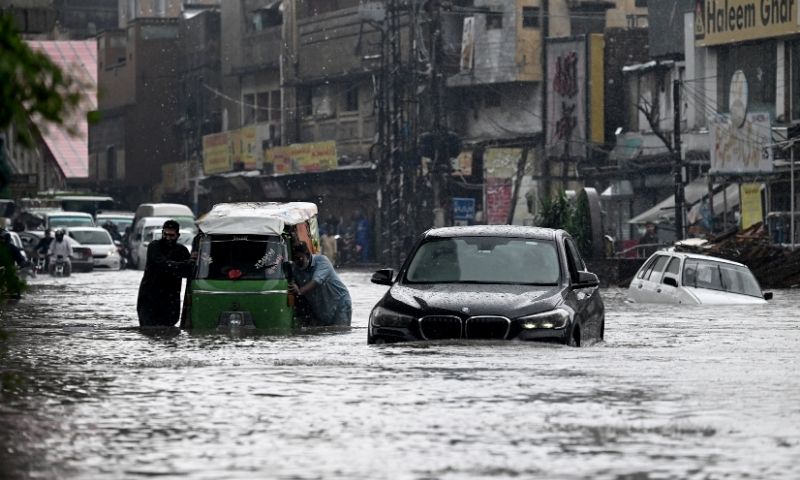
The weather outlook indicates scattered to widespread rain, wind and thunderstorms over the upper catchments of all major rivers, Islamabad, Azad Jammu and Kashmir, upper Punjab and upper Khyber Pakhtunkhwa during the next 36 hours.
The FFD warned that isolated heavy rainfall could occur over Islamabad and Azad Jammu and Kashmir as well as the upper catchments of the Indus, Jhelum and Chenab rivers.
During the next 24 hours, widespread rain and thunderstorms are expected over the upper catchments of the Jhelum, Chenab, Ravi and Sutlej rivers, besides Islamabad and Azad Jammu and Kashmir.
In Khyber Pakhtunkhwa, Abbottabad, Buner, Charsadda, Haripur, Kohat, Malakand, Mansehra, Mardan, Nowshera, Shangla, Swabi, Swat and Tor Ghar are expected to receive downpours and thunderstorms.
Several Punjab districts are also expected to receive widespread rain and thunderstorms, including Attock, Chakwal, Gujrat, Jhelum, Narowal, Rawalpindi and Sialkot.
Meanwhile, scattered rainfall is expected over the upper Indus catchment and a broader belt of Khyber Pakhtunkhwa, including Bajaur, Bannu, Batagram, Hangu, Karak, Khyber, Kohistan, Kurram, Lakki Marwat, Mohmand, North Waziristan, Orakzai, Peshawar and Dir.

River levels
Despite the forecast increase, the latest measurements show considerable room below major flood thresholds at most gauging stations.
At Kalabagh, the Indus was recorded at 255,100 cusecs against a medium-flood threshold of 375,000 cusecs. Kalabagh is currently in the low-to-medium range and is expected to move into medium-flood conditions as flows increase.
At Chashma, the flow stood at 241,700 cusecs against a medium-flood threshold of 375,000 cusecs. Taunsa was at 175,500 cusecs, below its low-flood threshold of 250,000 cusecs.
Further downstream, Guddu, Sukkur and Kotri were also below their respective low-flood thresholds, with flows recorded at 189,800, 169,000 and 177,900 cusecs respectively.
The Jhelum and Chenab stations were likewise mostly below low-flood thresholds, although the FFD expects their flows to rise moderately during the next 48 hours.
Reservoir status
The bulletin also highlights the current position of the country’s major reservoirs. Tarbela is at its Maximum Conservation Level, while Mangla is approximately 77 per cent filled.
The reservoir figures show Tarbela holding 5.580 million acre-feet of live storage against 6.511 MAF, while Mangla holds 5.582 MAF against 7.387 MAF of live storage.
Heavy rain recorded
The forecast follows significant rainfall already recorded in parts of the upper Indus catchment.
During the preceding 24 hours, Islamabad recorded some of the heaviest rainfall, including 230mm at New Kattarian, 206mm at Chaklala Airbase, 200mm at Shamsabad, 182mm at Golra and 159mm at PMD Headquarters.
Other notable rainfall included 53mm at Tarbela, 44mm at Takht Bhai, 35mm at Mardan, 31mm at Oghi and 24mm at Dir.
In the Jhelum catchment, Balakot received 22mm and Palandri 16mm, while in the Chenab catchment, Gujrat recorded 25mm, Sialkot Cantt 21mm and Gujranwala 16mm.

Nationwide picture
The current situation therefore presents a rising but geographically concentrated flood risk, rather than widespread flooding across the country at present.
The FFD reports all major rivers at normal levels, but forecasts increasing flows as rainfall continues over their upper catchments. The most immediate river concern is the Indus at Kalabagh and Chashma, while the Jhelum, Chenab, Ravi and Sutlej catchments face continuing rainfall during the next two days.
Most remaining parts of the country are expected to experience mainly hot and humid weather.
With rainfall forecast across upper Punjab, upper Khyber Pakhtunkhwa, Azad Jammu and Kashmir and the upper catchments of the major rivers through September 5, the FFD’s outlook points to a period of moderately rising river and nullah flows, requiring continued monitoring by relevant authorities.