NEW DELHI: Journalists covering student protests in India faced internet shutdowns, communication jamming, real-time facial recognition surveillance and the removal of news content from social media, Reporters Without Borders (RSF) said, warning that the restrictions were undermining press freedom.
The Paris-based press freedom organisation said in a statement that several measures used during protests in New Delhi in July had continued to affect journalists even after the demonstrations ended.
The organisation called on Indian authorities to stop practices that restrict access to information and interfere with the free practice of journalism.
#India: Journalists covering the student protests in July were subjected to facial recognition surveillance, internet shutdowns, signal jamming and content removal. RSF condemns these restrictions and calls on the Indian authorities to put an end to them. https://t.co/2T2dQVAIUx pic.twitter.com/F8pprXxQfd
— RSF (@RSF_inter) August 27, 2026
RSF said a video posted on July 20 by freelance journalist Sadhika Tiwari showing a female student in tears remained inaccessible on her Instagram account.
Tiwari said Meta had notified her that access to the post had been restricted in India following a government or law enforcement notice under the Information Technology Act.
Worrying form of censorship in India
RSF said Tiwari was not the only journalist affected. It said content had been removed or blocked through notices issued under Sections 79(3)(b) and 69A of India’s Information Technology Act, describing the practice as a worrying form of censorship.
The organisation said an interview by freelance journalist Yaqut Ali with a former spokesperson for the “Cockroach Party” had been blocked three times and remained inaccessible.
Two videos uploaded by independent outlet Maktoob Media on July 21 and 23 were also blocked, while Peek TV co-founder Priyanshi Sharma said an interview with a protester who claimed to have received threats was removed from the outlet’s Instagram page on August 4.
“The actions of the Indian authorities during the recent student protests … demonstrate how their tactics are designed to stifle media coverage and can be combined to suppress journalism,” said Célia Mercier, head of RSF’s South Asia Desk.
She said live surveillance, internet shutdowns and the removal of journalistic content had created a chain of restrictions intended to intimidate journalists and prevent information from being disseminated.
Internet shutdown and surveillance
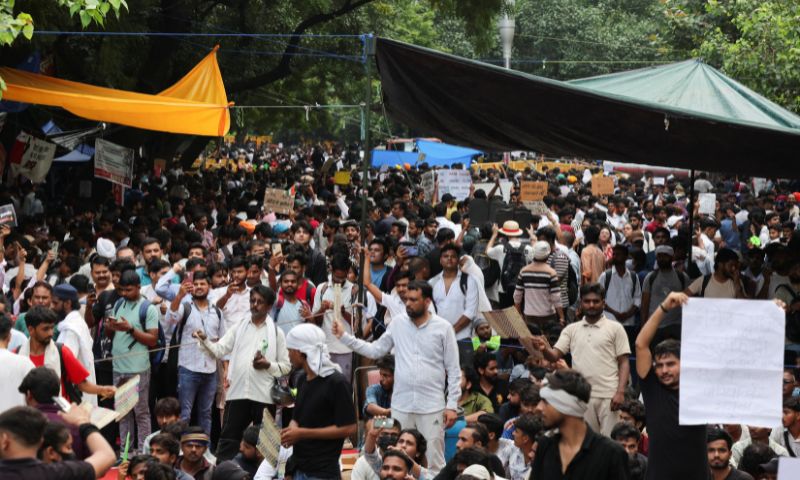
The protests were widely covered through social media, but mobile internet was suspended within a radius of one to three miles around the protest site a few hours after a march began in New Delhi on July 20, according to RSF.
A government order published on July 23 said the suspension was imposed in the interests of public order and to prevent incitement to commit an offence.
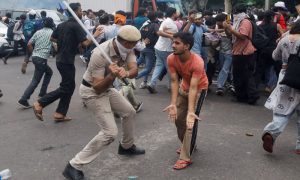
Journalists at the scene reported delays in uploading files and difficulties broadcasting live, limiting their ability to transmit footage of the police intervention as it happened. RSF said journalists also reported the use of signal-jamming equipment around the protest site.
The organisation also cited a July 29 article by the Software Freedom Law Center, which reported the use of CCTV cameras equipped with artificial intelligence and facial recognition technology, as well as handheld cameras and mobile surveillance vans.
A Reuters journalist reportedly saw his own face appear inside a surveillance vehicle, framed by a green rectangle. A police officer told the journalist that the system was being used to identify people and count protesters.
RSF said such surveillance raised concerns about the protection of journalistic sources because it could potentially identify reporters, track their movements and reveal the people they were interviewing.
India ranked 157th out of 180 countries and territories in RSF’s 2026 World Press Freedom Index, according to the organisation.
India’s student protests
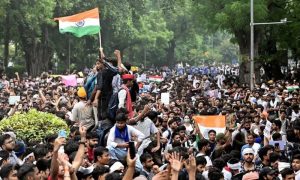
The student demonstrations were organised by the Cockroach Janta Party (CJP), and drew large numbers of students to New Delhi in July. The protesters were demanding the resignation of the education minister following a scandal involving leaked examination papers. The minister resigned on July 25.
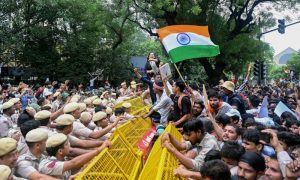
The youth-led movement originated as an online joke following remarks by India’s Supreme Court Chief Justice comparing unemployed young people to “cockroaches”.
Media outlets close to the ruling Bharatiya Janata Party (BJP) subsequently sought to discredit the protest movement.