ISLAMABAD: Pakistan on Thursday said that Chief of Defence Forces and Chief of Army Staff Field Marshal Syed Asim Munir’s recent visit to Iran was part of Islamabad’s continuing diplomatic efforts to facilitate an end to the US-Iran conflict and renewed efforts towards reopening the strategic Strait of Hormuz.
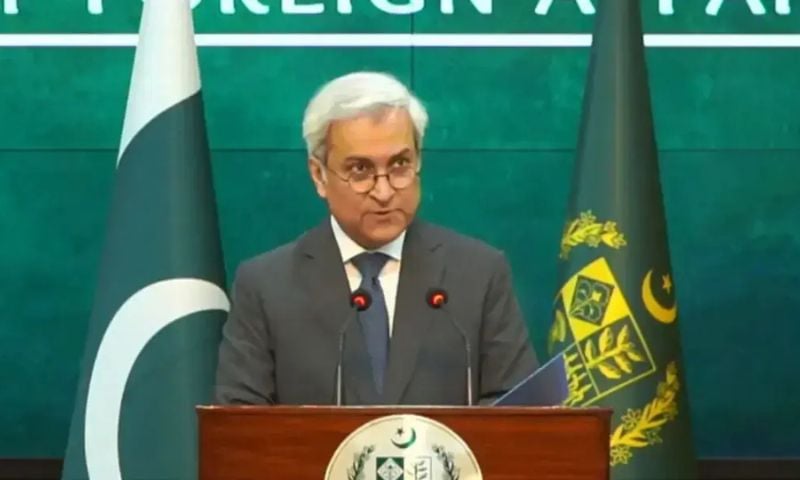
Addressing a weekly press briefing in Islamabad, Foreign Office Spokesperson Tahir Andrabi said Pakistan remains engaged, alongside other brotherly states, in sincere efforts to resolve the crisis in the Gulf and the Middle East with respect to the standoff between Iran and the United States.
The South Asian nation has emerged as a key mediator between Tehran and Washington in efforts to end the conflict that began after US and Israeli strikes on Iran on February 28.
Islamabad brokered a two-week ceasefire between the two sides on April 8, temporarily halting six weeks of intense fighting. Since then, the country has continued to facilitate communication by relaying messages between Washington and Tehran in a bid to support diplomatic efforts and prevent further escalation.
Tahir Andarabi noted that the discussions held during CDF Munir’s visit to Tehran “focused on regional de-escalation, breaking the military stalemate and exploring a negotiated settlement to restore peace and stability”.
He added that the visit underscored Islamabad’s sincere and constructive role in bridging differences between Washington and Tehran. The Iranian leadership appreciated Pakistan’s efforts towards dialogue, de-escalation, and the peaceful resolution of the conflict.
“I will also highlight that claims by certain quarters that the COAS and CDF visited Iran as envoy of President Trump or the US are misleading and factually incorrect, as his visit was undertaken purely in the context and backdrop of Pakistan’s role as a mediator,” he said.
Makkah Joint Defence Agreement is a defensive framework
To a question he said the Makkah Joint Defence Agreement is a defensive framework aimed at safeguarding peace and promoting regional stability.
Pakistan, Saudi Arabia and Turkiye signed a joint defence pact on August 7, 2026, establishing a collective security framework under which an armed attack against any one member is considered an attack against all three.
Weekly Press Briefing by the Spokesperson @TahirAndrabi
On Other Countries Joining Makkah Joint Defence Agreement pic.twitter.com/MZ5KMxFipT
— Ministry of Foreign Affairs – Pakistan (@ForeignOfficePk) August 27, 2026
“As an evolving security architecture, the MJDA remains open to countries that share its commitments to collective obligations and common security interests. Any formal request will be considered in consultation with our partners in Riyadh and Ankara,” the spokesperson added.
Pakistan ready for state-level talks
Responding to a question, the Foreign Office Spokesperson said Pakistan notes the proposal by the interim Afghan government’s Interior Minister for a dedicated bilateral mechanism to address contentious issues. He said Islamabad remains open to state-level dialogue.
However, the sustainability of any mechanism will depend on tangible actions, rather than mere assurances.
Andrabi further said that Islamabad wanted effective border management and verifiable counterterrorism measures from Kabul.
Weekly Press Briefing by the Spokesperson @TahirAndrabi
On Afghanistan – related Query pic.twitter.com/2UgGYVNAJg
— Ministry of Foreign Affairs – Pakistan (@ForeignOfficePk) August 27, 2026
The Foreign Office also called on the Afghan interim government to fulfil its international obligations, including those under the Doha framework.
He further said Afghanistan must prevent India-backed banned Tehreek-e-Taliban Pakistan (TTP) and Balochistan Liberation Army (BLA) from using its territory.
ALSO READ: ‘Taliban Must Walk the Talk’: Pakistan Reacts to Taliban Interior Minister’s Talks Offer
“Afghan soil must be prevented from being used by anti-Pakistan elements, including the TTP and BLA,” the spokesperson said.
He said Islamabad remains ready for institutional coordination, provided it results in tangible and verifiable counter-terrorism measures and effective border management.
Pakistan set to assume SCO Chairmanship
The spokesperson said Pakistan is set to assume the Chairmanship of the Shanghai Cooperation Organization (SCO) for a one-year term following the SCO Council of Heads of State Summit, scheduled to be held in Bishkek from 31 August to 1 September 2026.
In this connection, Prime Minister Muhammad Shehbaz Sharif will be visiting Bishkek to participate in the SCO Council of Heads of State Summit and hold bilateral engagements with the leadership of the Kyrgyz Republic, he noted.
The hallmark of Pakistan’s SCO Chairmanship will be the SCO Council of Heads of State Summit to be hosted by Pakistan in Islamabad in 2027.
Indian minister’s claims rejected
To another question, the Spokesperson categorically rejected the self-contradictory and retrospective claims made by the former Indian Chief of Defence Staff regarding Kirana Hills, near Sargodha.
He said during Marka-e-Haq, Pakistan’s layered air defence network effectively thwarted India’s military objectives, while Pakistan’s subsequent response under Operation Bunyan-um-Marsoos demonstrated the ability to impose cost across the conflict spectrum.
Weekly Press Briefing by the Spokesperson @TahirAndrabi
On India – related Queries pic.twitter.com/WqKFWUmv60
— Ministry of Foreign Affairs – Pakistan (@ForeignOfficePk) August 27, 2026
Tahir Andrabi said no strategic asset or sensitive infrastructure was compromised in Pakistan.
He said attempts to retrospectively recast these events through selective narrative or dramatised production cannot alter the verifiable operational record of May last year. He said history is established by facts and evidence, not by Bollywood-style retrospective claims.
Israeli settlements in West Bank
The Foreign Office spokesperson added that Israeli statement activity is contradictory to and in violation of international law.
“Israel has no right to build settlements in the West Bank. These settlements are deemed illegal, not just by the UN General Assembly, but also by the UN Security Council, through numerous resolutions,” he said.
Andarbi added that this settlement activity is against international law, and we have totally condemned it. So, any claim that Israel has a right to continue with these settlement activities in the West Bank is fundamentally flawed and contrary to international law.