Key points
- Trump says Mojtaba Khamenei is still alive
- Trump says US victory in Iran war is near
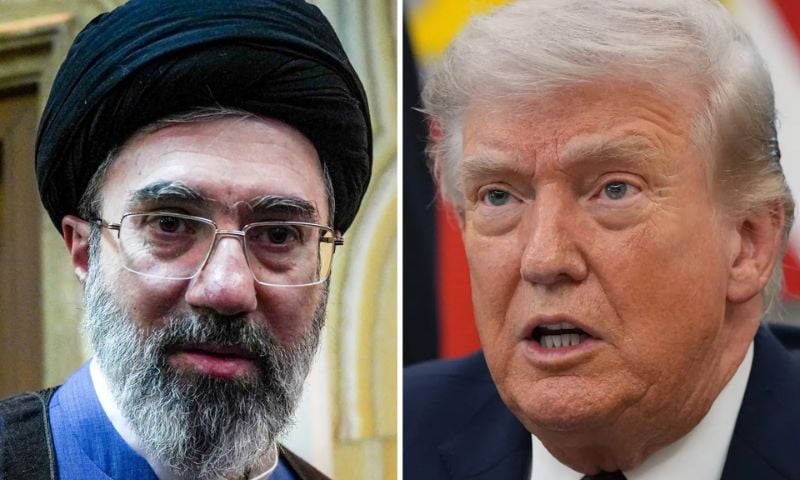
ISLAMABAD: US President Donald Trump said Wednesday that Iranian Supreme Leader Mojtaba Khamenei is alive but “very seriously wounded”, adding that the war with Iran could end soon.
Speaking by phone with conservative radio host Glenn Beck, Trump said Khamenei had suffered severe injuries to the left side of his body, including his arm and leg.
“I don’t think he’s dead. He was very seriously wounded,” Trump said.
Trump’s assessment has not been independently verified.
Khamenei has not made a public appearance since succeeding his father, Ayatollah Ali Khamenei, after the latter was killed in US-Israeli strikes in February.
His prolonged absence has fuelled speculation about his health and ability to govern.
Iranian media has released previously unseen footage of Khamenei earlier this month, but the footage was undated and could not independently establish when or where it was recorded.
Trump said Iran would be “putting on a pretty good show” if Khamenei were dead because Iranian officials continued to say they consult him on major decisions.
Trump predicts war will end soon
Trump said US military and economic pressure on Iran was producing results and that Washington was approaching a “very big victory”.
He said preventing Iran from acquiring a nuclear weapon remained the principal US objective.
The conflict has evolved into a prolonged confrontation involving attacks on military and energy infrastructure, sanctions and disruption to shipping through the Strait of Hormuz.
READ ALSO: Trump Says Iran Wants Deal but Rejects Terms He Deems Necessary
Despite Trump’s prediction of a near-term end to the conflict, the war remains unresolved, with diplomatic efforts to reach an agreement still facing major obstacles.
Hormuz remains key issue
Trump also claimed that the US Navy had full control of the Strait of Hormuz and that mines had been removed from the waterway.
He said 22 ships had transited the strait safely overnight and that 10 million barrels of oil had passed through on Tuesday.
Iran has disputed Washington’s claims of full control. Iranian officials have said the waterway will not be fully reopened until the United States accepts Tehran’s conditions.
Shipping data indicate that traffic remains far below pre-war levels.
Reuters reported that oil shipments through the strait were running at about 5 million barrels per day on Monday, compared with more than 20 million barrels per day before the conflict.
Iran and Oman have meanwhile been discussing a temporary shipping corridor through the strait and cooperation on mine clearance, signalling that the waterway remains a central issue in efforts to ease the conflict.
The Strait of Hormuz normally carries roughly one-fifth of global oil consumption, making any prolonged disruption a major risk for energy markets and the global economy.
The US-Israel war against Iran began on the last day of February with strikes targeting Iran’s nuclear facilities, military leadership and missile capabilities. Iran says its top leadership, including the supreme leader Ayatollah Ali Khamenei, was martyred in the very first strike by the US and Israel.
Iran retaliated with missile and drone attacks against Israel and US interests across the region, broadening the conflict beyond the two countries.
The fighting has also severely disrupted energy markets and shipping through the Strait of Hormuz, a vital route for global oil supplies.
Washington has imposed sweeping sanctions and sought to pressure Tehran over its nuclear programme and regional activities. I
Iran has rejected US demands and warned that any further escalation could threaten energy supplies and commercial shipping across the region.