


WASHINGTON: US Secretary of State Marco Rubio has told several foreign ministers from allied countries in recent days that the United States is not expected to launch new strikes against Iran “for the time being” and will instead focus on other forms of pressure, Axios reported on Tuesday.
The Axios report, citing a US official and a second source familiar with the matter, said Rubio had outlined the Trump administration’s current Iran strategy during phone calls with foreign counterparts.
Rubio tells allies U.S. shifting from strikes to sanctions on Iran https://t.co/DcBqlUbNQH
— Axios (@axios) August 25, 2026
The shift comes amid heightened tensions between Washington and Tehran and follows months of fighting that has disrupted shipping through the Strait of Hormuz, a vital route for global energy supplies.
Sanctions and naval blockade
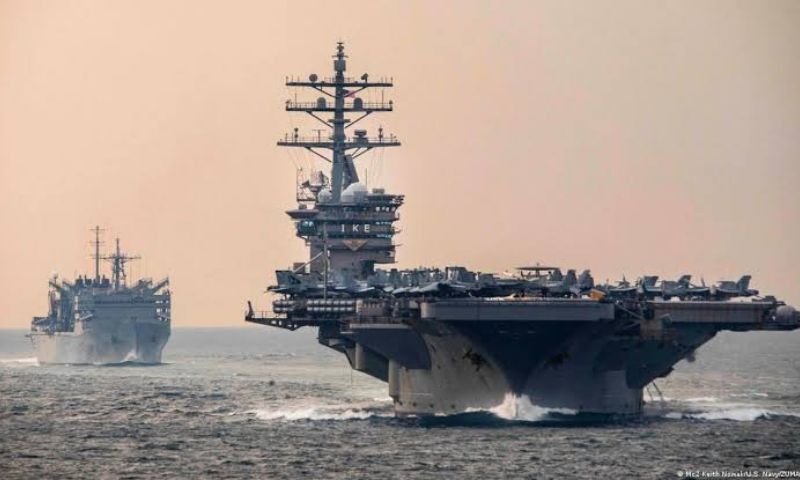
According to Axios, the United States plans to increase economic pressure on Iran through a naval blockade and a new sanctions initiative announced by the US Treasury Department.
The US also plans to move as much Iranian oil as possible through the Strait of Hormuz and into global energy markets, the report said.
One US official told Axios that Rubio made clear Washington was not planning a return to major combat operations, although he did not rule out military action if Iran attacks first.
A second US official, cited by Axios, said the US Navy’s efforts to clear mines from the Strait of Hormuz could represent a turning point in the conflict.
The official claimed the operation had largely neutralised one of Iran’s principal forms of leverage over global energy markets.
One US official also said the current approach could remain in place until after the US midterm elections, after which a renewed military campaign could again become an option, according to Axios.
Iran rejects US mine-clearance claims
Iran has rejected US claims that American forces have cleared mines from the waterway.
Iranian Deputy Foreign Minister Kazem Gharibabadi on Tuesday dismissed reports that US forces had cleared mines or were preparing to deploy mine-sweeping vessels in the Strait of Hormuz.
“If the United States claims that the mines have been completely cleared, why doesn’t a US ship pass through?” Gharibabadi said. “If they have cleared them, why don’t they pass? No one except Iran knows the location of these mines.”
He warned that US mine-sweeping vessels entering the area would be regarded as targets.
“If US mine-sweepers enter the region, they will become targets for us,” Gharibabadi said, adding that US President Donald Trump’s claims about mine clearance were intended to calm markets.
Iran, Oman discuss temporary corridor
Iran and Oman’s foreign ministers on Tuesday said they discussed a framework for a temporary corridor through the Strait of Hormuz and a mine-clearing project in the waterway which both border.
The two countries have sought to regulate transit through the Strait of Hormuz, as written in the Islamabad Memorandum of Understanding (MoU) between the US and Iran.
Oman’s Foreign Minister Badr al-Busaidi and Iran’s Foreign Minister Abbas Araghchi “discussed a phased framework that could provide a practical and implementable basis for moving forward” in talks in Tehran, a joint statement shared by Oman said.
Also Read: Iran, Oman Discuss Framework for Temporary Corridor Through Hormuz
The framework “includes the establishment of a joint temporary navigational corridor through the Strait of Hormuz and an agreement to implement a joint project to clear the Strait of mines,” the statement added.
Technical negotiations will continue to find a “permanent navigational corridor and future administration of the Strait, as well as a mechanism for information-sharing, traffic management, and the provision of relevant navigational and security services”, it added.
#Joint_Statement between the Sultanate of Oman and The Islamic Republic of Iran ، following the consultations between the Foreign Ministers of the Sultanate of Oman and The Islamic Republic of Iran .
His Excellency Foreign Minister Sayyid Badr bin Hamad bin Hamood Albusaidi paid… pic.twitter.com/3LPDUEpNl2
— وزارة الخارجية (@FMofOman) August 25, 2026
Both sides said it was important to hold joint discussions with states bordering the waters of the Gulf.
Trump claims Hormuz cleared of all mines
The announcement came as US President Donald Trump repeated claims that “all mines have been removed and/or detonated from within the International Waters of the Strait of Hormuz.”
In a post on his Truth Social platform, Trump said he had been informed by the US Navy that the mines had been cleared from the strait.
“I have just been informed by the United States Navy that all mines have been removed and/or detonated from within the International Waters of the Strait of Hormuz,” Trump wrote.
The US President warned Iran that any vessel found placing new mines in the waterway would be “immediately and systematically destroyed,” declaring a “Zero Tolerance” policy on mine placement.
Trump also said the US Space Force was monitoring the Strait of Hormuz, as well as nuclear-related sites including Pickaxe Mountain and three other sites he said had already been destroyed.
“Through Space Force, we are watching every square inch of the Strait, as we are, also, with Pickaxe Mountain and the already destroyed three other Nuclear sites.”
— Rapid Response 47 (@RapidResponse47) August 25, 2026
“There is a Zero Tolerance policy on mine placement in full force and effect,” Trump added.
Hormuz traffic remains disrupted
The Strait of Hormuz is one of the world’s most important energy chokepoints. Before the conflict, it carried about one-fifth of global oil and liquefied natural gas shipments.
The conflict began on February 28 after the United States and Israel attacked Iran. Tehran subsequently blockaded the Strait of Hormuz, while Washington imposed a naval counter-blockade on Iranian ports.
Commercial traffic through the waterway remains severely disrupted. Reuters reported that only five commodity vessels transited the strait on Tuesday, compared with a 10-day average of 15.
Iran and Oman, both coastal states on the strait, have for weeks been discussing the future of navigation through the waterway, with Tehran saying the geographical coordinates of a route envisaged by the two countries “have been agreed upon”.
Iranian officials, however, have insisted that the strait will not fully reopen until the United States meets Tehran’s demands, including lifting its naval blockade, dropping oil sanctions and unfreezing assets abroad.
Pakistan’s push to revive US-Iran MoU
The development comes after mediator Pakistan’s Chief of Defence Forces and Chief of Army Staff Field Marshal Syed Asim Munir met with the Iranian leadership in Tehran on Monday to discuss the revival of the Islamabad MoU.
Also Read: Pakistan, Iran Make Significant Progress Towards Reviving Islamabad MoU: Naqvi
Pakistan’s Interior Minister Mohsin Naqvi said that “significant progress” was made towards restoring the Islamabad MoU during talks between Field Marshal Munir and Iranian President Masoud Pezeshkian.
Naqvi hoped that the momentum would pave the way for further progress and lasting peace in the region.
Field Marshal Syed Asim Munir and I had a very positive and productive meeting with the President of Iran. Our discussion focused on the Iran US conflict, tensions in the Middle East and the way forward, as well as the steps needed by both sides for restoration of the Islamabad… https://t.co/jt1wtlESCa
— Mohsin Naqvi (@MohsinnaqviC42) August 24, 2026
In a further indication of the outcome of the high-level engagement, Iranian Deputy Communications Director Seyed Mehdi Tabatabaei described Field Marshal Munir’s visit to Tehran as “highly fruitful”.
برخلاف برخی گمانهزنیهای نادرست رسانهای، سفر فیلد مارشال عاصم منیر فرمانده ارتش کشور دوست پاکستان به ایران بسیار ثمربخش و واجد دستاوردهای دیپلماتیک بسیار ارزشمندی بود که نتایج آن بهزودی آشکار خواهد شد.
— سيد مهدي طباطبايي (@tabaei1356) August 25, 2026
His remarks reinforced statements from the Pakistani side about progress during the Tehran engagements, particularly discussions aimed at restoring the Islamabad MoU and advancing efforts towards a comprehensive settlement of the Iran-US conflict.
Naqvi, who accompanied Field Marshal Munir during his visit to Iran, said the “very positive and productive” meeting with President Pezeshkian focused on the Iran-US conflict, wider tensions in the Middle East and steps required from both sides to restore the Pakistan-brokered Islamabad MoU.
“The Iranian President candidly shared his Government’s perspective and concerns, and we had a very constructive exchange on the issues involved,” Naqvi said in a post on X.
“The Iranian President candidly shared his Government’s perspective and concerns, and we had a very constructive exchange on the issues involved,” Naqvi said in a post on X.
“Significant progress was made, and the meeting concluded on a highly positive note,” he added.
Naqvi said Pakistan remained hopeful that the momentum generated by the talks would help pave the way for further progress and lasting peace in the region.