Key points:
- Fruit exporter plans Rs1.92 billion Initial Public Offering (IPO) for Gulf expansion.
- New Middle East demand reaches about 71,000 tonnes.
ISLAMABAD: Pakistan’s goods and services exports rose 13.1 per cent to $3.94 billion in July, as a fresh-produce Pakistani exporter prepares to raise Rs 1.92 billion through an initial public offering to expand its presence in Middle Eastern markets.
Federal Minister for Planning, Development and Special Initiatives Ahsan Iqbal said goods exports increased 9.4pc to $3 billion in July 2026 from $2.8 billion a year earlier. Total goods and services exports rose from $3.48 billion to $3.94 billion during the period.
The export increase was broad-based, with surgical goods exports rising 16.3 per cent, food exports 8 per cent, leather goods 7.8 per cent and textiles 3.9 per cent.
The latest export figures coincide with growing efforts by Pakistani agricultural exporters to secure greater market access and investment for expansion.
Pakistani exporter plans Gulf expansion.
Sargodha-based SE Fruits and Vegetable Limited is preparing for a Pakistan Stock Exchange listing that could raise to R s1.92 billion through the issuance of 30 million shares.
Almost all of the IPO proceeds are planned for export expansion, including working capital, greater crop procurement, processing capacity and cold-chain infrastructure.
READ ALSO: Pakistan’s Initial Public Offerings Raise Over $70m
The company plans to target the United Arab Emirates, Oman and Arabian Gulf markets, where it says demand for Pakistani mangoes, mandarins and potatoes is increasing.
SE Fruits said it has received new indications of Middle Eastern demand for about 71,000 tonnes of produce. The demand prompted the planned listing, a direct link to the country’s strategy of export-led economic growth by diversifying its export base.
The company currently serves markets across the Middle East, Central Asia, the Far East, Europe and Australia.
The proposed IPO is expected to be priced within a range of Rs 40 to Rs 64 per share.
If fully subscribed at the upper end, the offering would raise about Rs 1.92 billion. The listing would also make SE Fruits the first fresh fruit and vegetable exporter to list on the Pakistan Stock Exchange, according to company and market reports.
The development highlights Pakistan’s shift from economic stabilisation towards export-led growth.
According to the Planning Minister, exports would remain a key driver under the government’s URAAN (the medium-term growth strategy) Pakistan programme. The framework’s objective is to translate recent economic stability into higher investment, employment and foreign-exchange earnings.
Other external-sector indicators also showed improvement in July.
Workers’ remittances rose 13 per cent year-on-year to about $3.63 billion, compared with $3.2 billion a year earlier. The current account deficit narrowed to $328 million from $529 million in July 2025. Information and Communication Technology exports reached $417 million during the month.
The overall industrial sector also showed signs of recovery, with large-scale manufacturing growing 5 per cent in FY2025-26 after contracting 0.74 per cent a year earlier.
Growth was recorded in 16 of 22 sectors, led by automobiles, transport equipment, electrical equipment, tobacco and food.
For Pakistan’s export strategy, the fresh-produce IPO highlights a challenge beyond simply increasing shipment volumes. The export-led growth strategy needs expanding processing, storage, refrigeration and supply-chain capacity, which is crucial for accessing higher-value international markets.
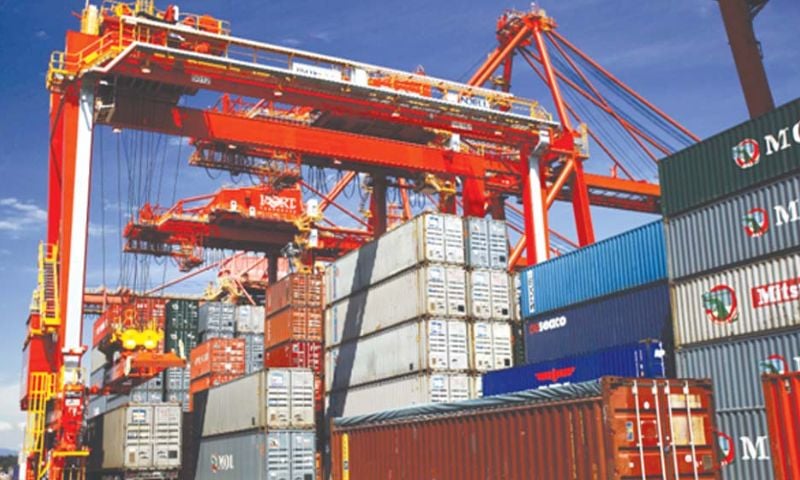
SE Fruits says it operates an integrated export chain covering sourcing, processing, packaging and logistics, with its produce shipped through Karachi and Port Qasim.
The combination of stronger overall exports and private-sector investment in export infrastructure could help Pakistan expand its traditional export base, particularly by increasing the value of agricultural and food shipments to fast-growing Gulf markets.
Supporting agriculture, the export-oriented output would not only strengthen the economy’s backbone but also help achieve the objective of export-led growth anchored in investment.