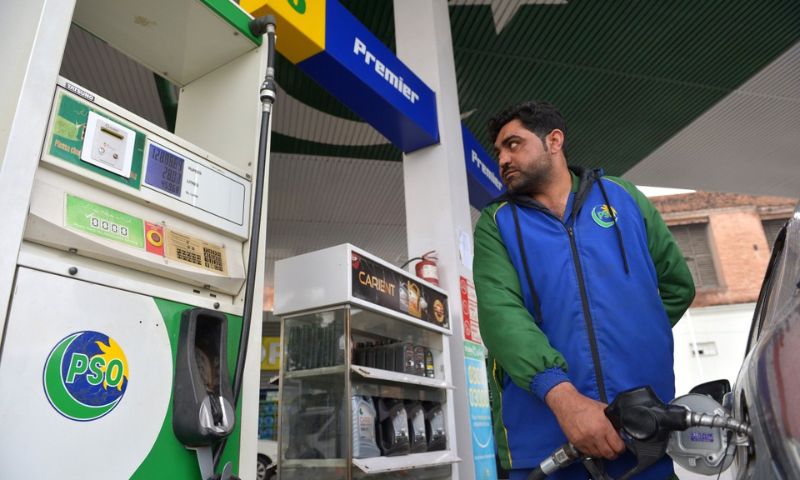
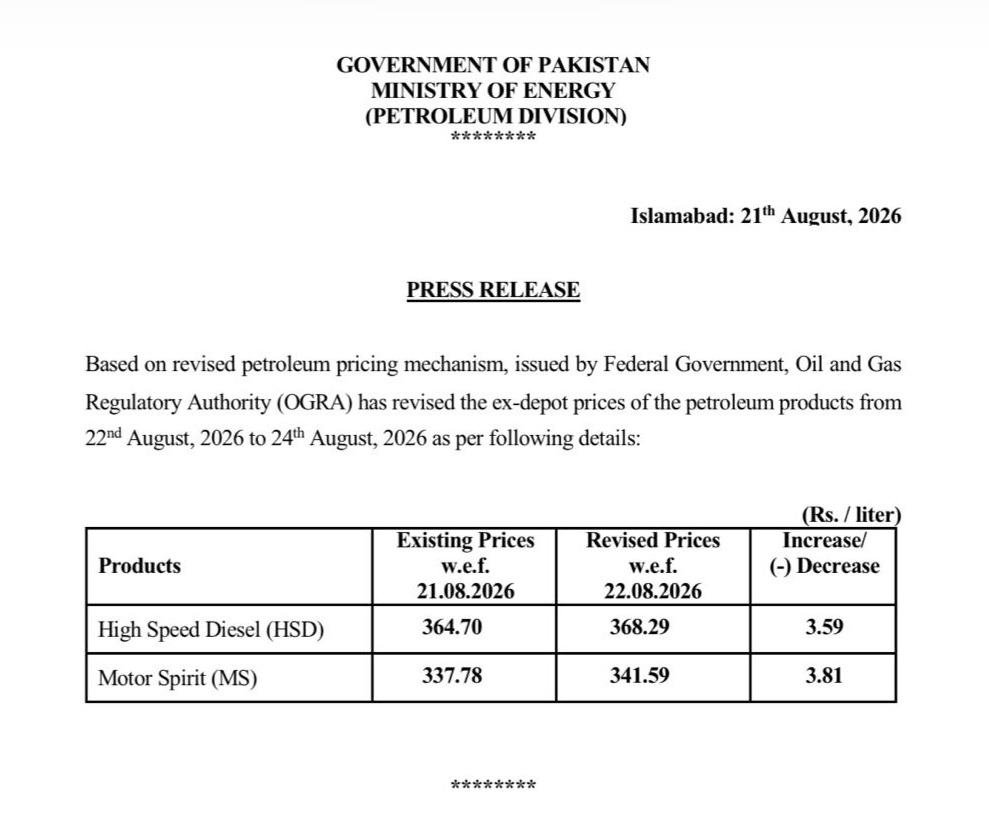
ISLAMABAD: The Pakistan government on Friday increased the prices of petrol by Rs3.81 and high-speed diesel (HSD) by Rs3.59 per litre under a new price mechanism.
Following the revision, petrol will be available at Rs341.59 per litre, while HSD will be sold at Rs368.29 per litre.
According to a notification issued by the Petroleum Division, the revised prices will take effect from Saturday, August 22.
The government on Wednesday announced a major reduction of Rs32.63 per litre in the price of high-speed diesel (HSD under the new price mechanism.
Pakistan daily fuel price review mechanism
The government of Pakistan shifted to a daily fuel price review mechanism amid heightened volatility in global oil markets triggered by renewed tensions in the Middle East. The move is aimed at ensuring that changes in international oil prices are reflected more quickly in domestic fuel rates.
The government had earlier replaced the fortnightly pricing system with weekly reviews following the outbreak of the Middle East conflict.
Petrol is mainly used in private transport, small vehicles, rickshaws and two-wheelers, and changes in its price affect the middle and lower-middle classes.
Similarly, changes in diesel prices also impact the public at large, as it is mainly used in the heavy transport sector, power plants and large generators.
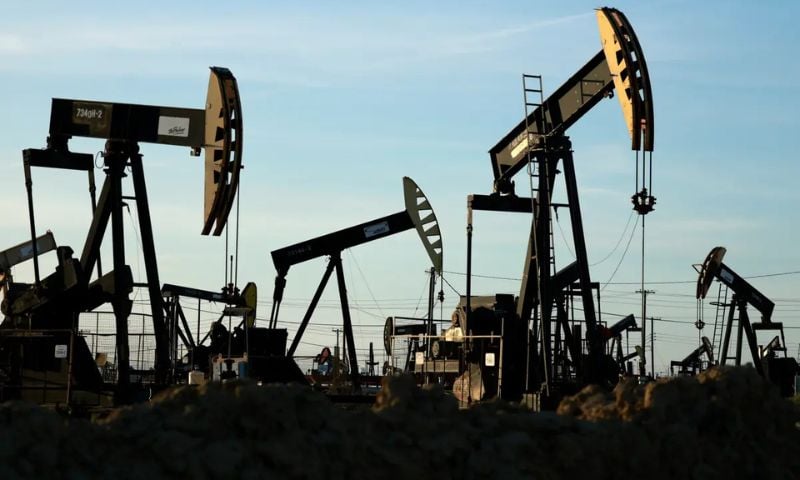
Oil stays near $93 after marginal decline
Oil prices edged lower on Friday but remained near $93 a barrel, keeping the market on course for a second consecutive weekly gain as disruptions to Middle Eastern supplies continued to support prices.
Brent crude was trading at around $93.4 a barrel, down about 0.4 per cent on the day, according to Trading Economics.
The benchmark remained close to its highest level since July 24, reached after a five-session rally.
OilPrice.com’s latest market data similarly showed Brent near $93.3, with the October contract marginally lower but still more than 5% higher over the previous five sessions.
West Texas Intermediate crude was around $86.4 a barrel, also down marginally, according to Trading Economics. The futures market had rallied for five straight sessions through Thursday, with Brent settling at $93.78 and WTI at $87.83.
Also Read: Oil Stays Near $93 After Marginal Decline
The latest decline therefore represents a modest pullback after a strong weekly advance rather than a change in the broader direction of the market.
Oil swings
Oil prices have swung sharply over the past seven months, driven largely by the Iran war, shifting ceasefire expectations and disruptions to Middle Eastern shipping.
Brent began 2026 near $70 a barrel before surging to about $126 in March after the conflict erupted and Hormuz flows were disrupted.
Prices subsequently eased as supply concerns receded, falling to around $70 in early July.
Renewed fighting and attacks on energy and shipping infrastructure then pushed Brent back above $100 in late July before it settled near $89 in August amid stalled US-Iran talks.