
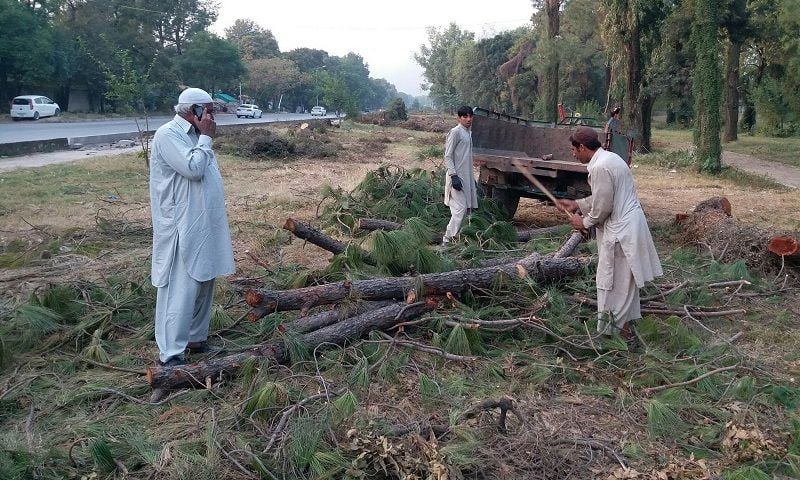
PESHAWAR, Pakistan: In the forests of Hazara, the sound of an axe can mean two very different things.
It can mark the felling of a tree legally selected for harvesting under a Scientific Management Plan. Or it can mark the beginning of an illegal chain in which timber is cut, moved through unofficial routes and eventually sold in distant markets.
Now, the Khyber Pakhtunkhwa Forest Department is proposing to harvest 33 million cubic feet of timber from the Hazara Region over the next 10 years, under a Scientific Forest Management system, WE News English has reliably learnt from official documents and sources.
On paper, the exercise is governed by Working Plans designed to determine which trees can be felled, how much timber can be removed, and how forests should be regenerated.
On the ground, however, the department is already struggling with timber smuggling, shortages of staff and vehicles, alleged political interference and large quantities of previously harvested timber that remain stuck in forests or depots.
That contradiction lies at the heart of the proposed 10-year harvest.
Under the proposal, around 3.3 million cubic feet of timber will be harvested annually through 23 Working Plans.
Consequently, a significant portion of the proposed harvest represents an unharvested backlog carried forward from earlier plans — some dating back to 1904 for Reserved Forests and the 1960s for Guzara and Protected Forests.
While the Khyber Pakhtunkhwa Forest Department has not provided an overall tree-count or revenue estimate for the full 10-year period, data for the 10 active Working Plans shows 63,267 trees marked for cutting out of 8,725,815 trees in the region.
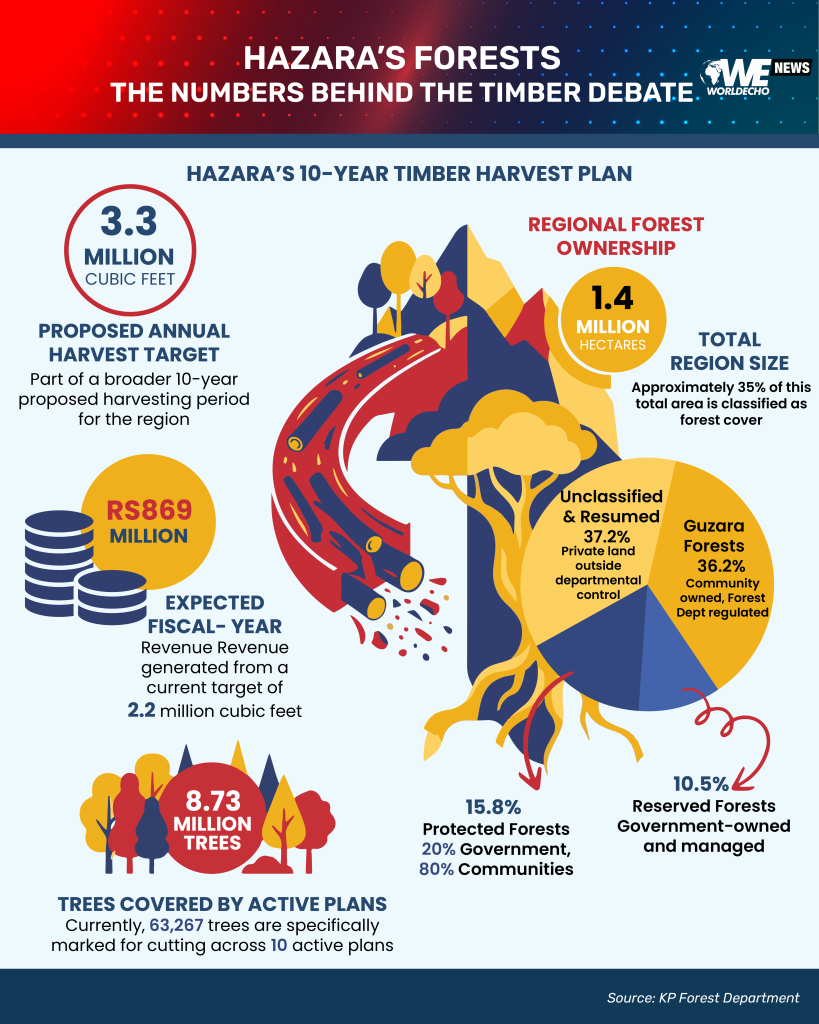
For the current fiscal year alone, 2.2 million cubic feet is scheduled for harvesting, with Rs869 million in expected revenue.
Theoretically, the proposal rests on a detailed system of forest inventories, Working Plans and tree marking. Its effectiveness, however, will depend on what happens when those plans meet the realities of Hazara’s forests and timber markets.
Who controls the forests?
Forests cover roughly 35 per cent of the 1.7 million hectares in the Hazara Region, operating under a complex web of ownership:
Reserved Forests, accounting for 10.5 per cent, are fully owned and managed by the government.
Guzara Forests, making up 36.5 per cent, are owned by local communities but regulated by the Forest Department.
Protected Forests, accounting for 15.8 per cent, are jointly held, with the government owning 20 per cent and communities holding the remaining 80 per cent.
The remaining 37.2 per cent consists of unclassified and resumed land, including private land outside departmental control.
A century of forest plans
The first Working Plan for Reserved Forests was prepared in 1904. The first Working Plan for Guzara Forests was introduced in 1965, while plans for Protected Forests were also prepared during the 1960s.
According to the department, harvesting proposed under these earlier Working Plans was not fully carried out, leaving unharvested volumes to accumulate as a backlog. The department has now proposed harvesting 33 million cubic feet of timber in next 10 years.
A Working Plan is generally prepared for a period of 10 to 15 years and is intended to provide a scientific basis for forest management and regeneration.
The process begins before the expiry of an existing plan, when the relevant conservator prepares a preliminary Working Plan and sends it to the Forest Planning and Monitoring Circle (FPMC).
The FPMC Conservator reviews the proposal and sends recommendations to the Chief Conservator before assigning the task to a Divisional Forest Officer (DFO) of the FPMC. Teams formed by the DFO then visit the forest and collect field data.
Subsequently, the plan passes through the FPMC Conservator, the concerned Conservator, and a technical committee before being sent to the Forest Secretary for sanction and approval by the Chief Conservator.
Under the Scientific Management Plan, Forest Department officials identify trees that are diseased, dead, dry or over-aged and mark them for cutting. A separate wing of the Forest Department monitors the process to verify whether only eligible trees have been selected.
Communities are also consulted where their ownership shares are involved, particularly in Guzara and Protected forests.
A Scientific Management Plan (SMP) for forests is intended to provide an evidence-based framework for deciding how a forest should be protected, maintained, regenerated and, where appropriate, harvested over a specific period.
But the system’s effectiveness ultimately depends on people being able to enforce those rules. And Hazara’s timber market offers a revealing test.
The cheapest timber trap
According to Khanzada Khan, a resident of Battagram who also owns forest land, illegally cut timber is cheaper than legally harvested timber — making it more attractive to buyers.
“The buyer told me he could obtain timber for Rs1,400 per cubic foot — even though it had been illegally cut.” – Khanzada Khan, forest owner
Khan tells WE News English that a buyer from Lahore once came to Battagram to purchase timber from his forest. He quoted Rs2,000 per cubic foot for legally harvested timber. The buyer, however, told him he could obtain timber for Rs1,400 per cubic foot — even though it had been illegally cut.
The difference was Rs600 per cubic foot, or 30 per cent. For a large timber consignment, that price gap can create a powerful incentive to buy illegally sourced wood.
Khan adds that legally harvested timber can be transported anywhere in Pakistan with a Forest Department permit, while illegally cut timber cannot legally be transported. Despite this, he reveals, the buyer purchased the cheaper timber, which was subsequently transported to Lahore.
According to Khan, an established network of people is involved in moving illegally cut timber from forest areas to different parts of the country, enabling such timber to reach distant markets despite restrictions on its transportation.
His account raises a difficult question for the proposed harvesting programme.
If legally harvested timber carries documentation and regulatory costs while illegally cut timber can be sold substantially cheaper and still reach markets hundreds of kilometres away, how effective is the regulatory system meant to protect the forest?
Power, politics and timber
A Forest Department official, speaking on condition of anonymity, alleges that in one district of Hazara Division, some political figures provide patronage to illegal timber cutting, with illegally cut timber being stored on their land. He says local Forest Department officials find it extremely difficult to take action against them.
These political families, he elaborates, have frequently been part of the government and have historically exercised influence over politically motivated recruitment in the Forest Department. He adds that local officials are reluctant to register First Information Report (FIR) against them and, when pressured to take action, often prefer to seek a transfer or even leave their jobs.
“Local officials are not willing to register an FIR under any circumstances. Instead, they say they would rather be transferred or removed from their jobs.” – Forest Department official
“Local officials are not willing to register an FIR under any circumstances. Instead, they say they would rather be transferred or removed from their jobs.”
The allegations could not be independently verified. If substantiated, the allegations would point to an institutional problem that goes beyond a shortage of personnel: the ability of field officials to enforce forest laws when powerful local interests are involved.
A Scientific Management Plan can specify precisely which tree should be cut. But if field officials cannot act against illegal cutting or influential timber interests, the distinction between authorised harvesting and illegal exploitation can become increasingly difficult to maintain.
Routes beyond control
To curb timber smuggling, the Forest Department has established 53 check posts across Hazara, of which 18 are equipped with Closed-Circuit Television (CCTV) cameras.
According to Forest Department data, between fiscal year 2018-19 and June 2025, authorities seized around 35,209 cubic feet of illegally transported timber in the Hazara Region and imposed fines amounting to approximately Rs383.6 million.
Another Forest Department official, who also wishes not to be named, says timber was previously smuggled through rivers in the Hazara region using boats. There were 32 points where the timber was unloaded, and the practice continued until 2012, he adds.
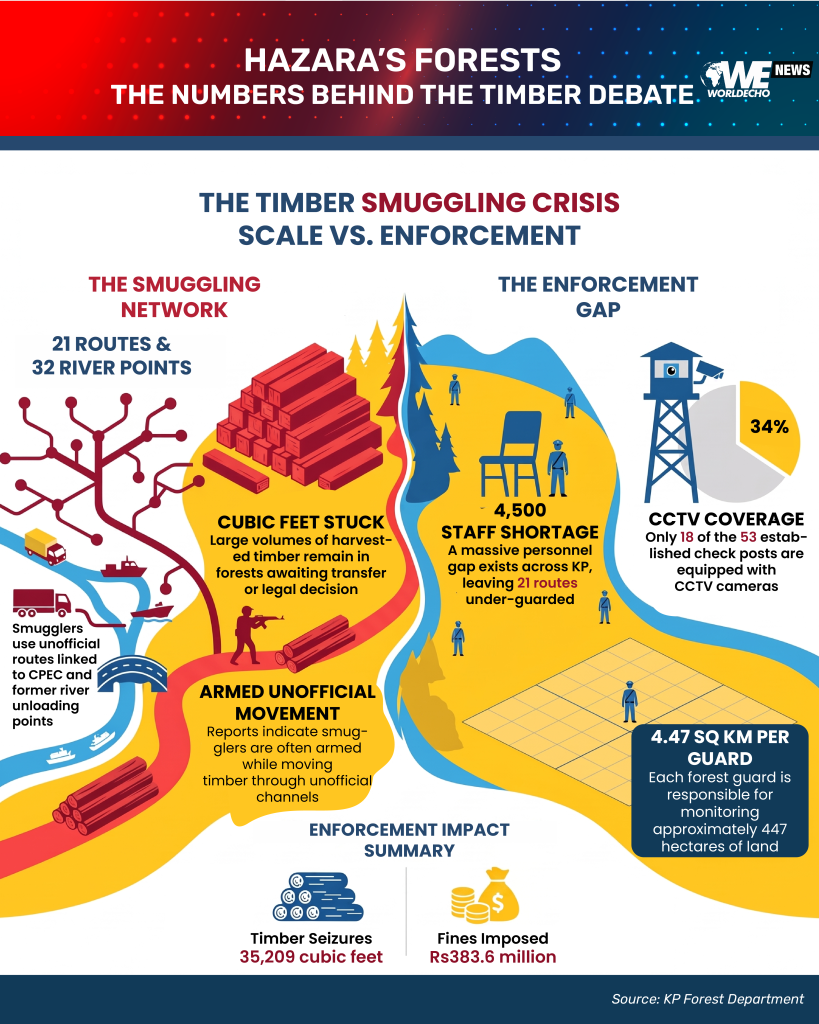
After the construction of the China-Pakistan Economic Corridor (CPEC), the officer explains, timber smuggling in the Hazara Region shifted to routes connecting with the CPEC.
“There are 21 such routes that join the Motorway, which are not fenced, providing the smugglers an unhindered route.”
The smuggling network presents a significant monitoring challenge for a department already struggling with personnel and resource shortages.
Chief Conservator of Hazara Region Asghar Khan says Motorway Police are a major obstacle to the Forest Department’s operations against timber smugglers.
“Forest Department officials are often stopped from carrying out operations and are not even allowed to keep their patrol squads stationed along the Motorway.” – Asghar Khan, Chief Conservator of Hazara Region
He says Forest Department officials are often stopped from carrying out operations and are not even allowed to keep their patrol squads stationed along the Motorway.
According to Asghar Khan, this has led to several disputes between the two departments. In 2022, the Forest Department and Motorway Police developed a joint strategy to coordinate operations against timber smugglers. Under the strategy, the Forest Department had to share confidential information about smuggling with the Motorway Police.
However, according to Khan, no significant action was taken despite the arrangement.
A thin enforcement line
Another Forest Department officer informs WE News English that the department faces a severe shortage of resources. He says that monitoring just 21 smuggling routes would require at least 189 personnel — three officials per route working in three shifts.
In addition, the department needs at least four vehicles to intercept and stop vehicles carrying illegally cut timber on the motorway, particularly because smugglers are often armed.
According to Hazara Region Chief Conservator of Forests Asghar Khan, the Forest Department is currently facing a shortage of around 4,500 employees across the province. Each forest guard is responsible for patrolling approximately 447 hectares (4.47 square kilometres) of forest land on foot.
That workload makes monitoring and protection extremely difficult.
When timber gets stuck
The problems do not end with illegal cutting.
In Upper and Lower Kohistan, more than 1.3 million cubic feet of timber was cut between 2008 and 2010. Of this, around 339,000 cubic feet either remains in the forests or has yet to be fully transferred to designated depots.
The government requires approval to move the remaining timber to depots for auction, but Cabinet approval has not been obtained even after 16 years.
“The timber was not extracted or shifted to the main depot within the specified period, after which the relevant policy expired.” – Saleem Khan Marwat, Conservator
According to Conservator Saleem Khan Marwat, the timber was not extracted or shifted to the main depot within the specified period, after which the relevant policy expired. Disputes among local communities also contributed to the situation.
Some of the timber has since been brought to a depot in Kohistan located along the Karakoram Highway, where it is lying in a roadside depot, while some of the cut trees are still lying in the forest. The timber is estimated to be worth up to Rs3 billion.
The cost of cutting
The proposed 10-year harvesting programme therefore comes at a time when the Forest Department is already marked by competing pressures.
There is the government’s argument that scientific harvesting is necessary to manage forests, remove diseased or over-aged trees, generate revenue and clear accumulated harvesting backlogs.
There are also the realities described by forest officials and local landowners: illegal timber can be cheaper than legal timber, smuggling routes remain active, enforcement personnel are scarce, vehicles are inadequate and influential interests are alleged to complicate action against illegal cutting.
According to Prof Sultan-i-Rome — a historian, researcher and prolific author who has written extensively on the history, forests, environment and socio-political affairs of Khyber Pakhtunkhwa — the management plan itself allows the wrong trees to be cut down.
For Hazara’s forests, the real test will not simply be how much timber the government can legally harvest, but whether it can prevent illegal cutting from growing alongside it.