Key points
- Iran war pushes diesel prices higher across Asia
- Chinese e-truck exports more than double
ISLAMABAD: The US-Iran war is giving China’s electric-truck industry an unexpected boost as soaring fuel costs push businesses across Asia to consider alternatives to diesel-powered vehicles.
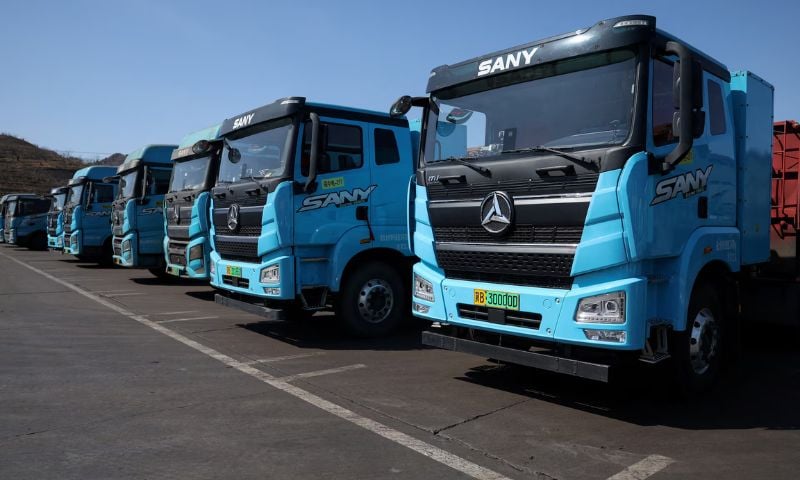
China’s exports of heavy electric trucks more than doubled year-on-year to 16,823 vehicles in the four months after the conflict began on February 28, according to Reuters.
About half of those shipments went to South and Southeast Asia, with exports to South Asia rising more than fivefold and those to Southeast Asia nearly tripling.
The disruption of oil supplies through the Strait of Hormuz has been particularly significant for Asian economies dependent on Middle Eastern crude.
Diesel prices have risen 48 per cent in Sri Lanka and 57 per cent in the Philippines since the start of the war, compared with a 15 per cent increase in China, according to Chinese media.
The resulting economics are making Chinese electric trucks more attractive.
Sany, the world’s biggest maker of electric heavy trucks, estimates that higher fuel prices have reduced the period required for buyers to recover the additional cost of an electric truck from about 28 months to 18 months.
China’s domestic market advantage
China’s domestic market provides its exporters with a major advantage.
Electric trucks accounted for about 30 per cent of Chinese truck sales last year, compared with almost none in 2021, and around 140,000 were sold in the first half of 2026.
READ ALSO: Chinese EV Exports Reshape Fuel Demand From Pakistan to UAE
Chinese manufacturers are also targeting markets beyond Europe, including Asia, Africa and Latin America, offering cheaper models and charging, power-generation and energy-storage systems to overcome infrastructure constraints.
The shift could have wider consequences for global oil demand.
China’s electric-truck fleet is estimated to save the equivalent of 141 million barrels of oil this year, more than 3 per cent of the country’s total consumption.
Its first-half e-truck exports alone are estimated to have replaced fuel demand at an annual rate of 1.6 million barrels.
The war has therefore created an unusual commercial dynamic: an oil-supply shock centred on the Middle East is accelerating China’s efforts to export a technology that reduces dependence on oil.
China’s Electric-Auto Rise
China’s electric-vehicle industry has grown from a policy-driven experiment into the world’s largest electric-car manufacturing and export base.
Government incentives, investment in charging infrastructure and years of support for battery technology helped Chinese manufacturers build scale rapidly. They have now created a domestic market large enough to drive down production costs and accelerate technological development.
The result has been a dramatic expansion in sales. New-energy vehicle (NEV) sales in China reached 7.45 million in the first half of 2026, with pure electric vehicles accounting for about 67 per cent of the total, according to China Association of Automobile Manufacturers data.
China’s advantage extends beyond vehicle assembly to batteries and critical components. Its highly integrated supply chain has allowed companies to produce increasingly affordable models at a speed that has challenged established Western and Japanese automakers.
The industry is now increasingly turning its scale into an export advantage. The International Energy Agency estimates that China produced about 16 million electric cars in 2025, nearly three-quarters of global electric-car output.
Chinese electric-car exports more than doubled that year to a record 2.5 million vehicles. That overseas demand has intensified as competition and overcapacity weigh on China’s domestic market.
Chinese manufacturers are expanding rapidly into Southeast Asia, Latin America, Europe, the Middle East and other emerging markets, where lower-priced electric models are gaining ground.
This industrial scale now extends beyond passenger cars to buses, vans and heavy trucks. The industry has created a Chinese electric-vehicle ecosystem that can respond quickly when high oil prices make electrification more attractive.