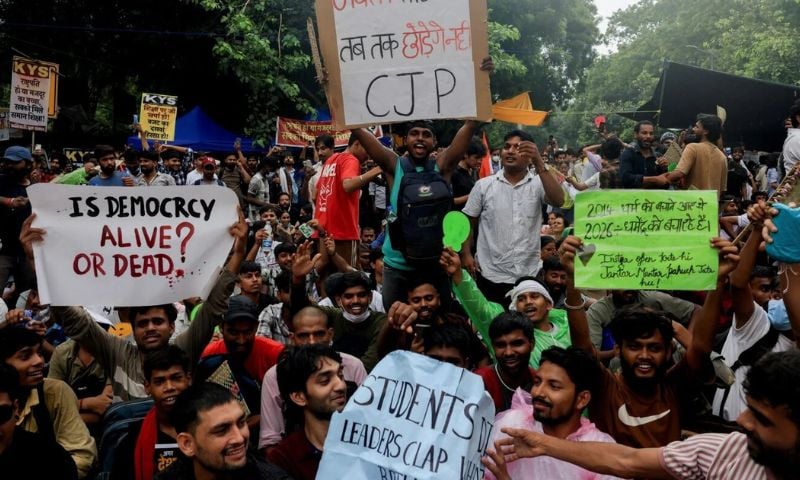
NEW DELHI: India’s ruling Bharatiya Janata Party (BJP) replaced its social media chief on Monday, weeks after youth-led protests fuelled by social media forced the resignation of the country’s education minister and exposed growing distrust among young Indians towards mainstream news outlets.
The BJP said Amit Malviya, who had headed its social media operation since 2015, was replaced by Deepak Mhaskey. The party did not give a reason for the change or specify what would change under Mhaskey’s leadership.
Congratulations to all the newly appointed office bearers of the BJP. Their appointments come at a crucial juncture as the party prepares to scale newer heights and take its message and organisation to every corner of the country.
I wish to particularly congratulate Shri Deepak…
— Amit Malviya (@amitmalviya) August 17, 2026
The reshuffle was the first by BJP president Nitin Nabin, who took charge in January at the age of 45 and is the youngest person to lead the party.
The move comes after weeks of protests led by the satirical Cockroach Janta Party (CJP), a youth movement that rapidly built a large online following and used social media to mobilise demonstrators against the government.
Welcome removal of Amit Malviya,who through his IT cell,spread hatred against Congress orchestrated propaganda against Rahul https://t.co/Ma2fBrXpst for new team,working with genuine dedication is one thing,if you continue to operate using same system of vote-bank & hate politics…
— Mumtaz Patel (@mumtazpatels) August 17, 2026
Social media drives India’s youth protests
The protests began after the cancellation of India’s National Eligibility cum Entrance Test (NEET), a highly competitive examination used for admission to medical colleges, following allegations of question-paper leaks.
The CJP emerged in May as a satirical online platform and amassed 15 million followers in less than a week. The BJP’s account had fewer than 9 million followers at the time.
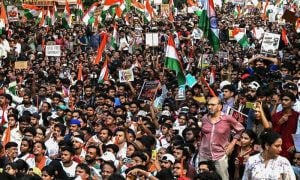
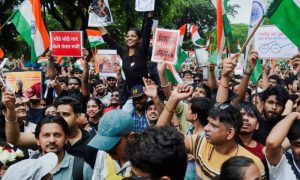
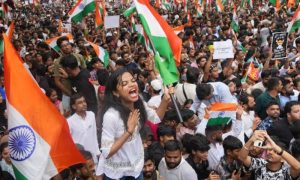
The protests eventually drew tens of thousands of people to New Delhi and other cities. Demonstrators demanded action over the examination controversy and called for the resignation of Education Minister Dharmendra Pradhan, who stepped down on July 25.
Social media became a major organising tool for the largely Gen Z protesters. They used rap songs, videos, memes and humour to criticise Prime Minister Narendra Modi and his government on platforms that the BJP has long used to communicate with supporters.
The movement also reflected a deeper frustration with India’s traditional news media, which many young protesters viewed as too close to the government.
India’s ‘lapdog media’ anger
At Delhi’s Jantar Mantar protest site, a large banner displayed the faces of mainstream television anchors and described them as “India’s worst enemies” and “more dangerous than terrorists or anti-nationals”.
Several videos showed protesters heckling and confronting journalists covering the demonstrations. Some reporters were physically assaulted, while protesters repeatedly used the slogan “Godi media”, a derogatory Hindi expression commonly translated as “lapdog media”.
Manisha Pande, editor-in-chief of independent outlet Newslaundry, said the hostility towards mainstream television news reflected a long-building crisis of trust.
“We’ve been leading up to this moment for a very long time,” Pande said. She said many Indians, regardless of their political affiliation, believed that their everyday concerns were no longer reflected in prime-time television news.
The protests therefore became not only a challenge to the government but also a test of India’s changing media landscape, with young people increasingly turning to independent digital outlets and social media creators.
From joke to protest movement
The CJP began as a joke after Chief Justice of India Surya Kant made remarks in May comparing some unemployed young people to cockroaches.
Abhijeet Dipke, then studying for a master’s degree in Boston, embraced the remark and posted an AI-generated image of a cockroach wearing sunglasses and addressing a crowd.
Dipke, 30, subsequently created the Cockroach Janta Party, a play on the name of the BJP. He listed “unemployed, lazy, chronically online, and ability to rant professionally” as eligibility criteria for supporters.
The movement quickly expanded beyond its satirical origins. Saurabh Shukla, co-founder of independent YouTube news outlet The Red Mike, said he recognised its potential early on and interviewed Dipke on May 21.
The video received more than one million views, Shukla said.
“At that time Dipke had no plans to come to India. He had no plans of forming the CJP, nothing at all,” Shukla said. “Woh hansi mazak mein — in a light-hearted way — we did that interview and it exploded.”
Indian police violence against protesters
The confrontation reached a critical point on July 20, when protesters attempted to march towards Parliament.
Delhi Police and paramilitary forces used tear gas, pellet guns and baton charges during the crackdown.
A video by YouTuber Samdish Bhatia documenting the violence has received more than six million views.
The demonstrations were also subject to extensive security measures. Facial-recognition systems and surveillance cameras were deployed around Jantar Mantar, while a police officer was seen wearing smart glasses.
Also Read: Rights Group Urges UN Probe Into India’s Use of Pellet Guns at Student Protest
The authorities also restricted food deliveries to the protest site.
Despite the pressure, protesters continued to gather. They used humour, profanity, memes and unconventional posters to express their anger.
“This was called an Instagram protest and we were always Instagram first,” Sharma said.
BJP seeks to regain ground with younger voters
The BJP has long been highly effective at using Facebook, WhatsApp and X to communicate its political message.
But the protests showed the difficulty of competing with a younger generation that relies heavily on short videos, memes and Instagram content.
Modi subsequently asked his ministers to become more active on Instagram and posted a vertical selfie video on the platform as part of an apparent effort to engage Gen Z.
In another video, Modi said he forgave young people who had used profanities against him.
At the same time, BJP supporters were accused of doxxing, harassing and threatening young women.