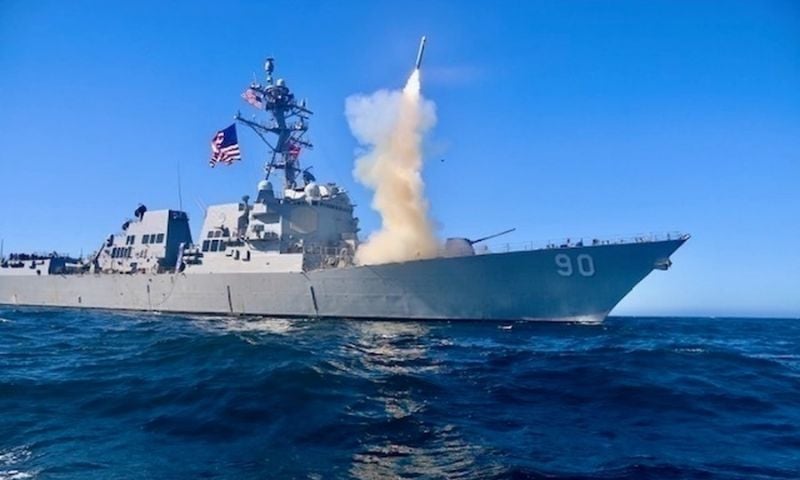
WASHINGTON: The US military has awarded RTX unit Raytheon a $22.9 billion contract to increase production of Tomahawk cruise missiles, as Washington moves to replenish weapons stocks depleted by arms supplies to allies and its own military operations, the Navy said on Monday.
The seven-year contract will enable Raytheon to increase annual Tomahawk production to more than 1,000 missiles, from about 60 currently, the company said. The deal formalises a framework agreement signed between the US military and Raytheon in February.
“We called on industry to rapidly scale up munitions output, and RTX is delivering,” Acting US Navy Secretary Hung Cao said in a post on X.
We called on industry to rapidly scale up munitions output, and @RTX_News is delivering.
This landmark Tomahawk contract ensures our warfighters continue to have the lethal firepower they need to win. pic.twitter.com/YekpFgKXSg
— Acting Secretary of the Navy Hung Cao (@SECNAV) August 17, 2026
Cao said the contract would accelerate Tomahawk deliveries and ensure US naval and joint forces had the firepower needed for current operations and to deter aggression.
Tomahawk missile production
The sea-launched Tomahawk is a mainstay of the US Navy’s surface fleet and provides long-range precision strike capability against land targets.
The missiles are primarily launched from warships and submarines and can travel more than 1,600 kilometres (1,000 miles).
The production increase is part of the US effort to expand weapons manufacturing capacity. The administration of President Donald Trump has been negotiating multi-year contracts with major defence companies, giving manufacturers greater certainty to invest in factories, equipment and production lines, according to Reuters.
Earlier this month, the US military signed agreements aimed at increasing production of components for Patriot and Terminal High Altitude Area Defense (THAAD) interceptor missiles.
Concerns over weapons stocks
The United States has supplied substantial quantities of weapons to allies while also expending munitions during the conflict with Iran, raising concerns over stocks of air-defence and precision-guided weapons.
Also Read: US Orders Defence Firms to Speed up Weapons Production as Iran Conflict Pressures Stocks
A study by the Center for Strategic and International Studies (CSIS), released last month, estimated that US stocks of Patriot and THAAD interceptors had fallen sharply during the conflict with Iran.
CSIS estimated that before the conflict began in late February, the United States had more than 2,300 Patriot interceptors and more than 450 THAAD interceptors. It estimated that stocks had subsequently been reduced by roughly half or more.
Trump denies missile shortage
The Washington Post reported this month that Trump had sought answers from Defence Secretary Pete Hegseth over concerns about weapons shortages during a recent Cabinet meeting.
Trump and Hegseth later denied that the United States was facing dwindling missile stocks.
Cao said the Navy was using “every available tool” to meet the demands of current operations.
“Guaranteeing our naval and joint forces have the lethal firepower they need to deter aggression and protect the homeland is paramount,” he said.