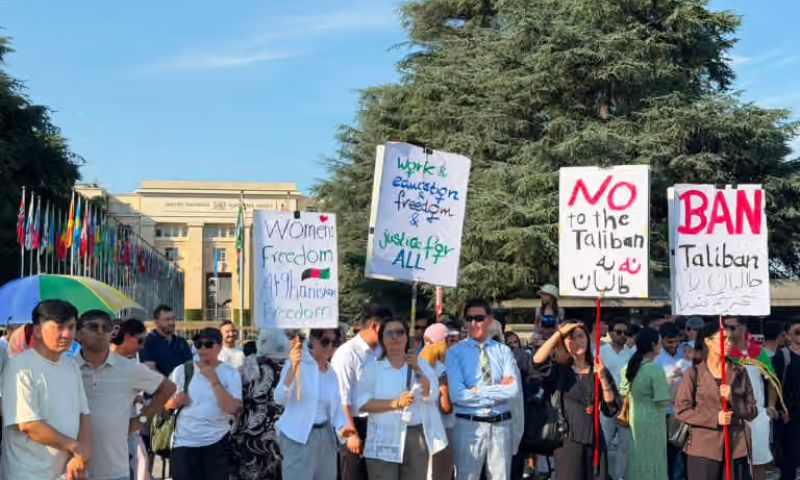
LONDON: Afghans held protests, advocacy events and other demonstrations in cities across Europe, North America and Asia to mark the fifth anniversary of the Taliban’s return to power, with participants urging governments not to normalise relations with the group and calling for international recognition of gender apartheid in Afghanistan.
Protests marking the anniversary were held in 28 cities, including Bonn, Geneva, Amsterdam, Munich, Stuttgart, Hamburg, Islamabad, Berlin, Kiel, Frankfurt, Helsinki, Zurich, Oslo, Cologne, Vienna, The Hague, Stockholm, Madrid, Barcelona, Bilbao, Toronto, New Westminster, Reston, Düsseldorf, Tehran, Paris, London and Washington, according to Afghanistan International.
Afghan protesters gather at Queen’s Park North Side on the fifth anniversary of the Taliban takeover of Afghanistan.
They demand freedom for women in Afghanistan and not to normalize Taliban in the west. pic.twitter.com/KWoQJqlkmh
— RealityDocu (@realitydocu) August 16, 2026
In some cities, Afghans marched and chanted slogans against the Taliban regime. Organisers held meetings, advocacy events, protest tents and hunger strikes. Many of the gatherings focused on the rights of Afghan women and girls and opposition to the normalisation of relations with the Taliban regime.
Gender apartheid in Afghanistan
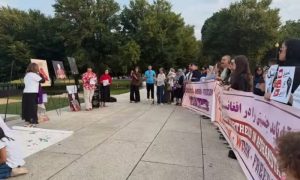
In Bonn, Germany, the Campaign Against Gender Apartheid in Afghanistan held a rally outside the United Nations office and issued a resolution.
The resolution called on the UN and the international community to recognise and criminalise gender apartheid in Afghanistan. It also urged an end to efforts to legitimise the Taliban regime and called for Afghan women, victims, protesters, civil society groups and democratic forces to be included in international decision-making.
In Geneva, Switzerland, demonstrators gathered outside the UN office in support of Afghan women and girls.
Protesters demanded to keep Afghan women’s voices visible, draw international attention to the human rights situation and emphasise the rights, freedom, equality and human dignity of women and girls.
A number of Afghan organisations, protest movements and citizens gathered in Paris, France, on Sunday (16 August) to mark five years since the fall of the previous government and the Taliban’s return to power. They called for an end to the normalisation of the Taliban, practical…
— Zan TV (@ZANTV) August 17, 2026
In Berlin, protest activities continued for several days. Organisers set up a protest tent and held a voluntary hunger strike before concluding the programme with a gathering near the Brandenburg Gate on August 15.
Protesting Afghans said the events were aimed at supporting human dignity, freedom, equality and human rights in Afghanistan.
Concerns over restrictions on Afghan women
In Munich, Afghan activists, academics, human rights defenders, political figures, artists and members of the public gathered at Bellevue di Monaco.
Women joining remotely from Afghanistan also spoke about the restrictions and concerns they face, according to Afghanistan International.
The discussions covered human rights, the situation of women and girls, education, the economy, migration and asylum, as well as Germany’s and the European Union’s policies towards Afghanistan.
A final resolution said education, employment, freedom and human dignity were fundamental rights.
In Kiel, Germany, a protest titled “Voice of the Unseen” was followed by a cultural programme. The Schleswig-Holstein Refugee Council called for an end to deportations to Afghanistan and greater protection for Afghans considered at risk.
In Amsterdam, organisations held demonstrations marking the fifth anniversary of the Taliban’s entry into Kabul. Protesters called on the Netherlands and the EU not to legitimise the Taliban regime and to prioritise Afghan women’s rights.
Protests across Europe and North America
In Spain, events were held in Madrid, Barcelona and Bilbao, according to Afghanistan International.
In Madrid, Afghan women, refugees and right groups gathered at Puerta del Sol and called for international action in support of Afghan women’s rights. The three cities were part of a coordinated international campaign on August 15 focused on opposition to gender apartheid and the legitimisation of the Taliban regime.
In Toronto, protesters gathered at Queen’s Park. Participants stressed women’s right to education and employment and called on Canada not to recognise the Taliban regime.
“Ban Taliban!”
“No to child marriage!”
“Taliban are terrorists!”Protestors in Toronto condemn the Taliban on the 5th anniversary of their takeover of Afghanistan as a result of the disastrous US withdrawal. pic.twitter.com/g0F2idCCyY
— Beth Baisch 📸 (@BethBaisch) August 15, 2026
The Afghan community in Toronto also issued a resolution calling for an end to gender apartheid, protection of the rights of women and girls, freedom of expression and the media, support for refugees and independent investigations into alleged human rights violations.
In Hamburg, Afghan migrants and civil society activists condemned the Taliban’s rule and what they described as violations of Afghans’ rights and freedoms.
A conference at Hamburg City Hall reviewed Afghanistan’s political, social and humanitarian situation, Germany’s Afghanistan policy, deportations and engagement with the Taliban regime.
In Frankfurt, protesters described August 15 as a “black day” in Afghanistan’s history. They chanted slogans including “No to the Taliban”, “Do not recognise the Taliban” and “Education, work, freedom”.
Participants called on governments and international organisations to support Afghans’ fundamental rights, particularly the rights of women and girls to education and employment, as well as civil liberties and human rights.
Events in Oslo and Canada
Several events were also held in Oslo, Norway. At one gathering, protesters marched from the Afghan embassy towards the Norwegian parliament.
Organisers expressed support for Afghan women’s struggle. Another event, titled “From Advocacy to Accountability”, focused on justice, accountability, cooperation among human rights defenders and the future of advocacy for Afghanistan. It was organised by Dialogue Hub for Common Ground and the Women’s Justice Movement.
In New Westminster, Canada, organisers held an event titled “Fresh Wound: From Remembrance to Action”.
The programme included expert speeches, a panel discussion, protest music and theatre. Participants discussed human rights, gender apartheid, cultural genocide and the future of civil activism.
In Cologne, Germany, a gathering titled “Five Years of Taliban Rule” was held at Heumarkt square. Organisers, including Afghanistan Is Not Safe Cologne and Bonn, Anar Academy, Amnesty International Cologne and Mosaik Köln-Mülheim, expressed solidarity with Afghan women and girls and protested the human rights situation under Taliban rule.
In Reston, Virginia, an event titled “Afghanistan, Five Years After the Fall” was held on August 15. It sought to remember victims, amplify the voices of Afghan women, refugees and separated families, and discuss Afghanistan’s future.
Related events were also held in Stuttgart, Helsinki, Zurich, Vienna, The Hague, Stockholm and Düsseldorf.
Five years of Taliban regime
The Taliban entered Kabul on August 15, 2021, as US and NATO forces were withdrawing from Afghanistan.
Then-president Mohammad Ashraf Ghani left the country the same day, while the Taliban took control of the capital without widespread resistance.
Many Taliban opponents, civil society activists, human rights defenders and Afghan citizens regard the anniversary as a “black day” and have organised protests in different countries.
Five years after the Taliban’s return, Afghanistan’s de facto government remains unrecognised by every country except Russia.
Since taking power, the Taliban has imposed sweeping restrictions affecting Afghans, particularly women and girls in education, employment and participation in public life.