
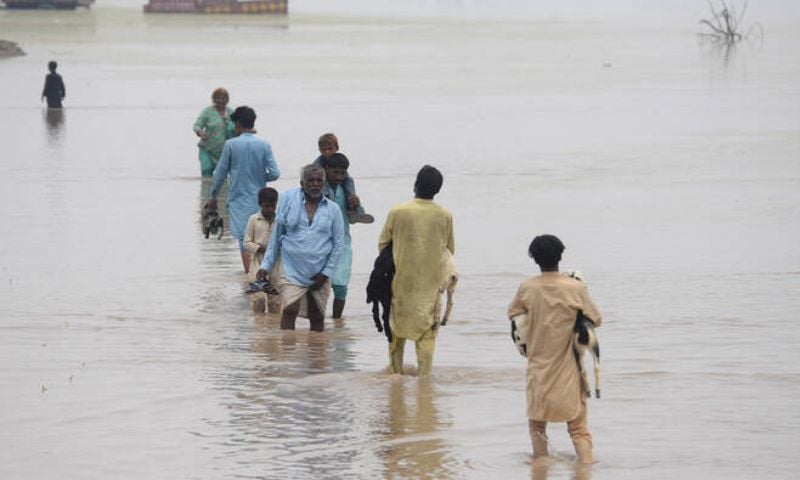
ISLAMABAD: Pakistan is bracing for yet another round of nature’s fury as the country prepares to receive its sixth monsoon spell in what has already been a devastatingly wet season.
The Pakistan Meteorological Department (PMD) has now forecast widespread torrential rains across the country from August 17 to 21, warning that the latest system could trigger flash floods, urban flooding, and landslides, threatening to cripple daily life and endanger vulnerable communities already reeling from weeks of relentless downpours.
Rain-wind/thundershowers are expected across upper and central parts of Pakistan from 17–21 August, with occasional gaps.
Isolated heavy rainfall may occur in vulnerable areas, with risks of urban flooding and landslides. Stay alert and follow PMD updates.#PMD #PakistanWeather pic.twitter.com/KfHIAs0yj2— Pak Met Department محکمہ موسمیات (@pmdgov) August 16, 2026
The powerful weather system, driven by monsoon currents from the Arabian Sea and Bay of Bengal continuously penetrating the region, is expected to intensify further as a low-pressure system moves westward from August 17, combining with an active westerly wave to unleash heavy to very heavy downpours across virtually every province of the country.
With the monsoon season already claiming dozens of lives this year (151 deaths and 448 injuries), the Met Office has urged all concerned authorities to remain on high alert and take precautionary measures to minimize risks as the latest system threatens to test the nation’s disaster preparedness yet again.
Northern areas and KP bracing for worst impact
The most vulnerable regions remain the northern belts of the country, where torrential rains could trigger dangerous flash floods and landslides that may block vital roads and cut off entire communities.
Kashmir and Gilgit-Baltistan are likely to bear the brunt of the weather system between August 17 and 19, with widespread rain-wind and thundershowers accompanied by heavy to very heavy falls. The areas expected to be most severely affected include the Neelum Valley, Muzaffarabad, Rawalakot, Hunza, Skardu, Gilgit, Astore, and Diamir, where authorities have been placed on high alert.
In Khyber Pakhtunkhwa, the Met Office has predicted torrential rains in Swat, Dir, Kohistan, Mansehra, Abbottabad, Peshawar, Mardan, Swabi, Charsadda, Nowshera, Kohat, Bannu, Lakki Marwat, Tank, and Dera Ismail Khan. The hilly terrain of the province remains particularly susceptible to flash flooding and landslides, with local streams expected to swell dangerously.
🌦️ Weekly Weather Outlook (16 – 22 August, 2026).#PMD #WeatherUpdate #PakistanWeather #RainAlert #HeavyRain #Thunderstorm #Monsoon #Islamabad #Punjab #KhyberPakhtunkhwa #GilgitBaltistan #Kashmir #StayAlert pic.twitter.com/bnrrXhYJLB
— Pak Met Department محکمہ موسمیات (@pmdgov) August 16, 2026
Punjab, Islamabad on high alert for urban flooding
The twin cities of Islamabad and Rawalpindi, along with major Punjab cities, are bracing for widespread rains from August 17 to 19, with the Met Office warning of urban flooding in low-lying areas that have historically struggled to cope with sudden, intense downpours.
Islamabad, Rawalpindi, Murree, Galliyat, Lahore, Gujranwala, Sialkot, and Faisalabad are all expected to receive heavy falls, while southern Punjab districts including Multan, Bahawalpur, Rahim Yar Khan, and D.G. Khan are likely to experience scattered rains with isolated heavy falls from August 18 to 20.
Hill torrents in D.G. Khan are also expected to swell dangerously, posing a serious threat to downstream communities.
Read Also: Pakistan on High Alert as Fifth Monsoon Spell Set to Lash from August 12 to 15
Sindh and Balochistan also in crosshairs
Pakistan’s southern provinces will not escape the sixth monsoon spell, with Sindh expected to experience rain-wind and thundershowers with heavy falls from August 17 to 22.
Karachi, Hyderabad, Thatta, Badin, Tharparkar, Mirpurkhas, Umerkot, Sukkur, and Larkana are among the districts likely to face significant rainfall, raising concerns of urban flooding in a city that has witnessed devastating monsoon floods in recent years.
In Balochistan, Zhob, Khuzdar, Lasbela, Awaran, Kech, Gwadar, Panjgur, and Musakhel are expected to receive rain with isolated heavy falls between August 17 and 21. Eastern Balochistan’s hill torrents are also likely to swell during this period.
Read Also: Pakistan on High Alert as Monsoon Floods Swell Rivers, Threaten Multiple Regions
PMD issues urgent safety warnings
In its advisory, the Met Office has warned that torrential rains could trigger flash floods in local streams of northern Khyber Pakhtunkhwa, Murree, Galliyat, Rawalpindi, and Kashmir between August 17 and 19. Hill torrents in D.G. Khan and eastern Balochistan may also pose a significant threat from August 18 to 21.
🌧️ Daily Flood Bulletin | 16 August 2026
Page 1 of 2#PMD #FloodBulletin #FloodUpdate #PakistanWeather #FloodForecast #FlashFlood #UrbanFlooding #RiverChenab #RiverIndus #Monsoon2026 #WeatherAlert #FloodMonitoring #DisasterPreparedness #EarlyWarning #StaySafe pic.twitter.com/qniT0xUf71— Pak Met Department محکمہ موسمیات (@pmdgov) August 16, 2026
Urban flooding is feared in low-lying areas of Islamabad, Rawalpindi, Lahore, Gujranwala, Sialkot, Karachi, Hyderabad, Sukkur, and other major cities, where drainage systems often fail to cope with intense precipitation.
🌧️ Daily Flood Bulletin | 16 August 2026
Page 2 of 2#PMD #FloodBulletin #FloodUpdate #PakistanWeather #FloodForecast #FlashFlood #UrbanFlooding #RiverChenab #RiverIndus #Monsoon2026 #WeatherAlert #FloodMonitoring #DisasterPreparedness #EarlyWarning #StaySafe pic.twitter.com/seP4Xfui4b— Pak Met Department محکمہ موسمیات (@pmdgov) August 16, 2026
The PMD has cautioned that landslides and mudslides could block roads in hilly areas of KP, Gilgit-Baltistan, Murree, and Kashmir, potentially isolating communities and disrupting rescue operations.
The department has also issued a stark warning about the potential for structural damage, stating that heavy rainfall, strong winds, and lightning could damage weak structures, electric poles, billboards, vehicles, and solar panels.
Pakistan Weather Update — 16 Aug 2026
Heavy rain, thunderstorms & strong winds expected across parts of Islamabad, Punjab & Kashmir.
Heavy rainfall possible at some locations
Thunderstorms
Strong winds#PakistanWeather #WeatherAlert #Islamabad #Punjab #Kashmir #Monsoon2026 pic.twitter.com/99owqvBD5C— Pak Met Department محکمہ موسمیات (@pmdgov) August 16, 2026
Public advisory and precautionary measures
The public, especially travelers and tourists, has been advised to exercise extreme caution and avoid unnecessary exposure to vulnerable areas during the monsoon spell.
Citizens have been urged to stay updated with the latest weather alerts issued by the PMD and to avoid crossing swollen streams or venturing into flood-prone regions.
“The public, especially travelers and tourists, has been advised to remain cautious, avoid unnecessary exposure to vulnerable areas, and stay updated with the latest weather alerts,” the PMD emphasised in its statement.
🌊Flood Hydrological Situation Report | 16 August, 2026 | 1200 PST#PMD #FloodUpdate #HydrologicalReport #FloodMonitoring #RiverFlow #IndusRiver #PakistanWeather #FloodForecast #WaterResources #EarlyWarning #StaySafe pic.twitter.com/P5gkPt2Mv7
— Pak Met Department محکمہ موسمیات (@pmdgov) August 16, 2026
All concerned authorities, including the National Disaster Management Authority (NDMA) and provincial disaster management bodies, have been instructed to remain on high alert and implement precautionary measures to minimise risks to life and property.
A nation on edge
The sixth monsoon spell arrives as Pakistan continues to grapple with the effects of climate change, which has made weather patterns increasingly erratic and destructive.
Read Also: Pakistan’s Monsoon Death Toll Rises to 151 as Fifth Rain Spell Approaches
The country, ranked among the most vulnerable nations to climate-induced disasters, has witnessed catastrophic flooding in recent years that has claimed thousands of lives and displaced millions.