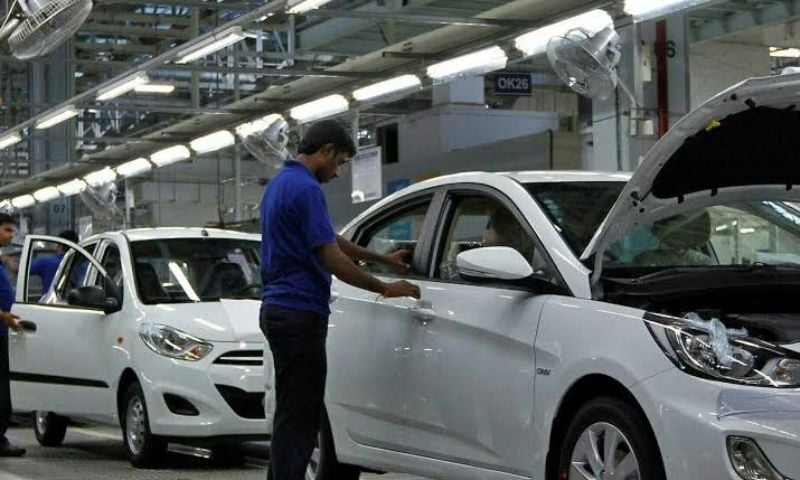
ISLAMABAD: Pakistan’s automotive sector must shift its focus from the domestic market towards exports and play a leading role in achieving the $63 billion export target envisaged under URAAN Pakistan, the Planning Commission said.
The commission said the industry had the potential to become a major source of foreign-exchange earnings if Pakistan strengthened its industrial competitiveness, improved productivity, adopted modern technologies and created a more conducive policy environment for export-oriented growth.
The call was made on Thursday during a policy dialogue titled “Unlocking Pakistan’s High-Value Export Potential: Threats and Opportunities for the Automotive Industry”, which examined ways to improve the sector’s global competitiveness and expand its presence in international markets.
The session was jointly chaired by Federal Minister for Planning, Development and Special Initiatives Prof Ahsan Iqbal, Federal Minister for Energy Sardar Awais Ahmad Khan Leghari and Special Assistant to the Prime Minister on Industries and Production Haroon Akhtar Khan.
Senior government officials, representatives of the automotive industry, academics, private-sector stakeholders and international development partners participated in the discussion, focusing on investment, productivity, technology, infrastructure, market access and policy support.
Speaking at the event, Ahsan Iqbal said export-led growth was at the heart of the government’s URAAN Pakistan initiative and should be treated as a national priority rather than simply an economic policy objective.
He said Pakistan could no longer rely predominantly on its domestic market and needed a fundamental transformation in industrial and economic policy to achieve its ambitious export targets.
According to the Planning Commission, the automotive sector is expected to make a significant contribution towards the $63 billion export target envisaged under URAAN Pakistan.
Ahsan Iqbal also referred to the longer-term ambition of taking the country’s exports to $100 billion, saying this would require major changes in industry, investment, infrastructure and technology. He said Pakistan already had industrial clusters and productive capacities that could provide a foundation for export growth.
However, he stressed that these capabilities needed to be modernised through higher productivity, improved infrastructure, adoption of advanced technologies and a more supportive business environment.
The planning minister expressed optimism that the new Auto Policy 2.0, being implemented under the leadership of Prime Minister Muhammad Shehbaz Sharif, would help reposition the automotive industry and facilitate its integration into global supply chains and markets.
He argued that Pakistan could not achieve sustainable economic strength through borrowing and short-term financial measures alone. “The country needs dollars,” he said, stressing that a stronger and more diversified export base was essential for generating sustainable foreign-exchange earnings.
The minister urged manufacturers, exporters, investors and other private-sector stakeholders to take the lead in developing the country’s export potential. He also called for closer coordination between the government and industry to identify promising international markets, remove regulatory and infrastructure bottlenecks and establish clear priorities for export-led growth.
Ahsan Iqbal further encouraged chambers of commerce and industry to promote export-oriented investment missions and develop sector-specific strategies aimed at increasing Pakistan’s access to international markets.
The government also called on industry stakeholders to prepare five-year export plans setting out the potential contribution of individual sectors, along with the policy and institutional support required to achieve their targets.
The Planning Commission also proposed a comprehensive district-level export development plan covering different regions and economic sectors. The initiative would seek to identify areas with existing industrial capacity that could be developed into globally competitive export clusters.
During the dialogue, participants examined the key constraints confronting Pakistan’s automotive export ambitions, including limited competitiveness, inadequate investment, low productivity, technological gaps, infrastructure challenges, restricted market access and the need for more predictable policy facilitation.
The discussions formed part of a broader series of consultations being organised by the Planning Commission to identify high-value export sectors and develop strategies for strengthening Pakistan’s industrial clusters.
The government’s renewed emphasis on the automotive industry comes as Pakistan seeks to diversify its export base, increase foreign-exchange earnings and move towards a more sustainable, export-driven model of economic growth.