
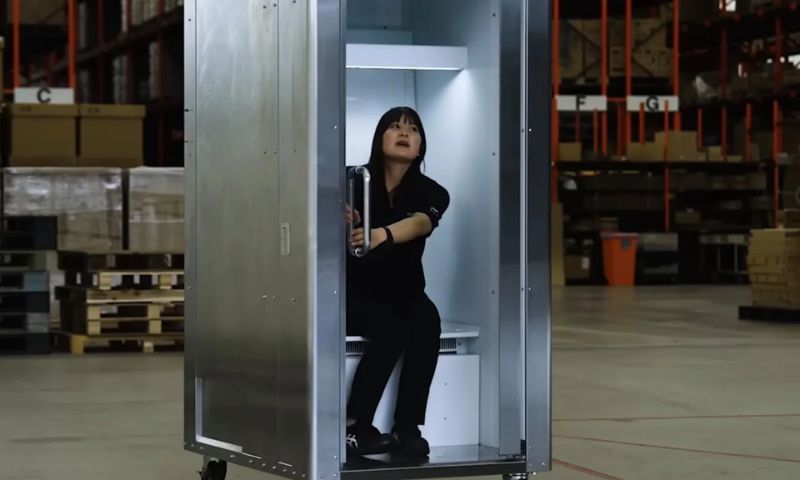
TOKYO: Japan’s increasingly punishing summers have produced an unusual new piece of heatwave technology: a refrigerator built for people.
The Do Hiemon Box, a one-person cooling booth, is being introduced at workplaces and public spaces as Japan struggles with severe heat. More than 53,000 people have been treated for heatstroke in the past two months, with 79 deaths reported, according to the BBC.
Developed by industrial supplier TRUSCO Nakayama, the booth resembles an oversized vending machine. Users step inside, sit down and are hit by cold air of about 5°C, directed around the upper body. The temperature and airflow can be adjusted across three settings, while the machine automatically switches off after 20 minutes to prevent excessive cooling.
#Japan has #human #fridges… wait… what?!?! Too hot outside? Just pop yourself in the chiller This is genius, why aren’t they everywhere? pic.twitter.com/6N2XgXYaOH
— Naveed Khan (@i_Naveediqbal) August 13, 2026
The idea has a distinctly Japanese origin. Company president Tetsuya Nakayama said the design was inspired by refrigerated vending machines — a familiar sight across Japan.
ALSO READ: Spain Darkens As Solar Eclipse Races South From Arctic
The standard model costs around 1.5 million yen, putting it beyond the reach of most households and making businesses its main market. Hundreds of units have reportedly been sold for use at construction sites, golf courses, leisure facilities and university campuses.
Cooling workers, not entire buildings
Unlike conventional air conditioning, the box is designed to cool one overheated person quickly rather than an entire room. It requires no installation, can be moved on wheels and operates indoors or outdoors. TRUSCO says it consumes about 0.51kWh under specified conditions and costs roughly 16 yen an hour to run.
What may look like a novelty reflects a much more serious problem. As extreme summer temperatures become harder to avoid, Japan’s “human fridge” shows how businesses are beginning to adapt workplaces around heat that can no longer be treated as an occasional inconvenience.