Key points
- Norway backs Pakistan’s role in Iran-US peace efforts
- Islamabad and Oslo seek to unlock bilateral trade potential
- Both sides discuss labour mobility and pending agreements
ISLAMABAD: Pakistan and Norway agreed on Thursday to deepen economic and diplomatic ties, including efforts to boost trade, expedite pending agreements, and expand labour mobility, as Oslo praised Islamabad’s role in promoting peace during the recent Iran-US conflict.
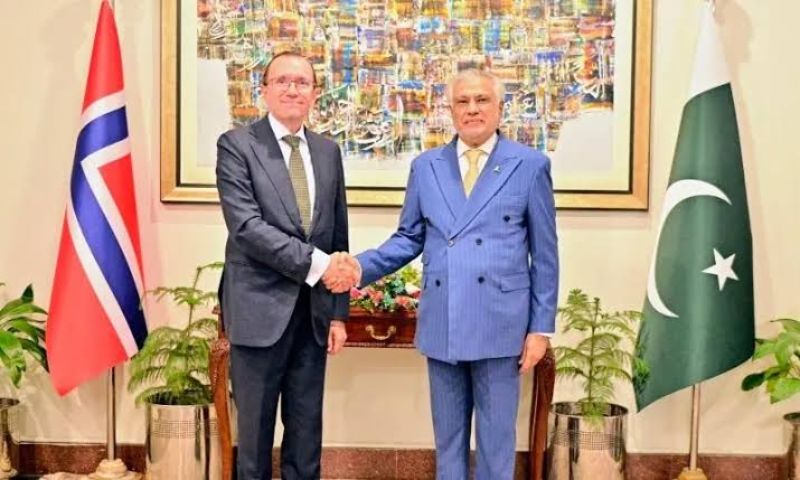
Deputy Prime Minister and Foreign Minister Ishaq Dar and Norwegian Foreign Minister Espen Barth Eide held delegation-level talks in Islamabad, followed by a joint press conference in which both sides outlined areas for expanding bilateral cooperation.
Dar said Pakistan attached great importance to its relations with Norway and that the two countries had agreed that bilateral trade remained below its potential. He said Islamabad and Oslo would work on concrete measures to increase economic engagement.
Norway and Pakistan focus on labour mobility
The two sides also agreed to expedite the finalisation of pending agreements and memoranda of understanding to strengthen cooperation across various sectors, Dar said.
Labour mobility was another focus of the discussions, with the two countries agreeing to enhance people-to-people contacts and continue working on legal pathways to facilitate employment opportunities for Pakistan’s skilled workforce in Norway.
The talks covered trade, investment, climate change, maritime affairs, and education. The two sides also recognised the contribution of Pakistan’s diaspora in Norway and agreed to strengthen people-to-people links.
Eide said Norway had strong links with Pakistan, noting that a large Pakistani community lives in Norway and that Norwegian companies are operating in Pakistan and contributing to its economic development.
The Norwegian foreign minister also strongly backed Pakistan’s efforts to facilitate dialogue and peace in the region.
He praised Prime Minister Shehbaz Sharif, Dar, and Field Marshal Syed Asim Munir for their roles in Islamabad’s efforts during the Iran-US conflict, describing Pakistan’s mediation efforts as a service to the wider world.
ALSO READ: Norway Reiterates Support for Pakistan’s Diplomatic Efforts to End Iran-US Conflict
Eide said Norway was ready to assist Pakistan’s peace efforts wherever it could be useful, pointing to Oslo’s own experience in peace negotiations and its ability to maintain dialogue with both Tehran and Washington.
He also linked the regional conflict to global economic and maritime concerns, saying Norway, as a major shipping nation, had a direct interest in open sea lanes and freedom of navigation.
Eide stressed that maintaining free passage through international waterways was not merely an issue for countries involved in the conflict but a matter of global concern.
He also referred to the importance of the United Nations Convention on the Law of the Sea as the international framework governing the oceans.
The two sides separately discussed regional and international developments, with Eide warning that continuing tensions posed risks to global stability and economic growth.
The visit marks the first by a Norwegian foreign minister to Pakistan in a decade and represents the highest-level engagement between the two countries in 10 years. Eide is visiting Pakistan on August 13-14 at Dar’s invitation.
The economic relationship has room for expansion. Pakistan’s trade data compiled by the Federation of Pakistan Chambers of Commerce and Industry shows total bilateral trade at about $186.4 million in 2025.
The break-up of trade comprised $126.7 million in Pakistani exports and $59.7 million in imports. Major Pakistani exports included apparel, textiles, leather goods, and cereals, while imports from Norway included iron and steel, aluminium, and electrical equipment.
The discussions therefore put both economic cooperation and regional diplomacy at the centre of the first Norwegian foreign ministerial visit to Pakistan in a decade, with Islamabad and Oslo signalling an intention to translate longstanding cordial relations into stronger commercial and people-to-people links.